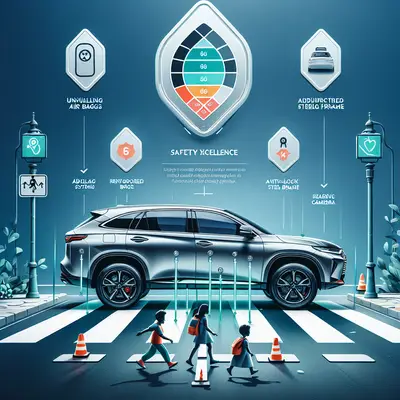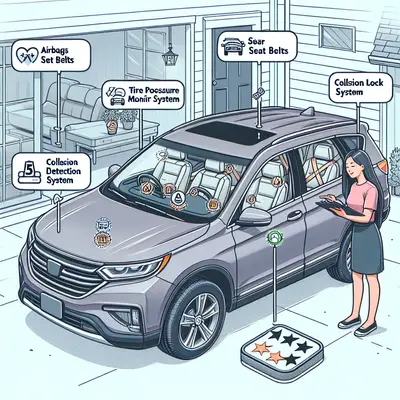
For families who expect more from an SUV than simply “five stars,” safety ratings can feel simultaneously essential and incomplete. They offer a necessary foundation, but not the full architecture of real-world protection. The modern family SUV is a sanctuary in motion, and understanding how safety ratings translate into daily confidence is as important as the badge on the grille. This is where a discerning eye—and a deeper reading of the data—transforms safety from a number into genuine peace of mind.
Why Safety Ratings Matter More for Today’s Families
The family SUV is no longer just a practical choice; it is the hub of school runs, weekend escapes, late-night airport pickups, and quiet conversations between destinations. Safety ratings from organizations like the National Highway Traffic Safety Administration (NHTSA) and the Insurance Institute for Highway Safety (IIHS) are designed to condense complex engineering into understandable benchmarks. For families, these benchmarks serve as a first filter, separating merely adequate vehicles from thoughtfully engineered ones.
Yet the modern safety landscape is evolving so quickly—advanced driver-assistance systems, structural innovations, child-seat compatibility—that relying solely on an overall star rating or a single “Top Safety Pick” label misses much of the nuance. Families benefit from reading between the lines: which tests matter most for second- and third-row occupants, how active safety tech can prevent crashes altogether, and why not all “standard safety suites” are created equal. In short, understanding safety ratings is less about memorizing acronyms and more about aligning sophisticated engineering with the realities of family life.
Exclusive Insight #1: The Front Passenger Score Isn’t the Whole Story
Many shoppers gravitate to the headline frontal crash rating, but families rarely all sit in the front row. If you regularly travel with children or elderly parents, the middle and rear seating positions deserve just as much scrutiny as the driver’s seat. IIHS now evaluates “moderate overlap” and “small overlap” front collisions with a closer eye on rear occupant protection, and some SUVs that excel in driver safety show subtle weaknesses in the second row.
This is where a deeper read of the test reports becomes invaluable. Look for language that specifically references rear occupant injury measures, seatbelt performance, and potential chest or head impacts. An SUV whose second row performs nearly as well as the front in crash tests offers a level of consistency that matters when your most precious passengers rarely sit beside you. The truly family-optimized SUV treats every row as the “primary” seating position, not an afterthought.
Exclusive Insight #2: Side-Impact Protection Is the Quiet Guardian of Urban Families
For many families, everyday driving is dominated by city streets, intersections, and congested suburban arteries—environments where side impacts and angled collisions are more common than dramatic highway head-ons. Modern side-impact tests, especially the updated IIHS side crash evaluations using a heavier, taller barrier, more closely mirror collisions with SUVs and trucks rather than small sedans.
A sophisticated family SUV should pair high side-impact scores with design details that are easy to overlook: robust door structures, thoughtful placement of side curtain airbags to cover all three rows, and reinforced B- and C-pillars that help maintain the cabin’s structure in a serious crash. When reviewing safety ratings, pay particular attention to any updated side-impact testing and whether the model you are considering has been evaluated under the newest, more demanding criteria. This is where some legacy “five-star” reputations quietly diverge from current reality.
Exclusive Insight #3: Active Safety Tech Is Only as Good as Its Calibration
Most modern SUVs offer an impressive alphabet of active safety features—AEB (automatic emergency braking), ACC (adaptive cruise control), LKA (lane-keeping assist), and beyond. Safety ratings increasingly incorporate these technologies, particularly emergency braking performance. Yet the on-paper presence of these systems tells only part of the story; how smoothly and predictably they work day to day is equally critical.
Families should look not only at whether a feature is standard but at how it performs in independent tests. IIHS, for example, evaluates front crash prevention systems for vehicle-to-vehicle and vehicle-to-pedestrian scenarios. An SUV that earns superior ratings here may be more adept at detecting a child stepping into a crosswalk or a cyclist near the shoulder. Just as important is how these systems feel behind the wheel: overly abrupt braking or jittery lane corrections can lead drivers to switch them off, neutralizing their benefits. The ideal family SUV marries high test scores with refined calibration—active safety that feels like an invisible, unobtrusive co-pilot, not a nervous passenger grabbing the wheel.
Exclusive Insight #4: Child-Seat Compatibility Is a Hidden Dimension of Safety
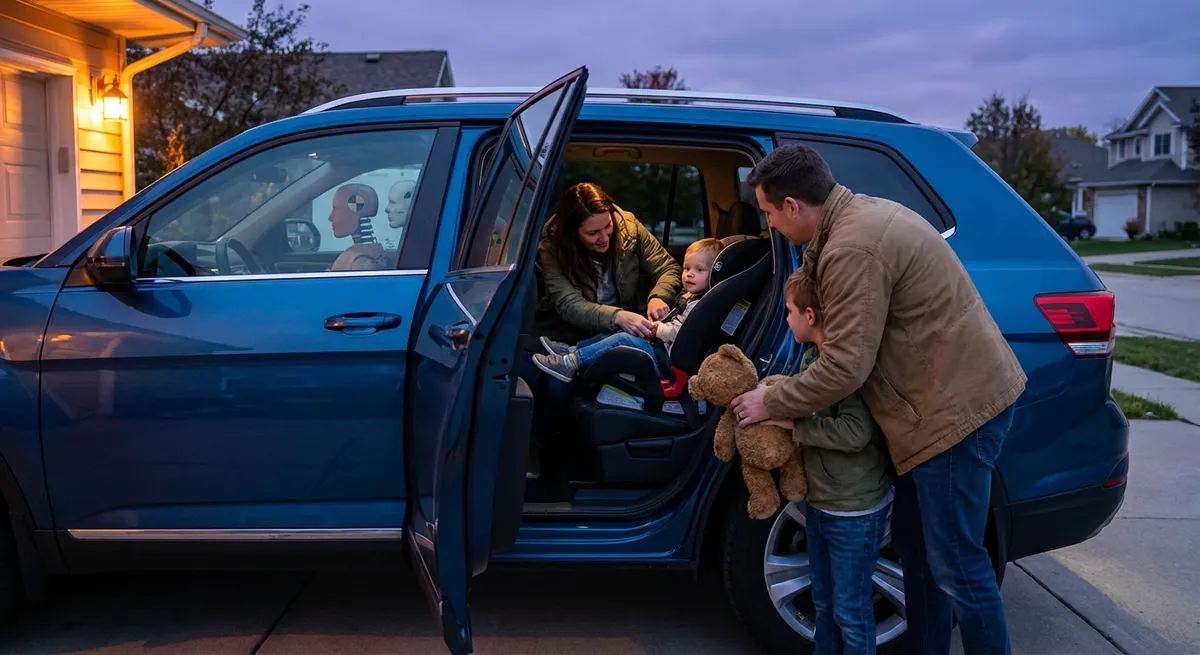
Child protection in SUVs is about far more than simply installing a car seat and tightening a strap. Safety ratings occasionally reference ease-of-use for LATCH (Lower Anchors and Tethers for Children) systems, but families benefit from digging deeper into how well a vehicle accommodates real-world child-seat setups. IIHS, for instance, publishes ratings on LATCH usability that highlight anchor accessibility, labeling clarity, and the risk of misrouting straps—subtleties that matter in the rush of a Monday morning.
A truly family-centric SUV makes it easy to install a variety of child seats without compromising overall safety. Look for clear, easily reachable lower anchors, realistically usable top tether points in the third row, and enough fore-aft space in the second row to maintain proper front seat positioning while a rear-facing seat is installed. When possible, review crash-test data and manufacturer recommendations for child-seat placement; some three-row SUVs are structurally optimized for the second row, while others extend robust protection to outboard third-row positions. The safest SUV is one that encourages correct installation every single time, even when life is a little chaotic.
Exclusive Insight #5: Weight, Structure, and the Subtle Art of Crash Compatibility
There is a long-standing perception that “bigger is safer,” and to an extent, physics supports it: in multi-vehicle collisions, heavier vehicles can offer some advantages. Yet size alone is a crude metric. Modern safety ratings increasingly reflect a more nuanced reality, where structural engineering, crumple zone design, and energy management determine how forces are absorbed and redirected around the cabin.
Families should look for SUVs that combine strong crash-test performance across multiple categories with evidence of thoughtful structural design: high-strength steel in critical areas, well-managed deformation in frontal and offset impacts, and cabins that remain impressively intact even in severe tests. It is also worth noting how a vehicle performs in the small overlap frontal tests, which simulate real-world collisions with poles, trees, or the edge of oncoming vehicles. The most sophisticated SUVs demonstrate a kind of structural grace under pressure—sacrificing bodywork in a precisely controlled way to preserve the integrity of the passenger cell.
Translating Ratings into Real-World Confidence
Once you understand the nuances behind star ratings and safety awards, the shopping experience becomes more focused and intentional. Instead of merely asking, “Is this SUV safe?”, you can ask more incisive questions: How evenly does it protect all seating rows? How well does its active safety suite handle pedestrians and cyclists? Can we easily and correctly install the child seats we actually own? Has this model been tested under the newest, most demanding protocols?
The result is a different kind of confidence—a quiet assurance that your chosen SUV is not only impressive in a lab or brochure, but carefully aligned with the realities of your family’s life. In a world of glossy marketing and crowded showrooms, safety ratings are a rare constant. When read with a discerning eye, they become less about numbers and more about what truly matters: returning home, safely and effortlessly, every single time.
Conclusion
Safety ratings are the starting point, not the finish line, for a sophisticated family SUV search. By looking beyond headline scores to understand rear-row protection, side-impact performance, active safety calibration, child-seat compatibility, and structural integrity, families can curate a vehicle that feels reassuringly over-prepared for the unexpected. The most compelling SUVs do more than earn accolades; they translate advanced engineering into everyday serenity. For families who value refinement as much as resilience, that alignment—between test results and lived experience—is the ultimate safety feature.
Sources
- NHTSA 5-Star Safety Ratings Overview - Explains U.S. government crash tests, rating categories, and how to interpret star ratings
- IIHS Vehicle Ratings - Provides detailed crash-test results, Top Safety Pick awards, and evaluations of active safety systems
- IIHS LATCH Ease-of-Use Ratings - Assesses how child-seat anchors are designed and how easily car seats can be installed correctly
- NHTSA Child Safety and Car Seats - Offers guidance on child restraint systems, installation best practices, and age-specific recommendations
- CDC Road Traffic Safety Data - Provides statistics and research on motor vehicle injuries and the impact of safety measures
Key Takeaway
The most important thing to remember from this article is that this information can change how you think about Safety Ratings.