The most satisfying family SUVs are not chosen from a billboard or a slogan; they’re curated, much like a well‑designed home. For families who value calm cabins, intuitive technology, and an underlying sense of security, the difference between “good enough” and “exactly right” lies in details that spec sheets rarely highlight. This buying playbook is designed for those who notice the stitching on the seats, the logic of the driver‑assist systems, and the way an SUV feels after three hours on the road with children in the back.
Below, you’ll find five exclusive, quietly powerful insights that go beyond horsepower and cargo volume—crafted to help you select a family SUV that will feel considered and correct, years after the first test drive.
The Cabin as a Living Space, Not a Sales Feature
Most brochures talk about “premium interiors,” but families actually live in these cabins: school drop‑offs, late‑night drives home from activities, weekend escapes with everyone (and everything) onboard. When you step into a candidate SUV, evaluate it as you would a thoughtfully designed room.
Pay attention to how natural light flows through the cabin—large windows and an airy greenhouse reduce fatigue and motion sickness, especially for children in the third row. Notice the textures you touch most often: steering wheel, door pulls, climate knobs. Do they feel substantial and forgiving to the hand, or thin and plasticky? Examine how the center console is arranged: Can the driver place a coffee, manage climate settings, and access a phone without visual clutter or awkward reaching?
Quiet is another form of luxury. Close the doors and simply listen. A soft, solid door thud often hints at better sound insulation and build quality. On the test drive, note how road noise, wind, and engine sound are managed at highway speeds. For families, a calm acoustic environment matters as much as seat comfort—it makes conversations easier and long trips significantly less tiring.
Finally, consider how easily the interior can be kept orderly. Are there discreet storage spaces for tablets, headphones, snacks, and reusable water bottles? Do the cupholders fit the actual bottles your family uses? An SUV that anticipates these small needs will feel “designed for you” every single day.
Safety That Feels Natural, Not Nagging
Top crash scores and long lists of driver‑assist features are table stakes in a modern family SUV. The true differentiator is how naturally those systems blend into your driving, supporting rather than startling you.
During your test drive, deliberately experience the active safety technology. Engage adaptive cruise control on a stretch of highway and notice how smoothly it modulates speed. Does it brake and accelerate gently enough that passengers remain relaxed, or does it feel abrupt? Try lane‑keeping assistance on a clearly marked road. Subtle steering support that centers the vehicle without tugging or beeping incessantly is worth seeking out.
Pay close attention to how warnings are communicated. Some SUVs overwhelm you with shrill chimes and flashing graphics; others use gentler tones, nuanced haptics, and clear visual cues in the instrument cluster or head‑up display. For a family vehicle, a measured, calm approach to alerts is more than a preference—it reduces stress for everyone on board.
Also, consider rear‑seat safety and visibility. Features like rear‑seat reminders, advanced rear occupant alerts, and high‑quality rearview cameras (ideally with multiple angles and a clean, wide field of view) matter when children, strollers, and bikes are in play. A vehicle’s safety suite should feel like a quiet, capable co‑pilot—present, attentive, and reassuring, without dominating the drive.
Everyday Ergonomics: The Art of Loading, Buckling, and Reaching
Spec sheets love to advertise cargo volume in cubic feet. Families care far more about how those cubic feet are shaped and accessed. This is where real‑world ergonomics separate a merely practical SUV from a brilliantly usable one.
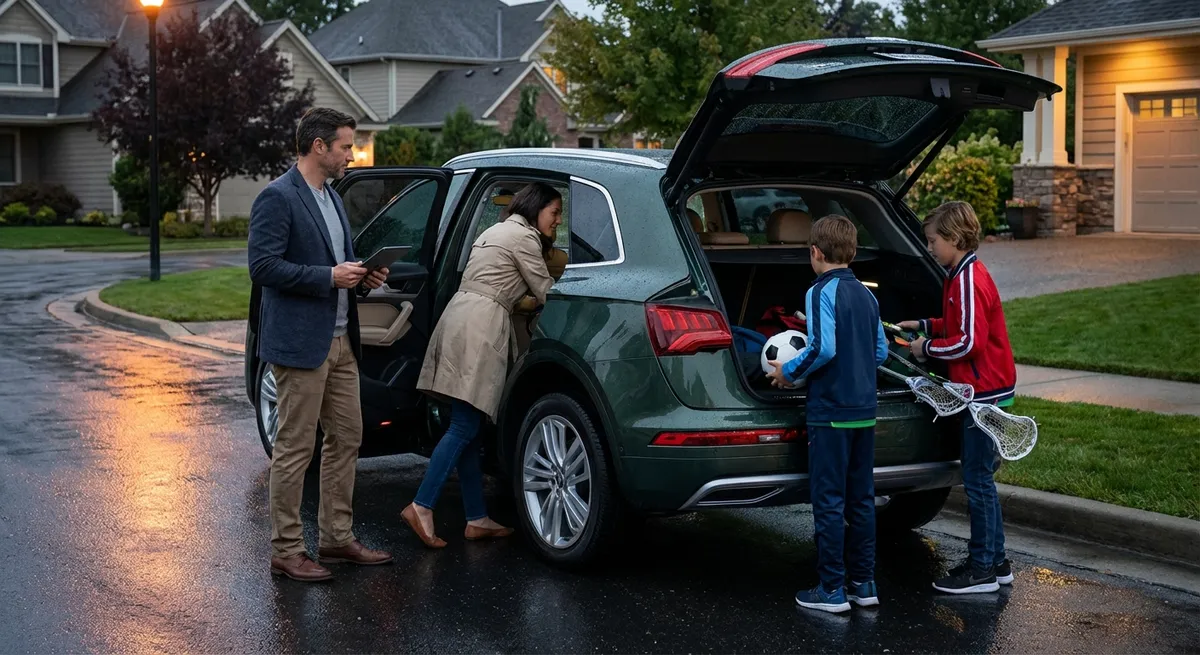
Start with the rear: Open the tailgate and look at the load floor height. Can a child place a backpack inside without straining? Is the opening wide and square enough to accommodate a stroller or folded wagon without awkward angles? Test the third‑row folding mechanism yourself. Ideally, it should be one‑handed, light, and intuitive—whether via pull straps, levers, or power controls—so that loading a bulky item doesn’t turn into a wrestling match.
For parents with young children, the relationship between second‑row seating and car seats is crucial. Bring your actual car seats to the dealership, if possible. Confirm that you can easily access LATCH anchors without digging into the seat cushions, that buckles remain reachable once seats are installed, and that there is enough space for a rear‑facing seat without forcing the front passenger into an awkward position.
If you plan to use the third row frequently, practice accessing it with the second row in place. Does the seat tilt and slide forward with a child seat installed? Is the step‑in height manageable for older relatives and small children alike? Every one of these micro‑moments—buckling in, sliding seats, lifting bags—either adds friction or disappears into the background. The right SUV makes these routines feel seamless and dignified.
Technology That Simplifies, Rather Than Shows Off
Family SUVs are now rolling technology hubs, but more features do not always equal a better experience. The most refined systems feel almost understated: clear, responsive, and thoughtfully organized for drivers who are often multitasking.
When you sit in the driver’s seat, gauge how quickly you can perform simple tasks without instruction—adjust climate zones, pair a phone, switch audio sources, or enable a navigation route. If you find yourself digging through deep menus, imagine doing that in the dark with restless passengers. A well‑designed interface offers large, legible icons, logical menu structures, and physical shortcuts (or configurable favorites) to commonly used functions.
Wireless smartphone integration is fast becoming essential, but implementation varies widely. On your test drive, run your usual apps (navigation, music, messaging) through Apple CarPlay or Android Auto. Observe whether connections drop, whether the system lags, and how the audio transition feels when calls come in. Also check the number and placement of USB‑C ports; a family SUV that supports multiple devices across all rows prevents low‑battery stress on longer trips.
Voice control is another subtle differentiator. Try ordinary, conversational commands—“I’m cold,” “Find the nearest coffee,” “Call home”—and see how reliably the system responds. You want technology that quietly adapts to your life, not a flashy interface that demands constant attention.
Driving Character: Calm, Composed, and Effortless
Performance for a family SUV is not about lap times; it’s about how effortless the vehicle feels with a full load of people and cargo. The right SUV combines sufficient power with composure, making every journey feel unhurried and controlled.
On your test drive, simulate real family conditions as closely as possible. Ask the salesperson to ride along in the back and, if allowed, fold a row or two and add some weight (bags, gear) to approximate a road‑trip scenario. As you accelerate onto a highway, note whether the engine sounds strained or relaxed, and whether the transmission hesitates or hunts for gears. A refined powertrain delivers steady, predictable acceleration with minimal drama.
Ride quality deserves special scrutiny. Seek out imperfect pavement—patches, expansion joints, and mild potholes—and pay attention to how the suspension manages them. An ideal family SUV filters harshness without feeling floaty or disconnected. Steering feel should be light enough for easy maneuvering in school parking lots yet precise enough to inspire confidence at speed.
If you are considering hybrid or electric variants, observe how transitions occur. In hybrids, the handoff between electric and gas power should be nearly imperceptible; in EVs, the tuning of regenerative braking should be smooth enough that passengers aren’t constantly jolted. A composed, predictable driving character contributes as much to family comfort as seat materials or screen size.
Conclusion
A truly satisfying family SUV is defined not by a single headline feature, but by a collection of intelligent, often understated decisions: the way the cabin calms rather than overwhelms, how safety systems support without scolding, how easily children can climb in and out, how intuitively the technology responds, and how serenely the vehicle moves down the road.
By approaching your next purchase with these five insights—treating the SUV as a living space, prioritizing natural‑feeling safety, scrutinizing everyday ergonomics, favoring simplifying technology, and insisting on calm driving dynamics—you move beyond marketing language and into a quieter, more confident kind of ownership. The result is not just an SUV that fits your family, but one that subtly elevates every journey you share.
Sources
- [National Highway Traffic Safety Administration (NHTSA)](https://www.nhtsa.gov/ratings) - Official U.S. government crash test ratings and safety information for comparing SUVs
- [Insurance Institute for Highway Safety (IIHS)](https://www.iihs.org/ratings) - Independent crash tests, headlight evaluations, and advanced safety feature assessments
- [U.S. Department of Energy – Fuel Economy](https://www.fueleconomy.gov/) - Comprehensive data on fuel economy, hybrid and EV options, and operating costs for family SUVs
- [Consumer Reports – Car Safety Guide](https://www.consumerreports.org/cars-guide-to-car-safety/) - In‑depth analysis of safety technologies and real‑world usability in modern vehicles
- [Edmunds – Car Seat Compatibility and SUV Reviews](https://www.edmunds.com/suv/) - Practical insights on car‑seat fitment, interior usability, and road‑test impressions
Key Takeaway
The most important thing to remember from this article is that this information can change how you think about Buying Guide.