Choosing a family SUV today is less about sheer size and more about how thoughtfully a vehicle supports the rhythms, rituals, and realities of your life. The modern family garage is no longer a compromise space; it is an extension of your home—curated, intentional, and quietly capable. This guide is designed for families who value refinement as much as practicality, and who expect their SUV to deliver composure, safety, and subtle luxury in equal measure.
Below are five exclusive, often-overlooked insights that go far beyond the brochure—and that can decisively elevate your next family SUV choice.
1. The “Third Row Truth Test”: Comfort, Not Just Capacity
Automakers love to advertise “three-row seating,” but the real question is: can adults sit in the third row with dignity, and can children access it without acrobatics?
When evaluating three-row SUVs, look beyond the stated passenger count and examine:
- Knee angle and hip point: A low, knees-up posture quickly becomes uncomfortable on longer drives. Prioritize third rows where the seat cushion is long enough to support thighs and the floor isn’t excessively high.
- Shoulder room over raw width: Many vehicles technically seat three across in the third row, but only two can sit comfortably. Pay attention to the shape of the interior panels and armrests—they often reveal the practical reality better than the spec sheet.
- Ingress and egress design: Test the tilt-and-slide mechanism of the second row with child seats installed. Some models retain sliding access even with a forward-facing child seat fitted, which can be transformative in daily use.
- Real luggage space with the third row in use: Fold the seats up and open the tailgate. Can it realistically hold a stroller and weekender bags without resorting to roof boxes? This is where many “three-row” SUVs quietly turn into two-and-a-half-row vehicles.
The “truth test” is simple: have every family member sit in every row, simulate your longest typical journey, and decide if the comfort level still feels acceptable. Capacity is marketing; comfort is reality.
2. The Quiet Cabin Equation: Layered Refinement, Not Just Insulation
Refined families often speak of a “quiet home.” A family SUV should aspire to the same standard. But cabin hush is not only about thick glass and sound insulation; it’s about the harmony of multiple design decisions.
When you evaluate an SUV’s refinement, pay attention to:
- Engine sound character: A well-tuned engine note fading unobtrusively in the background is more pleasant than a muted but strained powertrain. Hybrid and plug-in hybrid SUVs should transition between electric and combustion power almost imperceptibly.
- Road and wind noise balance: Drive the vehicle over rough asphalt and at highway speed. Some SUVs manage wind noise beautifully but neglect tire roar; others are the reverse. The best family SUVs offer consistent calm across varied surfaces.
- Vibration through touchpoints: Rest your hand on the door panel, steering wheel, and center console at cruising speed. Excessive vibration suggests compromises in chassis tuning or isolation that can fatigue occupants over time.
- Conversation ease: Can those in the third row converse comfortably with those in the front at 70 mph without raised voices? This is an elegant, real-world test of acoustics that spec sheets seldom capture.
Families who prioritize composure should treat cabin calm as a core buying criterion, not a pleasant afterthought. Time in the car should feel like a gentle pause between destinations—not an assault of noise and fatigue.
3. The “Daily Rituals” Audit: How the SUV Serves Your Real Life
An SUV that looks spectacular in the showroom but fumbles the school run is an aesthetic success and a practical failure. The most discerning families audit how well a vehicle anticipates daily rituals instead of relying on generic convenience features.
As you evaluate contenders, recreate your family’s most common scenarios:
- School drop-off choreography: Can children exit from the safest side quickly and independently? Are door openings wide enough for backpacks, musical instruments, and sports gear? Do power doors respond promptly rather than slowly prioritizing drama over efficiency?
- Grocery and gear loading: Test the tailgate height and opening speed. Can you load items one-handed while holding a child’s hand? Are there thoughtful touches like integrated bag hooks, underfloor storage for muddy shoes, and low liftover height?
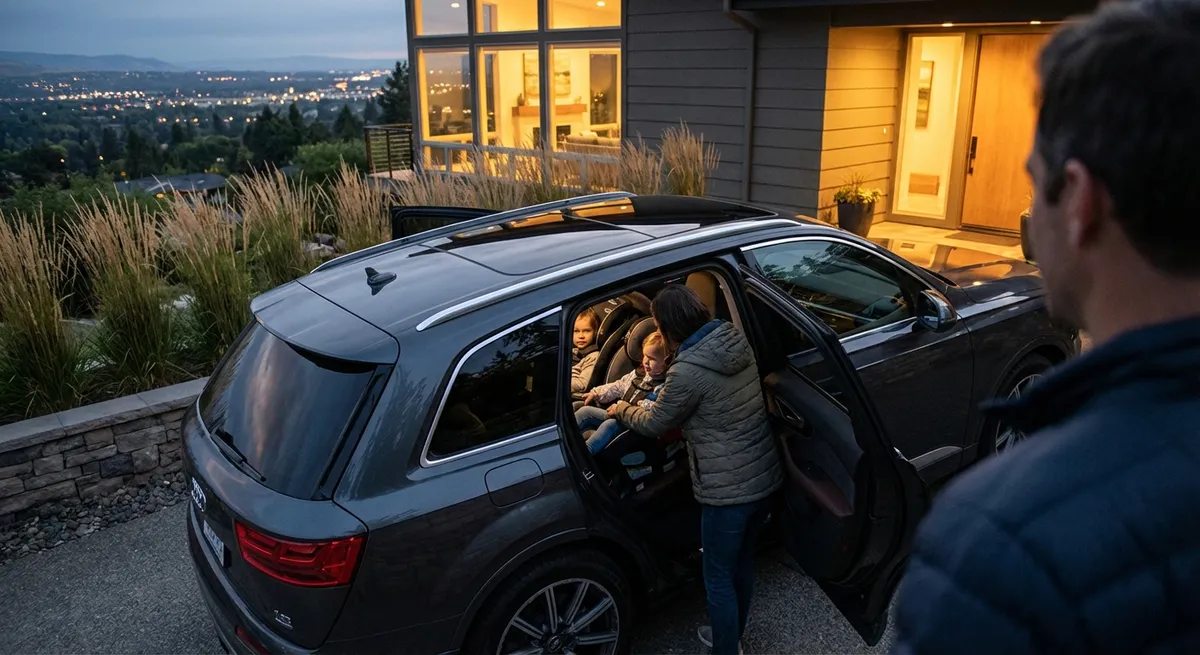
- Car-seat and booster strategy: Bring your actual car seats and boosters to the dealership. Confirm that buckles remain accessible when three across, that LATCH anchors are clearly marked and easily reached, and that tether anchor placement doesn’t conflict with cargo use.
- Charging and device ecosystem: Examine where USB-C ports and wireless chargers are placed. Are they accessible to both front and rear occupants without forcing cables to drape awkwardly over seats? Rear-seat power placement often reveals how “family-first” the interior really is.
This “daily rituals” audit transforms the buying process from an abstract evaluation into a rehearsal of real life, ensuring that style and substance remain in balance.
4. Safety as a System: How Well the Technologies Work Together
Most modern SUVs can boast an impressive list of safety features. The real sophistication lies in how seamlessly those systems integrate—and whether they support, rather than intrude upon, confident driving.
Consider the following dimensions of safety sophistication:
- Calibration, not just inclusion: Adaptive cruise control, lane keeping, and automatic emergency braking can feel either reassuringly natural or unnervingly abrupt. During your test drive, notice how gently systems intervene and how easily they can be tailored to your preferences.
- Child-centric safety realities: Check the ease of installing multiple child seats while keeping side-curtain airbags effective. Look for rear-seat reminder systems, seatbelt use indicators for each seat, and simple child-lock controls that are not buried in menus.
- Visibility as a first principle: Walk around the SUV and sit in every seat. How thick are the pillars? Are camera views high-resolution and well-angled, or grainy and distorted? An elegant surround-view camera with clear guidelines can be far more valuable than an additional driving mode you rarely use.
- Nighttime and bad-weather confidence: If possible, test the vehicle at dusk or in low light. Examine headlight clarity, automatic high-beam behavior, and wiper effectiveness. The most advanced matrix or adaptive headlights reshape driving after dark into something closer to daylight-level assurance.
For families, safety is less about isolated features and more about a cohesive, intelligent system that quietly supports every journey—whether it’s a five-minute errand or an all-day holiday drive.
5. The Ownership Experience: Subtle Luxuries That Emerge Over Time
A truly premium family SUV is defined not only by how it drives on day one, but by how gracefully it integrates into your life over years. The most insightful buyers consider the long arc of ownership—maintenance, support, and the enduring feel of quality.
Focus on attributes that reveal a vehicle’s long-term character:
- Material integrity, not just first impressions: Gently press on interior panels, open and close storage lids, and run your hand along seat edges and stitching. Heavier, well-damped movements and tightly finished materials tend to age far more gracefully under family use.
- Service network and digital support: Research dealer density, loaner vehicle policies, mobile service options, and the quality of the brand’s app ecosystem. Over-the-air (OTA) software updates can keep driver assistance, navigation, and infotainment features current for years.
- Resale value and total cost transparency: Premium family buyers often rotate vehicles on a predictable schedule. Strong residual values, transparent maintenance plans, and battery warranties (for hybrids and EVs) can preserve both peace of mind and financial elegance.
- Charging and fueling realities: For electrified SUVs, consider where and how you will charge. Home charging access, public charging availability along your usual routes, and onboard route planning for EVs are practical elements that deeply influence ownership satisfaction.
Viewed this way, your choice becomes less about a single transaction and more about curating a long-term companion—one that quietly proves its worth every time life becomes busy, complex, or beautifully unscripted.
Conclusion
For families who expect their SUV to be a sanctuary, a tool, and a subtle expression of taste, the true differentiators rarely appear in large print. They live in the quiet cabin, the comfortable third row, the intuitive daily rituals, the well-integrated safety systems, and the enduring elegance of ownership.
By looking beyond the brochure and interrogating how an SUV behaves in the nuanced context of real family life, you elevate your purchase from simple transportation to a carefully chosen partner. The result is not just an SUV that fits your driveway—but one that fits your family’s standards, pace, and aspirations with quiet confidence.
Sources
- Insurance Institute for Highway Safety (IIHS) – Vehicle Ratings - Comprehensive crash-test results and safety ratings for SUVs and other vehicles
- National Highway Traffic Safety Administration – 5-Star Safety Ratings - Official U.S. government safety evaluations and recall information
- Consumer Reports – Guide to Car Seat Safety and Vehicle Fit - Practical insights on child-seat compatibility and real-world interior usability
- U.S. Department of Energy – Fuel Economy Guide - Data on fuel economy and energy use for SUVs, including hybrids and EVs
- Edmunds – Car Noise and Comfort: What to Know - Explanation of cabin noise, insulation, and comfort factors relevant to family vehicles
Key Takeaway
The most important thing to remember from this article is that this information can change how you think about Buying Guide.