Selecting a family SUV today is less about chasing the latest trend and more about curating a space where your family’s daily life actually works. The spec sheets, star ratings, and glossy photos are only the beginning. What truly distinguishes a refined family SUV is how it anticipates real routines: school runs in the rain, late‑night airport pickups, silent highway stretches with sleeping children, and weekends when cargo space becomes non‑negotiable. This guide looks beyond surface impressions to explore the nuanced considerations that genuinely elevate a family SUV experience.
Reframing “Space”: How Cabin Architecture Shapes Daily Comfort
Most brochures will tell you cubic feet of passenger and cargo space; very few explain how that space actually feels. Cabin architecture—how the interior is shaped, layered, and accessed—often matters more than raw measurements.
Consider legroom distribution rather than overall legroom. A thoughtfully designed family SUV will provide generous space not just for front passengers, but also in the second row, where adults may sit during road trips, and in the third row, where teenagers will eventually outgrow “child-sized” accommodations. Pay attention to how high the second and third rows are positioned: stadium-style seating can improve outward visibility and reduce motion sickness, but if the floor is too high, knee and thigh support can suffer on longer journeys.
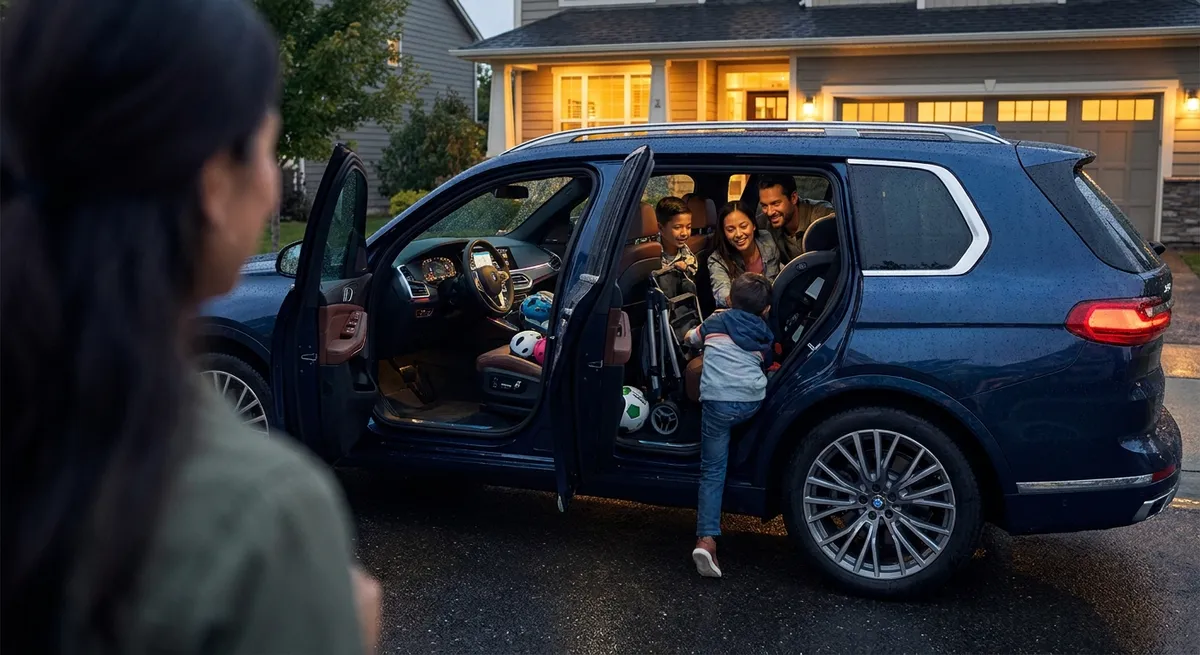
Door aperture width and sill height also deserve quiet scrutiny. Broad door openings and low, flat sills make it easier for younger children to climb in independently and for adults to secure child seats without contorting. Equally important is the “shoulder line” inside: narrow cabins with high door panels can feel confined, while more upright windows and slimmer pillars convey a sense of openness that matters on longer drives.
In the cargo area, look beyond capacity claims and consider real usability. A low, flat load floor and minimal intrusion from wheel arches make it far easier to load strollers, sports equipment, or luggage. Split-folding rear seats that fold nearly flat, with levers accessible from the cargo area, can transform reconfiguration from a chore into a simple, graceful motion.
The Quiet Discipline of Ride and Refinement
Noise, vibration, and harshness (NVH) are where a family SUV reveals its true character. With children in the back and conversations up front, refinement isn’t a luxury—it’s a form of calm.
Ask to test‑drive on variable surfaces: coarse asphalt, broken urban streets, and highway expansion joints. Observe how the SUV responds to sharp impacts: does the cabin shudder, or does the chassis absorb the disturbance with composure? A well-tuned suspension will control body motion without feeling brittle, especially in the second and third rows where occupants are more sensitive to vertical movement.
Acoustic isolation is equally critical. Models that employ laminated front glass, additional door seals, and strategic sound insulation around the firewall, wheel wells, and cargo area tend to maintain a more serene cabin. This matters not just for perceived luxury but for reduced fatigue on longer journeys and clearer communication at normal speaking volume.
Powertrain smoothness is another detail often overlooked. A refined engine and transmission pairing should deliver quiet, predictable power rather than abrupt shifts or constant high revs. In hybrid or plug‑in hybrid SUVs, pay attention to how the transition between electric and gasoline power feels—seamless integration signals a more sophisticated system that will be less intrusive to family life.
Safety as Experience, Not Just Specification
Modern family SUVs are saturated with safety language: acronyms, stars, and scores. Those metrics are important, but the day‑to‑day experience of safety is equally about how those technologies are implemented and how naturally they integrate into your driving habits.
Evaluate the clarity and subtlety of driver assistance alerts. Lane-keeping or collision warnings that are overly aggressive or cryptic can lead to drivers switching them off, negating their benefit. Look for systems that communicate with clear icons, gentle vibrations, or concise sounds rather than constant chimes. During your test drive, ask to experience adaptive cruise control and lane-centering on a highway stretch—notice whether the assistance feels reassuring and predictable rather than abrupt.
Physical safety design details also separate considered SUVs from the ordinary. Check for easily accessible LATCH anchors that do not require digging between cushions, and for top tether anchor points that are clearly marked—even in the third row. Door opening angles that allow a child seat to be installed without scraping the door frame, and rooflines that allow adults to lean in comfortably, are small but meaningful indicators of family‑oriented engineering.
Lighting is another overlooked safety dimension. LED headlights with good beam spread and automatic high beams can materially improve night driving comfort. Interior ambient lighting that is soft and well‑positioned allows you to locate items in the cabin at night without compromising the driver’s visibility. These details add up to a feeling of assurance that statistics alone cannot convey.
Five Exclusive Insights for the Attentive Family SUV Buyer
In a market crowded with similar-sounding features, a few nuanced considerations can sharply distinguish your final choice. These five insights, seldom highlighted in mainstream guides, can quietly transform daily life with your SUV.
1. The “Third-Row Reality Check”
If you expect to use a third row regularly, conduct a realistic test. Have the tallest family member sit in the third row, then position the second-row seat in front of them to an acceptable setting for that same person. This “tandem test” reveals whether the vehicle can truly accommodate six or seven people without compromise, or if the third row is best considered occasional.
Also try exiting from the third row with a child seat installed in the second row. Some SUVs offer clever tilt-and-slide mechanisms that work even with a car seat secured; in others, access becomes awkward the moment child seats enter the equation.
2. Climate Control Subtleties
Dual- or tri-zone climate control is now common; the refinement lies in airflow design. Look for ceiling- or pillar‑mounted vents for rear passengers rather than floor-only outlets, which can be less effective. Rear controls that allow older children or adult passengers to fine-tune temperature can prevent constant adjustment requests to the driver.
During the test drive, run the air conditioning or heating from a cold start and note how quickly the cabin stabilizes. Vehicles with heated rear seats, heated steering wheels, and rapid‑response defoggers make winter school runs far more pleasant, especially when multiple drop‑offs mean doors are opened frequently.
3. Storage That Matches Real Life
Evaluate interior storage against your actual routines, not in isolation. Can the center console accommodate a small handbag or tablet? Are there covered compartments to discreetly store valuables during a day at the park or an evening at the theatre? Door pockets should be able to hold water bottles upright without rattling, and the glovebox should not be entirely occupied by the owner’s manual and paperwork.
Pay particular attention to the “front-row catch-all” zones: a wireless charging pad that holds a phone securely through a spirited on-ramp, a dedicated spot for house keys, and a small, easily reached compartment for toll transponders or parking tickets. These details reduce clutter and help maintain a sense of order even on busy days.
4. Powertrain Choice with a Long View
Families often underestimate how their driving patterns will evolve over the vehicle’s lifespan. If your daily usage is mostly urban with predictable mileage, a hybrid or plug‑in hybrid can substantially reduce fuel costs and provide a quieter in‑town experience, especially when running in electric-only mode. However, consider the availability of home or office charging before committing to a plug‑in model; the full benefits emerge when regular charging is effortless.
If frequent long-distance travel is likely, scrutinize not just efficiency but also fuel tank capacity and range. An SUV that delivers excellent mileage but has a small tank may still require frequent refueling on road trips. For families considering future towing—whether a small camper or a boat—review both towing capacity and the presence of integrated towing features, such as trailer sway control and factory-installed pre‑wiring.
5. Infotainment That Ages Gracefully
The in‑cabin technology that looks striking on day one should also remain intuitive and dependable years later. Favor systems that retain essential controls—volume, temperature, defrost—as physical or at least separate, easily accessed buttons, not buried within touchscreen menus. This becomes especially relevant when wearing gloves in winter or trying to adjust settings quickly while focusing on the road.
Confirm whether the vehicle supports wireless Apple CarPlay and Android Auto, and evaluate the stability and responsiveness during your test drive. Multiple USB‑C ports, including in the second and third rows, can prevent conflicts over charging, while an available 110V or 230V outlet can power laptops or small devices on long journeys. Over‑the‑air software updates, increasingly common in newer models, help ensure your infotainment and safety systems remain current without repeated trips to the dealership.
Curating the Ownership Experience, Not Just the Purchase
The most rewarding family SUV ownership experiences arise when you step back from the excitement of newness and consider the full arc of living with the vehicle. This includes dealer proximity and service reputation, the availability of loaner vehicles during maintenance, and transparent service intervals. Ask about recommended maintenance schedules and the cost of key items such as brakes, tires, and hybrid system checks if applicable.
Warranty coverage, especially for the powertrain and hybrid components, signals the manufacturer’s confidence in the underlying engineering. Some brands now include complimentary scheduled maintenance for a defined period, which not only lowers ownership cost but also encourages adherence to service schedules that support long‑term reliability.
Finally, take the time to conduct a second test drive at a different time of day, ideally including your full family. Load the stroller, backpacks, sports bags, and perhaps even luggage, and drive the routes you use most—school runs, commutes, weekend errands. The right family SUV will reveal itself not just in its specifications, but in how seamlessly it integrates into these familiar routines while elevating them with a sense of calm, comfort, and quiet capability.
Conclusion
A sophisticated family SUV is not defined solely by its size, power, or badge. It is the sum of many measured decisions: cabin architecture that respects every occupant, refinement that quiets the day, safety systems that support rather than overwhelm, and thoughtful features that anticipate the small frictions of family life. By looking beyond brochures and focusing on lived experience—third‑row reality, climate subtleties, intelligent storage, long‑term powertrain strategy, and future‑proof technology—you position your family not just to own an SUV, but to enjoy a carefully considered companion for years of journeys to come.
Sources
- National Highway Traffic Safety Administration (NHTSA) – 5-Star Safety Ratings - Official U.S. government crash test ratings and safety information for SUVs and other vehicles
- Insurance Institute for Highway Safety (IIHS) – Vehicle Ratings - Independent crashworthiness and crash-avoidance ratings, including details on headlights and child seat anchors
- U.S. Department of Energy – Fuel Economy Guide - Comparative data on fuel economy, hybrid and plug‑in hybrid benefits, and estimated annual fuel costs
- Edmunds – Car Seat Safety and LATCH Guides - Practical evaluations of child seat installation and family‑oriented usability in different vehicles
- Consumer Reports – Guide to Car Reliability & Owner Satisfaction - Long-term reliability trends, owner satisfaction insights, and cost-of-ownership considerations for family vehicles
Key Takeaway
The most important thing to remember from this article is that this information can change how you think about Buying Guide.