The modern family SUV is no longer just a people-mover; it’s a mobile extension of your home, your calendar, and your lifestyle. Yet most buying advice fixates on obvious metrics—horsepower, cargo volume, and fuel economy—while overlooking the subtler qualities that determine how the vehicle will actually feel to live with over years of school runs, road trips, and late-night airport pickups. This guide steps beyond the spec sheet to explore the refined, real-world considerations that quietly separate a merely capable SUV from a truly exceptional one.
Understanding Your Family’s “Daily Rhythm Profile”
Before comparing models, it’s worth defining what your days truly look like. Not the idealized version, but the real one—running late to practice, juggling car seats and groceries, answering work calls between pickups.
Start by mapping out a typical week: How many occupants are in the car most of the time? How often do you use all three rows? Do you frequently parallel park in tight urban spaces, or cruise long distances on the highway? This “daily rhythm profile” becomes the lens through which every feature is evaluated.
For example, a family that frequently hosts grandparents or carpools will genuinely use a third row several times a week—so third-row comfort, not just availability, becomes critical. A family with one child and city parking constraints might be better served by a two-row SUV with exceptional maneuverability and a premium interior, rather than paying for seat capacity that seldom gets used.
Once your rhythm is clear, you can assign priorities: access and flexibility, ride comfort, technology experience, storage versatility, or long-range refinement. The right SUV isn’t universally “best-in-class”; it’s best aligned to your specific family choreography.
Exclusive Insight 1: The “Graceful Entry” Test Few Shoppers Perform
Most buyers open doors, sit in the driver’s seat, and maybe climb into the second row. Far fewer perform what might be called the “graceful entry” test—a simple, revealing ritual that says more about everyday usability than any brochure statistic.
Bring your whole family to the test drive. Have everyone enter and exit the SUV as they would in real life, multiple times:
- Children climbing into second and third rows
- An adult installing and buckling car seats
- A taller family member accessing the third row
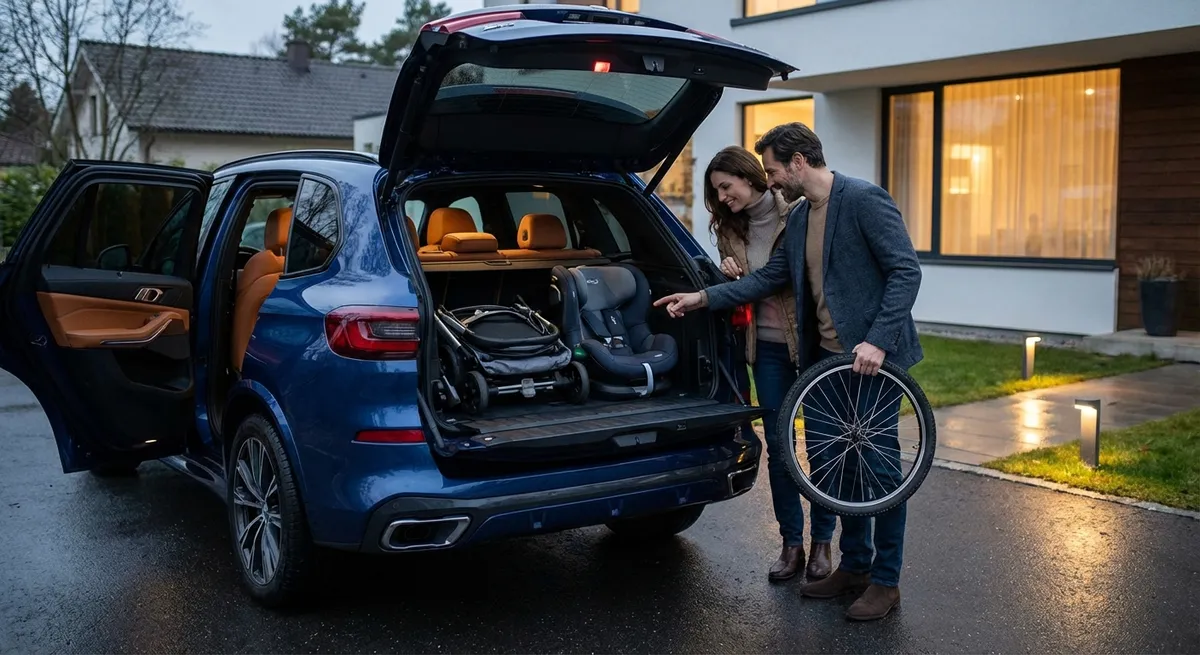
- Someone loading bags or strollers through the rear
Observe how many steps each action takes. Are there one-touch seat releases for third-row access, or does it require an awkward sequence? Do doors open wide enough for a grandparent with limited mobility? Is the step-in height comfortable in everyday clothes, not just jeans and sneakers?
Small design decisions—door cutouts, step-in height, grab-handle placement, seat-slide travel—determine whether the SUV feels graceful or clumsy in daily use. A model that passes the “graceful entry” test will age more gracefully with your family too, as children grow and needs evolve.
Exclusive Insight 2: Evaluating “Quiet Quality” Beyond Sound Ratings
Many SUVs advertise acoustic glass and sound insulation, but the authentic measure of calm isn’t just decibel reduction; it’s the character of the sound that remains. Families quickly learn that incessant wind rustle, coarse tire noise, or a booming exhaust note become exhausting on long drives, regardless of how powerful or efficient the vehicle may be.
During your test drive, intentionally seek out a range of conditions: rough pavement, smooth highway, moderate speeds, and a short stint at higher speeds. Then, turn off the audio system completely. Listen for:
- Wind turbulence around mirrors and A-pillars
- The consistency (or patchiness) of road noise over different surfaces
- Vibration or resonance through the seats and steering wheel
- The engine’s tone under gentle and brisk acceleration
A refined SUV will feel hushed but not lifeless; you should be able to hold a soft conversation with third-row passengers without raising your voice. If possible, schedule back-to-back test drives of your top contenders over the same route. The differences in quiet quality—how sound is managed, not just muted—will suddenly become surprisingly obvious.
Exclusive Insight 3: Interior Materials That Withstand Real Life, Gracefully
Families often assume they must choose between beauty and durability. The best SUVs prove otherwise, but it requires looking beyond initial showroom impressions. High-gloss piano black trim, for example, may appear sleek under dealer lighting, yet it quickly reveals fingerprints, dust, and micro-scratches in daily use.
Pay close attention to the following:
- Seat upholstery: Modern synthetic leathers can resist stains, UV, and stretching better than some genuine leathers. Light-colored interiors can feel airy and upscale, but examine how easily they might show denim transfer or spills.
- Touch surfaces: Run your hand along door panels, center consoles, and armrests. Soft, well-padded surfaces are more forgiving of bumps and more pleasant on long drives. Hard, shiny plastics tend to show wear sooner.
- Switchgear and controls: Gently operate buttons, knobs, and stalks. Do they move with a solid, damped action, or feel loose and brittle? Controls that feel substantial usually correlate with longer-term satisfaction.
- Flooring and mats: Consider how easily sand, crumbs, and mud can be vacuumed away. Optional all-weather mats or integrated cargo liners can be worth their price in preserved resale value.
Ask to see a pre-owned version of the same model, if available at the dealership. How do the materials look after two or three years of real family use? This real-world preview often reveals more than any marketing brochure.
Exclusive Insight 4: Tech That Serves You, Not the Other Way Around
Family SUVs increasingly resemble rolling tech hubs, but more screens do not necessarily mean a better experience. The most satisfying systems are intuitive, minimally distracting, and flexible enough to adapt to different drivers and passengers.
When evaluating technology, focus on how naturally it integrates into your family’s existing digital habits:
- Smartphone mirroring: Confirm support for Apple CarPlay and Android Auto, ideally wireless, and test how quickly they connect on startup.
- Physical vs. touch controls: Ensure high-frequency functions—volume, temperature, defrost—have intuitive physical controls. Requiring multiple screen taps to adjust climate or seat heating becomes frustrating and distracting over time.
- Rear-seat experience: If passengers regularly use devices, look for accessible USB-C ports in all rows, available rear climate controls, and, where offered, robust Wi‑Fi hotspots.
- Driver assistance calibration: Test adaptive cruise control and lane-keeping features on a real road, not just a parking lot. The best systems act like a discreet assistant, not an overbearing co-pilot, and can reduce fatigue on longer drives.
Most importantly, imagine your least tech-savvy family member operating the SUV alone. Could they quickly pair a phone, set navigation, and adjust safety settings without frustration? A genuinely premium SUV makes technology feel invisible—there when you need it, never demanding center stage.
Exclusive Insight 5: Future-Proofing for the Next Chapter of Family Life
An SUV is typically a multi-year commitment, often spanning several phases of family life—infant seats, booster seats, teen drivers, and beyond. Choosing with tomorrow in mind can prevent the need for an early replacement and protect resale value.
Consider how your needs might evolve over the next five to eight years:
- Child seats to independent riders: Check how many car seats can be installed securely, but also visualize a future where older children value legroom, device charging, and personal space.
- Travel patterns: Are you likely to take more road trips as children grow? If so, prioritize long-distance comfort, fuel efficiency (or EV range), and advanced driver assistance.
- Electrification and infrastructure: If you’re considering a hybrid or fully electric SUV, assess home charging options, local charging networks, and likely improvements in your region. Even if you purchase a gasoline model now, choosing a brand with a strong electrification roadmap can support resale desirability.
- Towing and hobbies: If you foresee trailers, boats, or larger recreational gear, confirm tow ratings and, equally important, how confident and composed the vehicle feels when towing.
Finally, examine total cost of ownership rather than sticker price alone: financing rates, insurance estimates, expected maintenance, and projected depreciation. A thoughtfully chosen SUV that ages well with your family can feel like a quiet luxury—rewarding you every day, rather than surprising you with compromises.
Conclusion
Selecting a family SUV is as much a lifestyle decision as it is a mechanical one. The most rewarding choice often emerges not from chasing the highest spec or most aggressive discount, but from patiently evaluating how an SUV supports your family’s daily rhythm, preserves calm, and anticipates the next chapter of your life together. By looking beyond the brochure—testing for graceful access, listening for quiet quality, scrutinizing materials, demystifying technology, and thoughtfully future-proofing—you curate more than transportation. You create a moving space that feels considered, composed, and unmistakably yours.
Sources
- [National Highway Traffic Safety Administration (NHTSA) – Vehicle Safety Information](https://www.nhtsa.gov/ratings) - Official U.S. government resource for crash test ratings and safety technologies
- [Insurance Institute for Highway Safety (IIHS) – Ratings & Research](https://www.iihs.org/ratings) - Independent safety evaluations, including crashworthiness and crash avoidance features
- [U.S. Department of Energy – Fuel Economy Guide](https://www.fueleconomy.gov/feg/byclass.htm) - Comparative fuel economy data for SUVs and crossovers, including hybrid and electric options
- [Consumer Reports – New & Used Car Reviews](https://www.consumerreports.org/cars/) - Long-term reliability data, owner satisfaction, and road-test impressions across SUV segments
- [Edmunds – Total Cost of Ownership](https://www.edmunds.com/tco.html) - Five-year cost of ownership projections including depreciation, insurance, fuel, and maintenance
Key Takeaway
The most important thing to remember from this article is that this information can change how you think about Buying Guide.