Family SUVs are marketed loudly—horsepower, screen size, cargo volume. Yet the families who value refinement tend to notice something different: the understated details that make every school run, weekend trip, and late-night airport pickup feel effortlessly composed.
This is an exploration of those details—the elements you will rarely see on a billboard, but will feel every single day. Consider these five insights a lens through which to view your next SUV: not as a commodity, but as a finely tuned family environment.
The Architecture of Calm: Cabin Layout That Reduces Friction
A genuinely family-focused SUV is not defined by how much it can carry, but by how gracefully it accommodates movement, conversation, and routine.
Begin with the second row. A sliding, reclining bench or captain’s chairs that tilt and slide with child seats installed can transform school mornings. The ability for children to step in and move to the third row without contortions keeps clothing neat, tempers steady, and timing precise. Look for wide door openings, low step-in heights, and doors that don’t intrude on the entry path.
Cabin “architecture” also includes how visible each passenger is. A subtly elevated second row, generous side glass, and a rear quarter window that doesn’t pinch upward too aggressively help prevent motion sickness and cabin fatigue. When everyone can see out, the drive feels shorter and more civilized.
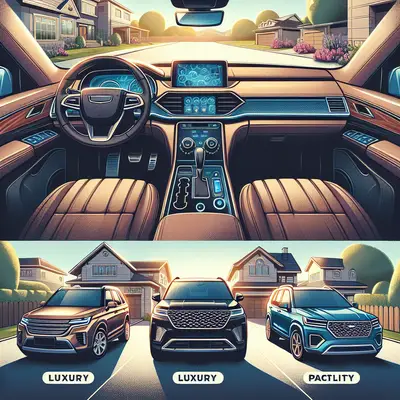
Equally important is cockpit design. A clear, uncluttered driver’s area with physical controls for the functions you use most (climate, volume, defogger) allows you to manage the car by feel, keeping your eyes on the road and your tone measured—especially when questions and requests are coming from every direction.
In a truly well-designed family SUV, the cabin becomes less a container and more a coherent space where each family member has room to exist comfortably, independently, and together.
The Subtle Comfort Matrix: Materials, Acoustics, and Climate Harmony
Comfort in a family SUV is not defined by a single feature, but by the cumulative effect of many. Families who spend serious time in their vehicle will notice how these elements interact.
Start with materials. Soft-touch surfaces at knee, elbow, and shoulder height reduce fatigue more than you might expect, especially on longer drives. Quality seat cushioning that supports the thighs and lower back helps both adults and growing children arrive feeling composed rather than wrung out. Leather or leatherette with a subtle texture tends to stay cooler, mask light scuffs, and clean more easily than ultra-smooth finishes.
Acoustic refinement is particularly underrated. Laminated front glass, additional door insulation, and acoustic windshields can reduce wind and road noise significantly, allowing lower volumes for both music and conversations. A quieter cabin means you hear your children clearly without raising your voice—and they, in turn, are less likely to escalate theirs. Active noise cancellation, when available, further smooths the sonic backdrop, especially at highway speeds.
Climate is another layer of this comfort matrix. Look for tri-zone (or at least dual-zone) automatic climate control with dedicated rear vents that begin near shoulder level rather than only at floor level. Ventilated front seats and heated second-row seats help keep everyone content through seasonal extremes. Subtle but telling touches include rapid-defog systems and remote start that can pre-condition the cabin before early school runs or late pickups.
The most refined family SUVs feel composed in every sense: temperature, sound, and touch are gently, almost invisibly, managed in the background.
The Ritual of Everyday Storage: Thoughtful Spaces That Anticipate You
The difference between a merely large SUV and a truly family-centric one is the intelligence of its storage. Space is abundant in this category; what matters is how well that space is curated.
Examine the center console and front storage first. Is there a dedicated, covered space where phones can charge wirelessly out of sight, reducing visual clutter and temptation? Are there separate small compartments for keys, toll transponders, and sunglasses, so these items never compete with drinks or snacks?
In the second row, door pockets that can accommodate both a full-size water bottle and a smaller children’s drink save you from constant juggling. A fold-down armrest with storage and cupholders that don’t interfere with child seats can keep personal items neatly contained. Integrated rear seatback pockets with multiple compartments—one for books, one for tablets, one for slim toys—help prevent the single, overflowing “catch-all” scenario.
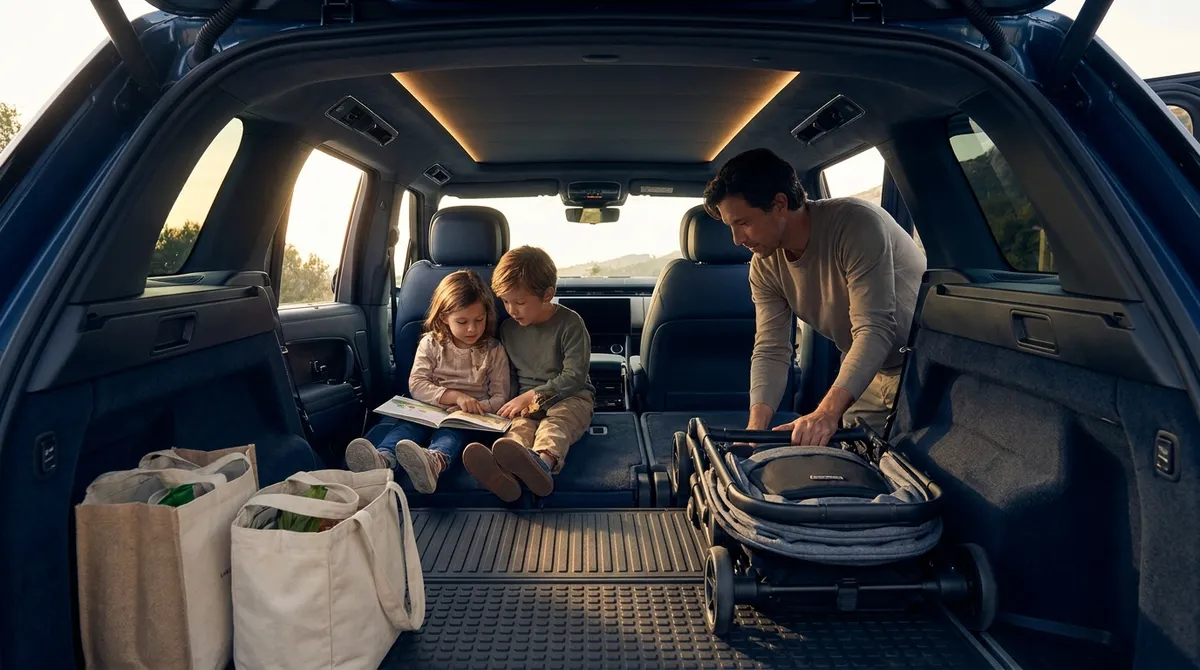
The cargo area is where thoughtful design is most apparent. A dual-level load floor can hide valuables beneath while still allowing a flat surface for strollers or grocery bags. Anchor points that are sturdy and well positioned make securing bulky items straightforward. Grocery bag hooks, subtle side cubbies, under-floor bins, and available cargo dividers prevent your weekly shop from cascading across the trunk at the first roundabout.
The most sophisticated SUVs feel premeditated, as if an unseen designer had already imagined your family’s specific rituals—and calmly created a place for each of them.
Technology as a Discreet Valet, Not the Main Event
Screens and features are easy to quantify; the true luxury is how quietly and competently your SUV’s technology works in the background.
Begin with the interface. A clear, restrained home screen, responsive touch controls, and an intuitive menu structure minimize distraction. Wireless Apple CarPlay and Android Auto mean no cables draped across the cabin, and profiles that remember individual driver settings (seat, mirrors, climate, favorite routes) make each entry feel immediately familiar.
Rear-seat technology should be supportive, not dominant. Multiple USB-C ports, ideally in both the second and third rows, allow each child or guest to manage their own devices. If there are dedicated rear screens, look for systems that support separate audio channels via headphones, so front-row serenity is preserved. A robust cabin Wi-Fi hotspot, when available, can transform long drives into productive or genuinely relaxing time, particularly for older children.
Driver assistance technology should feel like a discreet valet: always ready, never overbearing. Adaptive cruise control with stop-and-go functionality can reduce fatigue in traffic; lane centering that gently assists rather than tugs reassures rather than startles. A high-resolution 360-degree camera system with clear guidelines makes tight urban maneuvers and garage parking feel measured and confident.
The most considered family SUVs use technology not as a party trick, but as an invisible scaffold that supports your attention, reduces friction, and allows you to focus on what is happening inside the car, not on the car itself.
The Future-Proof Lens: Flexibility for Evolving Family Rhythms
A family SUV is rarely a short-term purchase; it is a long-term backdrop to graduations, new schools, shifting schedules, and changing hobbies. Future-proofing, then, becomes a sophisticated form of practicality.
Assess seating flexibility with a longer timeline in mind. Can the third row comfortably accommodate teenagers, not just small children? Are the ISOFIX/LATCH anchor positions compatible with potential configurations of multiple child seats and occasional adult passengers? Split-folding seats (often 40/20/40 in the second row, 50/50 or 60/40 in the third) allow you to carry sports equipment or musical instruments alongside passengers without resorting to awkward compromises.
Consider drivetrains and efficiency as part of this long view. A hybrid or plug-in hybrid SUV may offer quieter operation in urban environments and lower running costs, while giving you the range and flexibility for family road trips. Even if you do not plan to charge daily, the combination of electric assistance and a refined combustion engine can deliver both smoothness and reduced fuel consumption compared with traditional powertrains of similar size.
Connectivity and over-the-air update capability are increasingly relevant. An SUV whose software can be updated remotely may improve its navigation, safety systems, and even energy management over time, reducing the sense of technological obsolescence. Integration with digital keys and family sharing (where trusted family members can access the vehicle via their smartphones with restricted permissions) can also adapt to teenagers who begin driving or aging parents who occasionally borrow the car.
When you view your SUV through this future-proof lens, you begin to see it not simply as transportation, but as a flexible, evolving platform—one that can gracefully accompany your family through multiple chapters without feeling outdated or constrained.
Conclusion
For families who value refinement, the true measure of a family SUV is not captured by a single headline spec or dramatic design flourish. It lives in the architecture of the cabin, the quiet of the interior at speed, the intelligence of storage, the restraint of technology, and the flexibility to adapt as your family grows and changes.
Test drives and brochures will show you the obvious. The real advantage comes from noticing what is subtly, almost invisibly, well considered. When you find an SUV that aligns with these understated priorities, every journey—ordinary or exceptional—feels just a little more composed, a little more gracious, and unmistakably your own.
Sources
- Insurance Institute for Highway Safety (IIHS) – Vehicle Ratings - Authoritative crash test results and safety feature evaluations to support assessing SUV safety beyond marketing claims
- National Highway Traffic Safety Administration (NHTSA) – Vehicle Safety - U.S. government resource on vehicle safety technologies, crash test ratings, and child passenger guidance
- U.S. Department of Energy – Fuel Economy Guide - Official data on fuel economy and hybrid/plug-in hybrid benefits for comparing powertrains when future-proofing an SUV
- Edmunds – Family Car Buying Tips - Practical considerations on seating, cargo, and features specifically relevant to family vehicles
- Consumer Reports – Car Interior and Comfort Guide - Expert analysis on cabin comfort, materials, and ergonomics that influence daily livability in SUVs
Key Takeaway
The most important thing to remember from this article is that this information can change how you think about Family Features.