The most revealing details of a family SUV rarely appear in the headline specs. Horsepower, cargo volume, and touchscreen size may dominate the marketing materials, but they don’t tell you how calm your children will be on a late‑night drive home, whether your stroller will slide in gracefully or wedge awkwardly, or how effortlessly you can transition from weekday school runs to a weekend out of town. The true measure of a family SUV is found in the subtle interactions you have with it every single day.
At Family SUV Review, we look past the glossy promises to understand how an SUV behaves in real family life. The insights below distill what our readers consistently tell us matters most when they live with a vehicle—not just test drive it. Consider these five exclusive review angles as your “quiet filter” for separating polished marketing from genuine, long‑term satisfaction.
1. Real-World Cabin Calm: How We Evaluate “Family Quietness”
For families, cabin quietness is less about decibels on a spec sheet and more about how the SUV manages sound during real life. We pay attention to how the cabin feels on coarse highway surfaces, in heavy rain, and when driving past trucks or construction—not just on a smooth dealer test-drive route. A well-insulated SUV can radically lower tension levels on long trips, letting conversations stay at a normal tone and making audiobooks, calls, and rear-seat movies more enjoyable. We also note how the climate control fans sound at higher settings, whether the engine intrudes when you accelerate to join fast traffic, and if the mirrors or roof rails whistle at speed. For families with young children, that combination often determines whether naps survive a long journey. In our reviews, we describe not only how quiet an SUV is, but what kinds of sounds remain, and whether they blend into the background or become a constant irritation over time.
2. The “Hands Full” Test: Small Touches That Change Busy Mornings
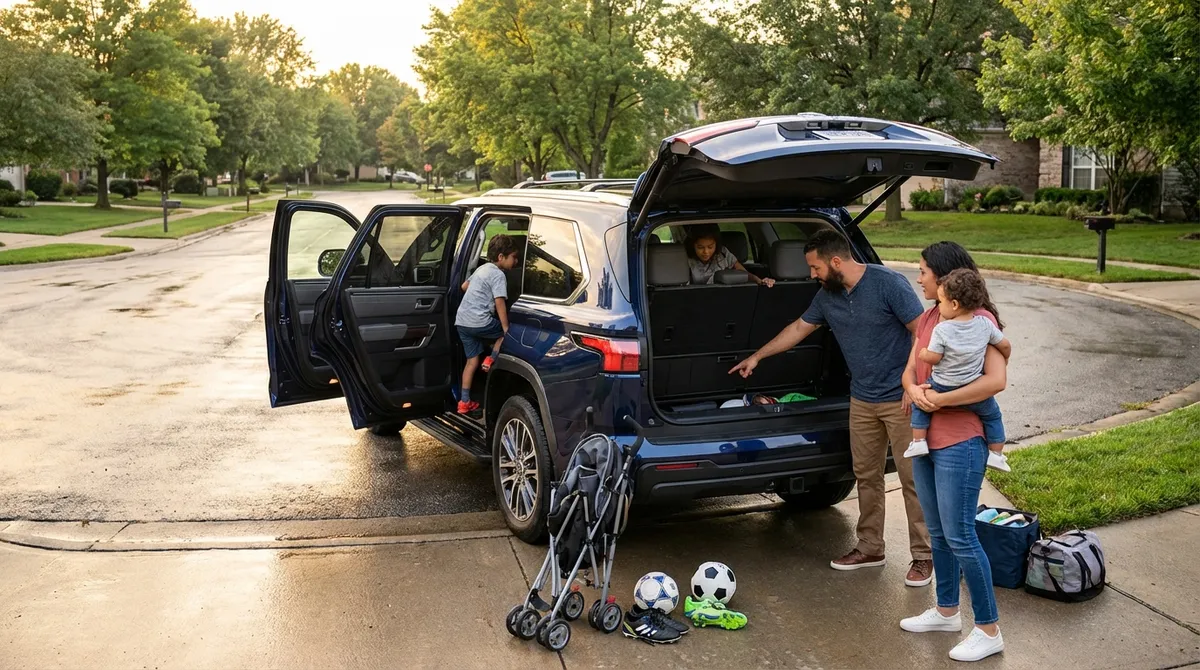
No spec table captures how an SUV behaves the moment you approach with a child on one hip, a laptop bag on your shoulder, and groceries in both hands. That’s why our reviews include what we call the “hands full” test. We evaluate how easy it is to open the tailgate without putting anything down, how intuitive keyless entry feels when your key is buried in a bag, and whether door handles and latches operate smoothly even with limited grip. We examine how wide the doors open in tight parking spaces, how easily a sleeping child can be transferred into a car seat, and whether door sills are low and clean enough to avoid dirty trouser legs. We also explore how quickly the vehicle recognizes the key, how reliably any gesture- or foot-activated tailgate actually works, and whether the cabin lighting helps you locate items on dark mornings. These details determine whether day-to-day use feels effortless or mildly frustrating—every single time you leave the house.
3. Cargo That Works Like a Well-Designed Closet, Not a Storage Bin
Cargo space is often reduced to a simple number in liters or cubic feet, but families experience it more like a meticulously designed closet: accessible, ordered, and adaptable. When we review an SUV, we focus on how the cargo area copes with real family objects—a folded stroller, sports bags, a week’s worth of groceries, musical instruments, or a family’s luggage for a long weekend. We examine whether the floor is flat with the seats folded, if there’s a loading lip that makes heavy items more awkward, and whether the tailgate’s shape eats into usable height or width. Storage beneath the floor, side cubbies that prevent bottles from rolling, and hooks that can actually support filled shopping bags all matter more than raw volume. We also consider how easily the third row (if available) folds from the rear, whether you can lower seats one‑handed while holding something else, and how simple it is to keep the space clean. In practice, a thoughtfully shaped and intelligently organized cargo area can feel significantly larger—and more luxurious—than the number suggests.
4. Technology That Behaves Like a Discreet Assistant, Not a Demanding Gadget
In family SUVs, technology succeeds when it quietly enhances your drive instead of competing for your attention. Our reviews go beyond screen size to focus on how intuitively the system works and how well it integrates into daily routines. We assess how many taps it takes to adjust climate settings, whether volume and frequently used functions still have physical controls, and how quickly the system boots up first thing in the morning. We pay attention to how reliably the vehicle connects to multiple phones, whether rear-seat passengers can easily manage their own media or climate, and how seamlessly navigation adjusts to traffic without requiring constant input. Driver-assistance features are evaluated not just on presence, but on refinement: Does lane-keeping feel confident or fidgety? Does adaptive cruise brake smoothly or abruptly? True premium technology should feel like a capable co‑pilot—predictable, polite, and easy to live with—rather than another device you have to manage on top of everything else.
5. Seating That Adapts as Your Children Grow
The best family SUVs are designed not for a single life stage, but for evolution—infant seats today, teenage legs tomorrow. We assess how straightforward it is to install and access child seats, including how easy it is to reach latch points without contorting your hands or removing cushions. We look at third-row access with real-world scenarios in mind: can you reach the back with a forward-facing car seat installed in the second row, and how practical is it for grandparents or friends to climb into the rear? We also examine seat contouring and padding to see how they support adults and older children on long journeys, not just on short test drives. Adjustable thigh support, reclining second rows, and separate climate zones can be the difference between a peaceful road trip and a series of rest-stop negotiations. As part of our reviews, we describe which seating layouts work best for different family structures—two young children, three across, blended families, or multigenerational passengers—and how gracefully the cabin can be reconfigured as your needs change.
Conclusion
When you strip away the marketing language, a family SUV is ultimately a daily partner in the choreography of your life: school runs, late meetings, spontaneous detours, and carefully planned weekends away. The most useful SUV reviews recognize that families are not buying a machine; they are investing in a space where countless everyday moments will unfold. By focusing on cabin calm, “hands full” usability, genuinely intelligent storage, discreet technology, and future-ready seating, we aim to help you look past the brochure and toward the experience you will live with for years. In that space—where design, comfort, and practicality intersect—your next SUV becomes less of a purchase and more of an upgrade to your family’s daily rhythm.
Key Takeaway
The most important thing to remember from this article is that this information can change how you think about SUV Reviews.