For families who treat the family car as an extension of their home, a typical SUV review rarely goes far enough. Star ratings and cargo volumes tell only part of the story; what truly matters is how an SUV behaves in the quiet, unphotographed moments of everyday life—early school runs, late-night airport pickups, and weekends that blur the line between routine and escape. This is where a more refined lens on SUV reviews becomes essential: one that reads between the specs and focuses on how an SUV genuinely supports a family’s rhythm.
Below are five exclusive insights that elevate a standard review into something far more useful for families with exacting standards—those who appreciate nuance, subtle engineering decisions, and the difference between “good enough” and “effortlessly right.”
Insight 1: The “Third Hour” Comfort Test, Not Just the First Impression
Most SUV reviews note seat comfort, but usually after a quick drive or a short test route. For a family, the more revealing question is: how does the cabin feel after three uninterrupted hours?
A sophisticated review looks past initial softness and instead examines long-haul consistency. That means evaluating thigh support for taller drivers, how well lumbar support maintains posture when you’re on a long highway stretch, and whether second- and third-row passengers still feel supported once everyone settles in. It also includes the shape and padding of armrests, the angle of rear seatbacks, and how easily kids can find a comfortable position without slouching.
Climate control is equally critical during this “third hour.” Dual- or tri-zone systems are table stakes; what matters is how evenly the cabin maintains temperature and how quietly the fans operate at higher settings. Families with infants may also appreciate reviews that comment on how gently the system manages airflow near child seats and whether rear vents are positioned to cool (or warm) the cabin without blasting small passengers directly in the face.
In thoughtfully written reviews, the “third hour” test becomes a subtle but telling indicator of whether the SUV is genuinely engineered for family journeys or simply styled for showroom appeal.
Insight 2: Real-World Quiet—Not Just a Claim of “Refinement”
Many SUVs are marketed as quiet, but silence has layers. Families tend to notice the smallest interruptions: a faint whistling from the mirrors at highway speeds, a low-frequency drone from the tires on coarse pavement, or a harsh engine note when merging onto a busy road with a full load.
An elevated SUV review dissects cabin noise into its components: wind, road, and powertrain. It should describe how the SUV sounds and feels at typical family speeds—35 mph in town, 60 mph on the highway, and brief stints at higher speeds during long drives. This is where premium engineering makes itself known through laminated glass, additional door seals, underbody shielding, and careful aerodynamics around the mirrors and pillars.
For families, noise levels directly affect fatigue and mood, especially with younger passengers. Subtle noise control allows conversations in the third row without raised voices, makes audiobooks and podcasts easier to follow, and lets a baby sleep more soundly on the way home. Reviews that take the time to assess how different surfaces (city streets, older highways, newly paved roads) affect cabin serenity deliver a level of insight that spec sheets cannot.
Put simply, quiet isn’t just a luxury detail—it’s a family feature. The best reviews treat it that way.
Insight 3: The “Hands Full” Usability Check
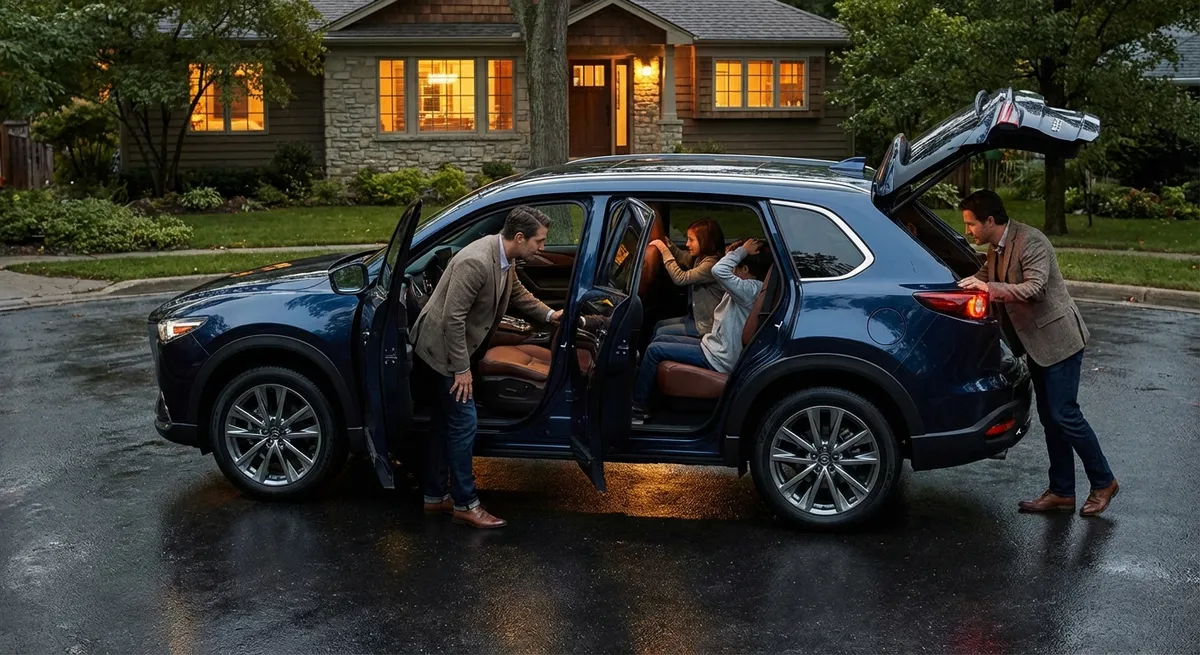
A family SUV earns its reputation in that one very specific moment: you are approaching the vehicle with a sleeping child in your arms, groceries on your wrist, and a backpack sliding off your shoulder. This is when thoughtful convenience features move from “nice to have” to “indispensable.”
Sophisticated reviews should describe how the SUV behaves in exactly these moments. Does the keyless entry system unlock quickly and reliably when your hands are occupied? Is there a foot-activated tailgate that works consistently, even in the rain or snow? Are the door openings large and low enough that lifting a child into a car seat feels natural rather than awkward?
Interior storage also deserves a finer-grained analysis. Rather than simply stating that there are “plenty of cupholders,” a premium review looks at whether they are well-placed for all rows, how securely they hold a child’s water bottle, and whether front-console storage is deep enough for modern family essentials: phones, snacks, hand sanitizers, and small toys. It also notes whether purse or laptop bag storage feels intentional or improvised.
Finally, reviewers should explore how quickly the interior can transition—two car seats and luggage for a weekend trip, or a flat load floor for a run to the home improvement store. The ability to reconfigure the cabin with one hand while managing children is a subtle but powerful sign of genuinely family-centric design.
Insight 4: Subtle Safety Intelligence, Not Just Star Ratings
Crash-test scores and safety ratings remain essential, but for families who read carefully, the differentiators are often more nuanced. A truly insightful review goes beyond “it has advanced driver-assistance features” to examine how those systems behave in real life.
This includes how smoothly adaptive cruise control modulates speed when traffic compresses, whether lane-keeping assist feels natural or overly assertive, and if forward-collision warnings are helpful or annoyingly sensitive. Families with children in the second and third row may also appreciate commentary on how the SUV’s structure, airbag coverage, and head restraint design protect all occupants, not just those in the front seats.
Equally important is the clarity and restraint of alerts. Subtle, well-tuned warnings—both visual and audible—can prevent fatigue and reduce distraction. Overly frequent or intrusive alerts, on the other hand, can lead to drivers ignoring or disabling them. A refined review critiques the quality of this safety “conversation” between SUV and driver, rather than simply listing which features appear on the spec sheet.
In addition, families benefit from insights into child-seat friendliness: the accessibility of LATCH anchors, the ease of routing seatbelts around bulky seats, and how much space remains for front passengers when rear-facing seats are installed. These are details that a data table will not reveal, but that significantly influence day-to-day safety and comfort.
Insight 5: Long-Term Calm—How the SUV Will Age With Your Family
Many reviews focus on the moment of purchase; discerning families care equally about the years that follow. An elevated SUV review looks ahead, asking: how gracefully will this vehicle age as children grow, schedules intensify, and tastes evolve?
One aspect is material durability. Premium-feeling surfaces are impressive at first touch, but the real benchmark is how they stand up to booster seats, sports gear, pet claws, and the occasional spilled juice. A thoughtful review notes whether the leather or upholstery feels robust, whether high-touch areas like door pulls and steering wheels seem built for daily use, and how easily surfaces clean up after inevitable mishaps.
Technology longevity matters just as much. Families should be guided to assess whether the infotainment interface feels intuitive enough for both tech-savvy teens and less tech-forward caregivers, and whether wireless updates and smartphone integrations are likely to keep the system feeling current over time. Reviewers can also highlight how quickly the system boots up, how reliable the connectivity feels, and whether important functions (defrost, temperature, drive modes) remain accessible through physical controls rather than hidden in deep menu structures.
Finally, long-term calm is supported by ownership considerations: projected reliability, warranty coverage, and the availability of service centers that understand family schedules and needs. While a review cannot predict the future, it can contextualize the vehicle’s track record, the manufacturer’s reputation, and how well the SUV seems engineered for the realities of multi-year, multi-driver family life.
When reviews deliberately take this longer view, they help families choose not only the right SUV for today, but a calm, capable companion for many seasons of life.
Conclusion
For families who value refinement, the difference between a good SUV and an exceptional one rarely resides in a single headline feature. It emerges from how dozens of small decisions—seat cushioning, door sealing, child-seat access, control layout, and tech behavior—interact with everyday family routines. SUV reviews that focus only on horsepower and cargo volume inevitably miss the quiet excellence that makes living with a vehicle feel effortless.
By seeking out evaluations that consider third-hour comfort, true real-world quiet, hands-full usability, subtle safety intelligence, and long-term calm, families can look well beyond the brochure. The result is a more confident, more informed decision—one that respects not just the vehicle’s specifications, but the lived experience of the family it will serve.
Sources
- [National Highway Traffic Safety Administration (NHTSA) – 5-Star Safety Ratings](https://www.nhtsa.gov/ratings) - Official U.S. government crash-test ratings and safety information for SUVs and other vehicles
- [Insurance Institute for Highway Safety (IIHS) – Vehicle Ratings](https://www.iihs.org/ratings) - Independent crash-test results, headlight evaluations, and child-seat latch ratings
- [U.S. Department of Energy – Fuel Economy Guide](https://www.fueleconomy.gov/feg/findacar.shtml) - Authoritative data on fuel economy, energy use, and cost estimates for specific SUV models
- [Consumer Reports – Guide to Car Safety Features](https://www.consumerreports.org/cars-driving/car-safety-features-a6197875919/) - Detailed explanations and comparative insights on advanced driver-assistance systems and safety technologies
- [Edmunds – Car Seat Checks and Family Car Reviews](https://www.edmunds.com/car-seat-check/) - Practical evaluations of child-seat compatibility, anchor accessibility, and family-focused usability across many SUVs
Key Takeaway
The most important thing to remember from this article is that this information can change how you think about SUV Reviews.