Families rarely shop for an SUV in a vacuum. You’re not simply comparing engines and touchscreens; you’re quietly assessing how a vehicle will absorb your routines, your gear, your children’s moods, and your own standards for comfort and safety. At Family SUV Review, we see each model as more than a spec sheet—it’s a living space, a mobile office, a weekend basecamp, and often the calm between school runs and evening commitments. This article explores how to interpret SUV reviews through that lens, with five exclusive insights that discerning families consistently appreciate but rarely see highlighted in traditional coverage.
Reading Reviews Through the Lens of Real Family Use
Most SUV reviews still treat a vehicle as a solo driver’s machine. They focus on 0–60 mph times, cornering behavior, and headline features without fully considering the orchestration of daily family life. Yet families evaluate value in more nuanced ways: how a cabin sounds at 70 mph with sleeping children, whether the climate controls are intuitive enough for grandparents, and how easy it is to reconfigure seating when a playdate becomes an impromptu carpool.
As you browse reviews, look for evidence that the writer has genuinely used the SUV in family scenarios: mentions of loading strollers, installing multiple child seats, or navigating narrow school pickup lanes. Reviews that gloss over second- and third-row experience or only reference “rear passengers” in passing are often missing the heart of what makes an SUV truly family-ready. A premium family review respects that every design choice—from door geometry to cupholder placement—either adds friction to your day or quietly removes it.
Exclusive Insight #1: The “Graceful Entry” Factor
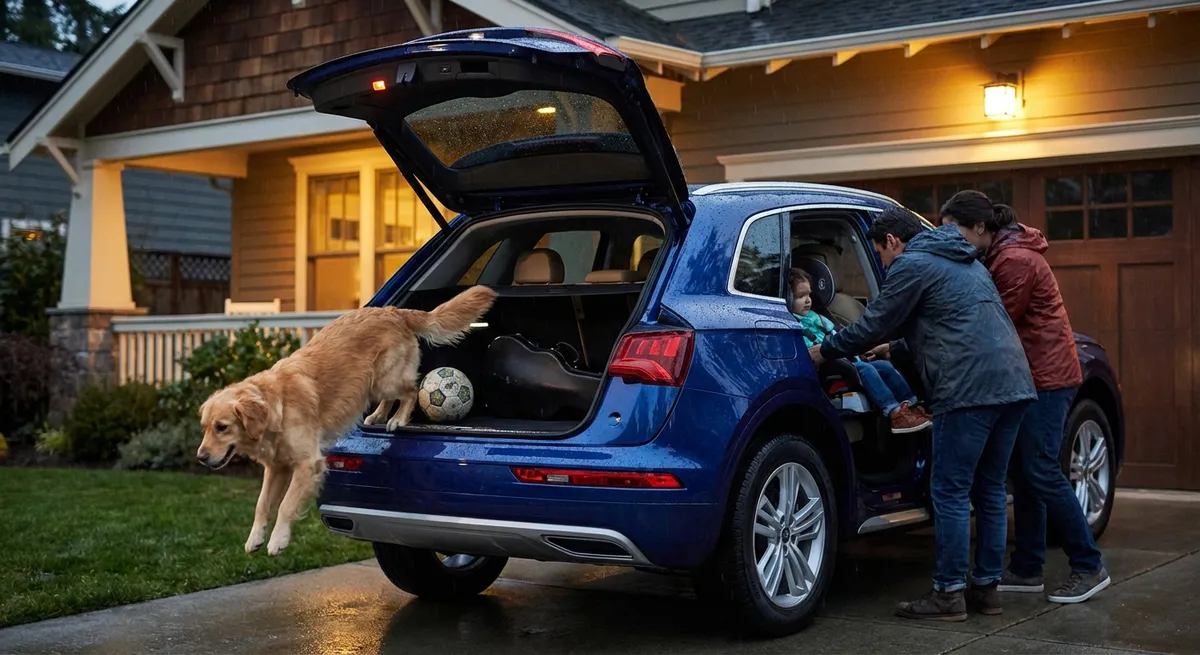
Families quickly learn that how you get into and out of an SUV matters as much as what it’s like to sit inside. We call this the “Graceful Entry” factor: a combination of door opening angle, sill height, roofline design, and handle placement that determines whether daily access feels composed or clumsy.
When reading reviews, look for notes on:
- Door swing and aperture: Wide-opening rear doors make installing child seats and loading toddlers much easier, particularly in tight parking spaces. Reviews that mention “excellent access to the second row” or “wide rear door openings” are quietly flagging family-friendly design.
- Step-in height: Too low and you stoop; too high and young children struggle to climb in. A balanced ride height allows adults to slide in without effort while giving kids a sense of independence.
- Head clearance at entry: Sloping rooflines are stylish but can lead to bumped heads when buckling a child into a rear-facing seat. Seek reviews that discuss “generous headroom” at door openings, not just when seated.
- Grab handles and door pulls: Sturdy, well-placed handles help older family members and children enter with confidence and stability. Reviews that reference “thoughtfully positioned grab handles” usually indicate careful ergonomic planning.
A sophisticated family SUV doesn’t just look elegant in the driveway—it allows everyone, from toddlers to grandparents, to enter and exit with poise.
Exclusive Insight #2: Cabin Calm as a Daily Luxury
Many SUV reviews mention road noise and refinement, but families experience “cabin calm” differently. It’s not merely how quiet the vehicle is; it’s how effectively it shelters occupants from the low-level fatigue of daily driving. On a long trip, this difference is noticeable: the SUV that still feels composed and soothing after three hours with children in the back stands apart.
When evaluating reviews, pay close attention to:
- Noise isolation at highway speeds: Look for mentions of “wind noise around the mirrors,” “tire roar on coarse pavement,” and “hushed cabin conversation at 70 mph.” These details matter when a napping child is in the third row.
- Vibration and ride quality: Firm suspensions can feel energetic on a brief test drive but become tiring over time. Reviews that call out “controlled yet supple ride” or “excellent absorption of sharp impacts” usually signal long-haul comfort.
- Airflow and climate subtlety: Families value HVAC systems that cool or heat efficiently without drafts or abrupt temperature swings. Reviewers who mention “even temperature distribution” and “quiet fan operation” are often calling out subtle but consequential advantages.
- Acoustic engineering beyond insulation: Laminated glass, active noise cancellation, and aerodynamic mirrors all contribute. When reviews specify these features—not just generic “quiet cabin” remarks—it indicates a more thoughtfully engineered environment.
In premium family life, calm is a prized commodity. An SUV that preserves it, even in traffic and on imperfect roads, carries more value than an extra inch of screen or a marginal horsepower gain.
Exclusive Insight #3: The “Third-Row Truth” That Spec Sheets Hide
On paper, the third row often looks generous. In reality, many “seven-seat” SUVs are best understood as “five-plus-two” solutions. Space charts and legroom figures rarely capture what matters: whether that third row is a realistic place for real people, for real distances, with real luggage in the back.
Refined family-focused reviews will discuss:
- Access with child seats installed: Many SUVs lose easy third-row access when a child seat occupies the second row. Look for language about “tilt-and-slide even with a car seat installed” or “dedicated walk-through second-row configuration.” This is where premium family usability reveals itself.
- Usable space for different ages: Reviews that test adults in the third row, not just children, give you a truer sense of room and posture. Phrases like “acceptable for adults for short trips” versus “genuinely adult-friendly third row” draw an important distinction.
- Luggage capacity with all seats in use: The cargo space behind the third row is crucial during airport runs, sports tournaments, or holidays. Reviews should specify how many carry-ons or duffel bags fit with all three rows raised, rather than quoting only maximum cargo volume with seats folded flat.
- Ceiling height and window design: A low roofline or small windows can make the third row feel confined, even if measurements look adequate. Sophisticated reviews often note “airy feel” or “light-filled third row,” which directly affects how comfortable children feel on longer journeys.
Families who frequently carry six or seven passengers need third-row honesty, not brochure optimism. A review that scrutinizes this space with the same seriousness as the driver’s seat is inherently more aligned with real-world family needs.
Exclusive Insight #4: Tech That Serves the Family, Not the Dashboard
In the current SUV landscape, glossy screens and long feature lists are common. The real differentiator isn’t how much technology is present, but how seamlessly it supports family life. A premium experience prioritizes clarity, restraint, and ease of use over novelty.
In well-considered SUV reviews, look for:
- Learning curve and distraction: Rather than merely applauding screen size, discerning reviewers describe how intuitive the interface is when driving, how easy it is to adjust climate or navigation with minimal glances, and whether there are physical controls for frequently used functions.
- Rear-seat tech experience: Families often place equal value on what’s available in the back. Reviews that mention rear USB-C ports at multiple seating positions, independent climate zones, and thoughtful phone storage reveal a more family-centric evaluation.
- Connectivity reliability: Apple CarPlay and Android Auto are commonplace, but implementation quality varies. Pay attention to comments about connection stability, wireless performance, and how quickly the system responds when first starting the vehicle.
- Update philosophy and longevity: Some modern SUVs support over-the-air updates that refine features over time. Reviews that discuss the brand’s software track record and update cadence help you anticipate how the SUV will age technologically.
The most sophisticated family SUVs fade into the background, making calls, navigation, and entertainment effortless rather than attention-seeking. Reviews that emphasize usability over spectacle are better aligned with how your family will actually live with the vehicle.
Exclusive Insight #5: Subtle Safety and Comfort Signals That Matter Over Years
Most SUV reviews now mention crash-test ratings and the presence of driver-assistance features. For families, that’s the starting point, not the finish line. The more revealing details are often the quieter ones: how assist systems behave in traffic, how predictable the brakes feel, and how gracefully the vehicle manages fatigue on both driver and passengers over time.
Seek out SUV reviews that thoughtfully address:
- Mannered driver-assistance behavior: Lane-keeping and adaptive cruise can be either confidence-inspiring or intrusive. Reviews that describe “natural-feeling steering assistance,” “smooth following distances,” and “predictable lane-centering” are highlighting daily livability, not just feature presence.
- Child-seat compatibility and anchor access: Multiple LATCH points, easily accessible top tether anchors, and wide-opening rear doors make safe installation simpler. Reviewers who test various child-seat configurations and mention “clear anchor labeling” and “no need to compress cushions” are providing a deeper level of safety insight.
- Seat design for endurance: A seat that feels comfortable for 20 minutes can become a nuisance after two hours. Look for commentary on lower-back support, thigh support, and adjustability for different body types. Families who regularly take journeys with mixed-age passengers benefit from truly supportive ergonomics for everyone.
- Predictable, linear controls: Brakes, steering, and throttle response should feel consistent and confidence-building, particularly when the vehicle is fully loaded. Descriptions like “progressive brake feel,” “stable in emergency maneuvers,” and “reassuring body control” are more than enthusiast language—they point to how composed the SUV will feel in unexpected situations.
Over years of ownership, these quieter qualities define your relationship with the vehicle. Reviews that honor these subtleties respect the reality that a family SUV is not just a purchase—it’s a long-term, moving companion.
Conclusion
When viewed through a truly family-centered lens, SUV reviews become far more than performance summaries and feature inventories. They transform into portraits of how a vehicle will integrate into your routines, your standards of comfort, and your expectations for safety and ease. By focusing on graceful entry, genuine cabin calm, honest third-row usability, tech that serves rather than distracts, and the subtler safety and comfort cues that reveal themselves over time, you gain a more sophisticated framework for evaluating any SUV review you encounter.
The most rewarding family SUV won’t necessarily be the one with the most dramatic statistics. It will be the one whose thoughtful details quietly support your life, day after demanding day, with the kind of refinement you notice most when everything simply works.
Sources
- National Highway Traffic Safety Administration (NHTSA) – Vehicle Safety Ratings - Official U.S. government crash-test ratings and safety information used to evaluate SUV safety performance
- Insurance Institute for Highway Safety (IIHS) – Ratings & Research - Independent crash-test data and detailed evaluations of crashworthiness and crash-avoidance technologies
- Edmunds – Car Seat Check and Family Car Reviews - Practical assessments of child-seat installation, rear-seat space, and family usability across many SUVs
- Consumer Reports – Guide to Car Safety Features - Explains modern safety and driver-assistance systems and how to interpret them in vehicle reviews
- Kelley Blue Book – Three-Row SUV Buying Guide - Overview of three-row SUV considerations, including third-row space and cargo usability for families
Key Takeaway
The most important thing to remember from this article is that this information can change how you think about SUV Reviews.