For families who approach major purchases with care and intention, an SUV’s safety rating is not a box to tick—it is a narrative to be read closely. Those neat rows of stars and scores conceal layers of engineering decisions, real‑world testing, and subtle trade‑offs that matter when you are entrusting a vehicle with the people you value most. Understanding what sits behind those ratings transforms safety from a marketing slogan into a quiet, confident standard woven into every school run, weekend escape, and late-night airport pickup.
Safety Ratings as a Design Philosophy, Not a Scoreboard
Most shoppers see safety ratings as a final verdict—five stars versus four, “Top Safety Pick” versus “meets minimum.” Discerning families, however, recognize that these ratings reflect a deeper design philosophy. A high score is rarely an accident; it is evidence of a manufacturer that prioritized crash structure, energy management, and restraint systems from the first sketch of the chassis.
Instead of asking, “How many stars does it have?”, a more revealing question is, “How did this vehicle achieve those stars?” For instance, look at how the brand discusses its safety strategy on its official site: do they speak in specifics (load paths, crumple zones, multi‑phase steels) or vague superlatives? Examine whether the vehicle performs consistently across diverse tests—moderate overlap, small overlap, side impact, roof strength, and rear collision whiplash protection—not simply in headline frontal crash results. Families attuned to these nuances see the ratings as a curated window into the brand’s priorities, and they reward those who engineer for the difficult tests, not just the easy wins.
The Hidden Weight of Structure: Geometry, Materials, and Occupant Space
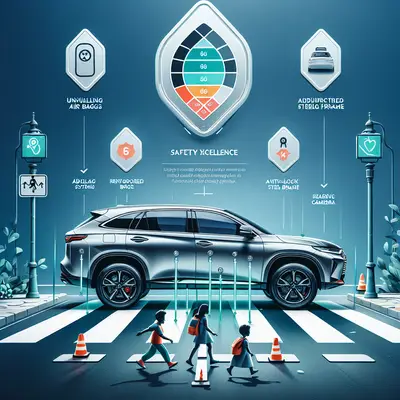
Beneath the leather stitching and ambient lighting lies the single most important silent guardian in an SUV: its structure. Safety ratings increasingly reward manufacturers that maintain a stable occupant cell—preserving survival space—even under severe deformation in crash tests. For a family, that preserved space is the difference between a cabin that collapses inward and one that keeps intrusion to a minimum around legs, feet, and chest.
Pay attention to how the structure is described in technical materials: high‑strength or ultra‑high‑strength steel, hot‑stamped components, and multi‑load‑path design all signal a deliberate approach. Ratings from agencies such as NHTSA and IIHS indirectly reveal structural integrity through their comments on intrusion measurements and dummy injury criteria. SUVs that excel here often show minimal footwell deformation and limited steering wheel movement in frontal tests, and robust roof strength relative to vehicle weight in rollover evaluations. For families, especially those with taller occupants or multiple car seats, this is not abstract engineering—this is about creating a protective architecture that surrounds everyone, in every seating position.
Second‑Row and Third‑Row Reality: Where Ratings Often Grow Quiet
Most safety ratings highlight the driver and front passenger. Yet family life rarely centers on the front row; it unfolds in the second and third rows, where children sleep, squabble, and snack. Discerning families look beyond front-seat performance to understand how well an SUV protects those who sit further back—because in a true family vehicle, the back rows should not be an afterthought.
Look for crash-test comments and detailed reports that mention rear occupant protection, side-curtain airbag coverage that extends to the third row, and seat-mounted thorax airbags that reach outboard passengers. Evaluate head restraint geometry and whiplash performance scores, which often vary significantly between rows. Additionally, seek out details on LATCH anchor placement, the number of full LATCH positions, and whether top tether anchors are easy to access without contorting around headrests or trim pieces. Families who scrutinize these subtleties ensure that every child, from the infant in a rear‑facing seat to the teenager in the third row, benefits from thoughtful, well‑tested protection.
Active Safety as a Seamless Co‑Pilot, Not a Distracting Gadget
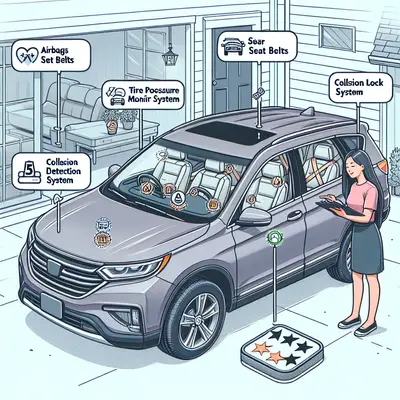
Modern safety ratings now incorporate active safety systems—those that help you avoid a crash altogether: automatic emergency braking, lane‑keeping assistance, blind‑spot monitoring, and more. However, the mere presence of a feature is not enough. Discerning families focus on how gracefully these systems integrate into everyday driving, and how rigorously they have been validated in independent testing.
Seek out ratings and evaluations that go beyond checkboxes to describe system behavior: Does automatic emergency braking detect pedestrians and cyclists as well as vehicles? Does lane centering work smoothly on curved roads, or does it oscillate and demand constant correction? Premium SUVs that understand their role as quiet co‑pilots deliver assistance in an unobtrusive, almost anticipatory manner—alert when needed, invisible when not. Look for models that pair strong independent test performance with an intuitive interface: clearly labeled driver-assistance menus, easily adjustable sensitivity settings, and steering‑wheel controls that you can operate by feel rather than by guesswork. For a family, this translates into fewer surprises, less driver fatigue, and a calmer cabin on long journeys.
Long‑Term Safety: How Well an SUV Ages with Your Family
A five‑star rating at launch is reassuring, but truly considered families think about how an SUV’s safety character will age over five, eight, or ten years. Safety is not only about crashworthiness—it is about maintaining control in adverse conditions, remaining mechanically sound, and continuing to receive critical software updates for key systems.
Study reliability data and recall histories from trusted sources to understand whether essential safety components—braking systems, electronic stability control, airbags, seat mechanisms—have a track record of durability. Examine how long a manufacturer supports over‑the‑air updates or dealer software refreshes for advanced driver-assistance features; a premium experience is one where your SUV becomes safer, not more obsolete, over time. Consider tires and braking distances as part of this long‑term picture, since ratings assume a vehicle in optimal condition. A family that schedules regular maintenance, chooses high‑quality replacement tires, and stays current with software and recall campaigns quietly sustains the safety promise made on the day of purchase.
Conclusion
When you move beyond the surface of safety ratings, the conversation shifts from stars and accolades to architecture, philosophy, and everyday reality. A discerning family does not simply collect labels like “Top Safety Pick+” or “5‑Star Overall Rating”; it interprets what those labels reveal about structure, seating, assistance technologies, and longevity. By reading the fine print behind each score—how the body preserves space, how the back rows are protected, how the SUV helps you avoid danger, and how it holds its integrity over time—you transform the act of choosing a family SUV into a quiet assurance. The result is not only a safer vehicle, but a more serene confidence every time you close the door, fasten a child’s belt, and drive into the day.
Sources
- [National Highway Traffic Safety Administration (NHTSA) – 5-Star Safety Ratings](https://www.nhtsa.gov/ratings) - Official U.S. government crash test results and explanations of frontal, side, and rollover ratings
- [Insurance Institute for Highway Safety (IIHS) – Vehicle Ratings](https://www.iihs.org/ratings) - Independent crash test data, including small overlap tests, roof strength, and rear crash protection
- [U.S. Department of Transportation – Child Safety Seat Information](https://www.nhtsa.gov/equipment/car-seats-and-booster-seats) - Guidance on child restraint systems, LATCH usage, and best practices for securing children in vehicles
- [Euro NCAP – Safety Assist and Crash Test Protocols](https://www.euroncap.com/en/vehicle-safety/) - Detailed procedures on active safety assessments and occupant protection in European testing
- [Consumer Reports – Guide to Car Safety & Reliability](https://www.consumerreports.org/cars-guide-to-car-safety/) - Comparative insights on safety performance, reliability trends, and real-world owner experiences
Key Takeaway
The most important thing to remember from this article is that this information can change how you think about Safety Ratings.