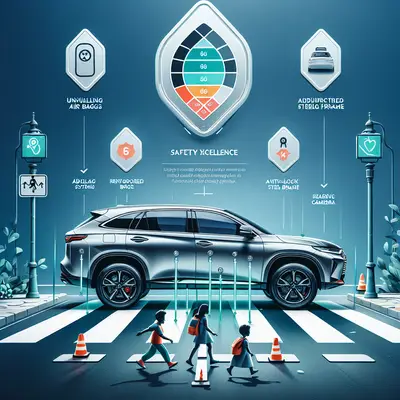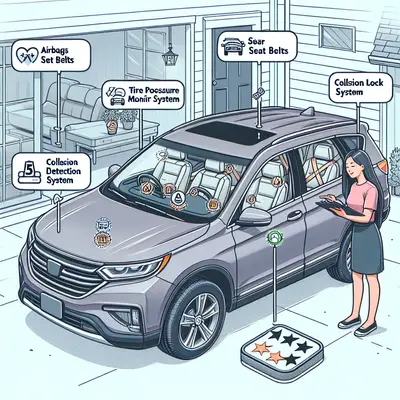
Safety ratings may look simple—stars, scores, colored bars—but for families choosing a premium SUV, those symbols are only the opening notes of a much richer composition. Behind every rating is a philosophy: how a testing organization defines “acceptable risk” for your children, your partner, and the people you care about most. When you understand that philosophy, you stop shopping by star count and start curating a safety experience that genuinely matches your family’s life.
This is where discerning parents quietly separate themselves from the crowd. Instead of asking, “Is this SUV safe?”, they’re asking, “Safe for whom? In which situations? According to whose standards?” The answers live in the details most shoppers never see—but once you know where to look, they’re impossible to ignore.
Insight 1: The “Crash Signature” Matters More Than the Overall Score
Every family SUV develops its own “crash signature”—a distinctive pattern of how it behaves in different types of collisions. Two SUVs with identical overall ratings can protect occupants in very different ways. One may excel in moderate frontal impacts but quietly underperform in small overlap crashes that mimic clipping a guardrail or hitting a pole. Another may be near-perfect in side-impact performance but reveal weaknesses in rear impact and whiplash protection.
For families, the art is in matching this crash signature to your real-world driving environment. Do you spend most of your time on congested urban streets with frequent intersections and side-impact risk? Or long stretches of highway where higher-speed frontal collisions are more relevant? Diving into sub-scores—frontal, small overlap, side, rear, and roof strength—allows you to shape your selection around actual risk exposure instead of trusting a single aggregated rating. Sophisticated buyers don’t chase the “best number”; they curate the safest pattern.
Insight 2: Child Occupant Protection Is Not a Footnote—It’s a Parallel Score
Many safety reports treat children as a secondary metric, but for families, child occupant protection deserves to stand beside adult safety as an equal pillar, not a footnote. Look for test protocols that evaluate child dummies in multiple seating positions, with different types of restraints, and in both frontal and side impacts. This is where the subtleties emerge: head excursion limits, chest loading, and how well the vehicle structure and airbags cooperate with real-world child seats.
Pay particular attention to how rating agencies describe ease of installing child restraints. A vehicle can test well with perfectly mounted test seats in a lab yet make everyday installation clumsy or error-prone. Hidden anchor points, overly deep seats, or sculpted cushions that fight against secure installation can quietly degrade real-world safety, even if the headline score appears reassuring. In a truly family-centric SUV, child safety is not merely compliant—it is elegantly intuitive.
Insight 3: Active Safety Systems Are Graded on Subtlety, Not Just Presence
Most spec sheets now boast a familiar alphabet soup: AEB, LKA, ACC, BSD. The sophisticated family buyer knows that the presence of these systems means far less than how gracefully they behave. Advanced driver-assistance systems are increasingly evaluated not just on whether they exist, but on how consistently—and predictably—they intervene. Braking that activates too late or lane-keeping that “ping-pongs” between markings may technically earn a pass, but in daily use it can erode driver confidence rather than enhance it.
Look closely at testing notes that describe performance in edge cases: pedestrians at night, cyclists emerging from between vehicles, vehicles stopping unexpectedly ahead. The best SUVs achieve a subtle harmony: they support rather than surprise, complement rather than control. For a family driver managing noise, questions, snacks, and schedules, the difference between clumsy assistance and polished intervention can be the invisible margin that prevents a collision in the first place.
Insight 4: Structural Integrity Is About How an SUV Deforms, Not Whether It Does
All vehicles deform in a crash; the question is how intelligently they do it. The strongest family SUVs are designed not to resist impact at all costs, but to manage it with intention—directing forces away from the occupant cell while preserving legroom, headroom, and survivable space. Sophisticated safety evaluations now extend beyond simple intrusion measurements to examine how consistently that space is preserved across multiple impact types and occupant sizes.
Watch for comments on “structural kinematics” and “deformation patterns.” These describe how the vehicle’s safety cage holds up under asymmetric or offset loads, which are far more representative of real-world crashes than a perfectly centered impact. Vehicles that maintain a stable cabin environment, with limited steering-column intrusion and predictable airbag deployment, offer a quieter kind of assurance: that in the most chaotic moments, the interior world your family inhabits remains remarkably intact.
Insight 5: Occupant Compatibility and Visibility Are the Overlooked Safety Multipliers
Safety ratings often focus on how well an SUV protects its own occupants, but a truly refined approach also considers how that vehicle behaves in the broader ecosystem of traffic. Some evaluators now look at “compatibility”—how an SUV’s front-end design, bumper height, and structural stiffness affect smaller vehicles and pedestrians. A thoughtfully engineered family SUV aims to reduce harm in both directions: exceptional protection inside, tempered aggression outside.
Equally crucial, yet often underappreciated, is visibility. High-resolution camera systems, well-calibrated surround-view monitoring, and carefully tuned LED headlamps are increasingly evaluated in sophisticated safety protocols. Beyond headline brightness, details like beam spread, glare control, and realistic camera distortion correction all shape how confidently a driver can read their surroundings. For a parent reversing out of a busy school parking lot or navigating a dimly lit suburban cul-de-sac, these refinements can quietly outpace the impact of a single crash test result.
Conclusion
When you approach SUV safety ratings as a connoisseur rather than a casual browser, the landscape changes. The conversation moves beyond star counts and into nuance—crash signatures, child protection philosophies, the character of driver-assistance systems, and the elegance of structural and visibility engineering. This is where premium family SUVs begin to distinguish themselves in ways a simple chart cannot capture.
For families who see their vehicle as a moving sanctuary, safety is not a checkbox; it is a curated experience built from many finely tuned decisions. Understanding the deeper language of safety ratings allows you to choose not merely a “safe” SUV, but one whose protection profile aligns seamlessly with how—and with whom—you actually drive.
Key Takeaway
The most important thing to remember from this article is that this information can change how you think about Safety Ratings.