Choosing a family SUV today is less about sheer size or screen count and more about how gracefully a vehicle supports the life lived within it. The most satisfying choices are rarely the loudest on a spec sheet; they are the models that quietly anticipate your family’s rhythms, protect your time, and preserve your calm. This guide steps beyond the obvious checklists to focus on the subtle, high-impact considerations that truly distinguish a sophisticated family SUV.
The Art of Cabin Calm: Beyond Simple Quietness
Noise levels in a family SUV are often treated as an afterthought, yet they profoundly shape every journey. Silence here is not merely the absence of sound; it is the careful management of it. Look for laminated (acoustic) glass in the front windows and windshield, comprehensive door sealing, and targeted insulation around the wheel wells—areas where road roar typically seeps in.
More premium models integrate active noise cancellation, using microphones and audio processing to neutralize low-frequency hums from the road and engine. This matters on long motorway drives, where fatigue often arises less from distance and more from background noise. A calmer cabin allows for softer conversations, clearer navigation prompts, and more relaxed children—especially when naps and audiobooks are part of the family routine.
If possible, request an extended test drive and specifically assess sound quality at 60–70 mph on various surfaces. Turn off the stereo and listen for wind around mirrors, tire noise over coarse asphalt, and engine behavior during gentle acceleration. What feels “fine” in a short city test can become tiring over years of ownership. A genuinely quiet, composed cabin is one of the most enduring luxuries an SUV can offer a family.
Intelligent Space, Not Just Big Space
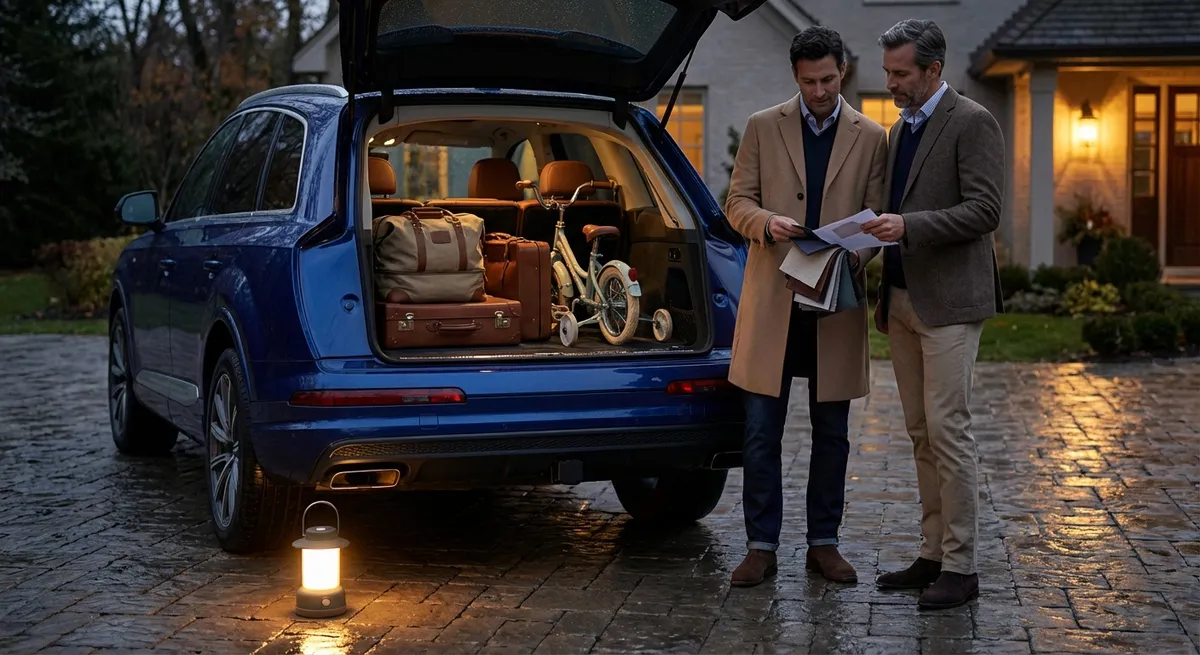
Many SUVs advertise impressive cubic feet of cargo space, yet live smaller than their numbers suggest. The difference lies in how intelligently that space is shaped and accessed. Families benefit less from theoretical volume and more from thoughtful, usable geometry.
Assess the load floor height: a lower, flatter floor makes it easier to lift strollers, scooters, and weekly shopping without awkward angling. Notice whether the wheel arches intrude into the cargo bay, complicating the loading of wide items. Split-folding rear seats that fold nearly flat—and can be released from the cargo area—offer genuine everyday convenience, especially when juggling children and bags simultaneously.
In the second row, pay attention to seat travel and adjustability. Sliding and reclining bench seats or individual captain’s chairs can transform the space, making room for a rear-facing child seat without crushing front-passenger legroom. Check how easily you can access the third row with a child seat installed in the second; some SUVs offer a clever “tilt-and-slide” function that works even with an anchored seat, while others require full removal.
Subtle storage solutions also matter: a dedicated space for a handbag or laptop, a hidden compartment for valuables when parking at a sports ground, a neatly integrated area for charging cables and tablets. True practicality is about how gracefully the SUV works with your routine, not simply how much it can carry.
Quietly Competent Safety: Layered Protection That Feels Natural
Modern SUVs are rich with safety technology, but families should distinguish between systems that merely tick regulatory boxes and those that subtly enhance confidence without intruding. The most refined implementations are almost invisible when you drive well, stepping in only when genuinely needed.
Seek out models that have strong crash-test performance from both the National Highway Traffic Safety Administration (NHTSA) and the Insurance Institute for Highway Safety (IIHS), paying particular attention to side-impact ratings and pedestrian protection where available. However, go further than star counts and labels: examine how the advanced driver assistance systems (ADAS) actually behave on the road.
On your test drive, sample adaptive cruise control and lane-centering assistance on a lightly trafficked road. Note whether steering corrections feel smooth and predictable or twitchy and abrupt. Does the forward collision warning activate only when appropriate, or does it cry wolf in everyday traffic? For families, the ideal system reduces cognitive load without undermining the driver’s sense of control.
Additionally, explore the ease of installing and checking child seats. Multiple ISOFIX/LATCH anchors, clear markings, and accessible top tether points turn a weekly struggle into a simple ritual. Some premium SUVs include rear-seat reminder alerts if a rear door was opened before departure—an understated but meaningful safeguard during busy days and disrupted routines.
Technology That Refines, Not Dominates
A sophisticated family SUV should offer technology that quietly serves you, not demand constant attention. Screen size alone is a poor proxy for quality; the layout, responsiveness, and logical flow of the interface matter more than diagonal inches.
During your evaluation, focus on three things: intuitiveness, distraction level, and longevity. Can you operate climate controls, change audio sources, and adjust navigation without diving through multiple layers of menus? Physical knobs or toggles for core functions (temperature, volume, demist) remain a strong marker of considerate design, particularly when driving with children in the back and attention already divided.
Wireless Apple CarPlay and Android Auto can be extremely valuable for families, reducing cable clutter and making it simple to hand off navigation or media duties between drivers. However, test how quickly your phone reconnects after short stops and whether the system ever freezes or lags. Over-the-air software update capability is another subtle advantage, allowing the SUV’s digital experience to improve over time rather than age prematurely.
Finally, consider rear-seat tech with intention. Built-in screens can look impressive but may lock you into aging hardware. In many cases, robust rear USB-C ports, integrated tablet holders, and a strong in-car Wi-Fi hotspot offer a more future-proof, flexible solution that adapts to your children’s changing ages and devices.
Driving Character That Respects the Family Pace
Performance in a family SUV is not about headline acceleration figures but about how confidently and comfortably it carries your loved ones through everyday life. The most satisfying models blend composed ride quality, measured power, and reassuring predictability.
Begin with the suspension. Look for a ride that rounds off sharp edges—speed bumps, patched tarmac, drain covers—without feeling vague or floaty. Some premium SUVs offer adaptive damping or selectable drive modes that subtly tailor the ride and steering for different scenarios, from urban school runs to weekend motorway trips. Test how the car behaves with a full complement of passengers and luggage, not just an empty cabin.
Steering feel is another understated virtue. You want light, precise steering at low speeds for easy parking and school gates, with enough stability at higher speeds to avoid constant micro-corrections. Pay attention to how the SUV behaves in tight multi-storey car parks and on narrow residential streets, especially if you are moving up in size from a smaller vehicle; all-round parking sensors and a high-resolution 360-degree camera can make a larger SUV feel instantly more manageable.
Powertrains deserve careful scrutiny, particularly if you are considering hybrid or electric options. For a refined family experience, prioritize smoothness and predictability over raw output. In hybrids, ensure that the transition between electric and petrol power is nearly seamless. In fully electric SUVs, note not only range but also how the vehicle manages climate control, especially in extreme temperatures—your family’s comfort should not be sacrificed to eke out a few extra miles.
Conclusion
A sophisticated family SUV is not defined by a single headline feature but by a constellation of quietly thoughtful decisions: a cabin that tempers the outside world, space that adapts elegantly to changing needs, safety systems that protect without nagging, technology that feels timeless rather than trendy, and dynamics that soothe rather than startle. When these elements align, an SUV becomes more than transport—it becomes a calm, capable backdrop to the evolving story of family life.
Approach your search not as a race to the most features, but as a careful curation of the details that will genuinely matter to your household over the next decade. In doing so, you elevate every journey—from dawn school runs to late-night returns from weekend adventures—into something quietly, consistently exceptional.
Sources
- NHTSA – 5-Star Safety Ratings - Official U.S. government crash-test ratings and safety information for passenger vehicles
- IIHS – Ratings & Evaluations - Independent crashworthiness and crash-avoidance ratings for SUVs and other vehicles
- EPA – Fuel Economy Guide - Official fuel economy data for petrol, hybrid, and electric SUVs in the U.S.
- Edmunds – Car Noise Levels Explained - Overview of cabin noise, sound insulation, and their impact on driving comfort
- Consumer Reports – Guide to Advanced Safety Features - Detailed explanations of modern driver assistance systems and how they work in real-world driving
Key Takeaway
The most important thing to remember from this article is that this information can change how you think about Buying Guide.