For many families, safety ratings have become the quiet deal‑maker—or deal‑breaker—behind every SUV purchase. Yet for all the stars, scores, and acronyms, much of what truly distinguishes a safe family SUV from a merely adequate one lives in the fine print. The difference isn’t always dramatic on a spec sheet, but in a real‑world moment that matters, those subtleties can feel enormous.
Understanding how safety ratings are created—and what they sometimes overlook—allows you to shop not just by headline scores, but by the deeper engineering decisions that protect your family every day. Below, we explore five exclusive insights that help you see beyond the badge and into the substance of a genuinely protective family SUV.
1. Why a “Perfect” Score Doesn’t Always Mean Perfect for Your Family
Two SUVs can both earn top safety ratings and yet behave very differently in the situations that actually matter to your household. Ratings from organizations like NHTSA and IIHS are standardized, which is valuable for comparison, but your family is not standard: you may have multiple car seats, a tall driver, a shorter co‑driver, aging parents who ride in the second row, or teens who prefer the third row. Each of these realities changes how the vehicle’s safety engineering interacts with real occupants.
What the ratings rarely reveal is how consistently the vehicle protects every seating position. For instance, some SUVs deliver excellent front crash performance but only modest side‑impact protection in the third row. Others shine in front passenger protection but compromise headroom, making proper head‑restraint positioning difficult for taller teens. As you interpret scores, pair them with questions like: How many people will we genuinely carry most of the time? Which rows will children or grandparents actually use? An SUV that is “top rated” in a lab might feel less than ideal once you overlay the pattern of your daily life onto its cabin layout and restraint systems.
2. The Quiet Power of Structure: Crash Engineering You Never See
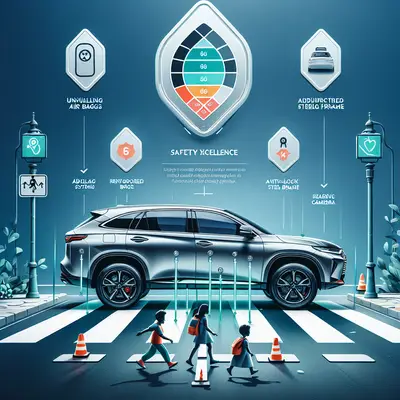
Behind every star rating is an invisible architecture of steel, aluminum, and energy‑absorbing pathways that decide where impact forces travel in a collision. Modern family SUVs use highly advanced structures—multi‑phase steels, carefully tuned crumple zones, and reinforced safety cages—but not all approaches are equal. The most thoughtfully engineered SUVs manage an elegant balance: they allow controlled deformation in the right places to absorb energy, while preserving a rigid survival cell around the occupants.
What safety ratings don’t fully capture is how this structure behaves across a spectrum of crash types, speeds, and angles beyond test standards. A vehicle that performs brilliantly in small overlap frontal tests, for example, often reveals meticulous effort in load path design—how energy is routed around the cabin instead of into it. Families should pay attention to crash test commentary, not just scores: references to minimal cabin intrusion, stable structures, and well‑managed deformation indicate an SUV whose safety engineering is deeply considered, not merely tuned to “pass the test.” This structural integrity becomes especially important on crowded highways and in multi‑vehicle collisions, where impacts rarely arrive in perfect, predictable forms.
3. Advanced Driver Assistance: When More Features Don’t Equal More Safety
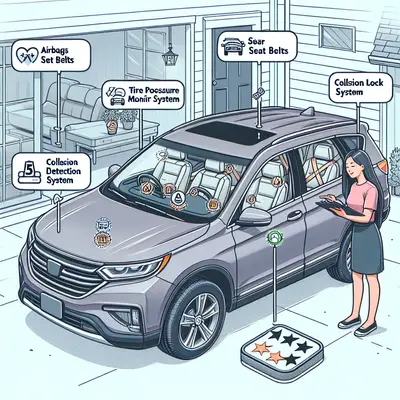
The modern family SUV often reads like a technology showcase: adaptive cruise control, lane‑keeping assistance, automatic emergency braking, blind‑spot monitoring, and more. It is tempting to equate a longer feature list with superior safety, but the real measure is not how much technology is present—it is how well it all works together, and how naturally it integrates into everyday driving.
Premium‑feeling safety tech is discreet, predictable, and confidence‑inspiring. The best systems intervene gently but decisively, support (rather than fight) your driving inputs, and avoid a constant stream of false alarms that erodes trust. Look for details such as smooth braking when automatic emergency systems activate, lane‑keeping that centers the vehicle without “ping‑ponging” between lines, and blind‑spot alerts that are visible yet unobtrusive at night. Importantly, investigate whether the vehicle’s safety systems are standard or hidden in packages; a model with a flawless rating in its most expensive trim may provide a meaningfully different level of real‑world safety in a lower‑spec version. For a family SUV, consistency of protection across the range matters as much as innovation.
4. Child Seat Realities: The Part of Safety Ratings You Must Test Yourself
Formal safety ratings rarely tell the full story for the youngest passengers—the ones many families are most intent on protecting. Crash tests are typically run with adult‑sized dummies, and while organizations are beginning to incorporate child safety metrics, the practical experience of installing and using car seats remains largely overlooked in headline scores.
Here, small engineering decisions create outsized day‑to‑day consequences. LATCH anchor accessibility, seat contouring, angle adjustability, and third‑row access can determine whether you can achieve a rock‑solid, safe car‑seat installation without acrobatics—or not. Some of the safest SUVs on paper can be frustrating in practice when you attempt three car seats across a row or a combination of boosters and rear‑facing seats. When evaluating safety, treat a “test fit” of your actual child seats as essential. Observe how much effort it takes to tighten the installation, whether seatbelt buckles are easily accessible between boosters, and whether tether anchors are sensibly placed for all rear rows. A truly family‑friendly SUV doesn’t just protect well in a lab; it enables you to use child restraints correctly every single time.
5. The Overlooked Art of Visibility and Escape
Not all critical safety features are digital or structural. Some of the most meaningful protections are surprisingly analog: outward visibility, cabin layout, and how quickly you can exit or access the vehicle in an emergency. While crash tests simulate impact performance, they don’t rate how easily a panicked teenager can reach a door handle after a minor collision, or how well a driver can see a child running behind the vehicle in a crowded school pickup lane.
Pay close attention to sightlines from every seating position. A thoughtfully designed family SUV will pair wide glass areas with intelligently shaped pillars, minimizing blind spots without sacrificing structural strength. Interior ergonomics also matter: simple, clearly labeled child locks; rear doors that open wide for swift access to car seats; third‑row mechanisms that fold and slide intuitively; and a cargo area that allows quick retrieval of emergency gear without unpacking the entire trunk. These are subtle design choices that rarely surface in safety scores, yet they directly influence how deftly your family can respond when something unexpected happens—on the road or at the curb.
Conclusion
Safety ratings are a powerful starting point, but they are not the full story. For families, the real measure of a safe SUV lives at the intersection of test‑lab performance and everyday elegance: how intuitively the vehicle protects, how naturally its technology supports you, and how effortlessly your loved ones fit, ride, and exit.
By looking beyond the stars—into structure, technology execution, child‑seat practicality, and the quiet art of visibility and escape—you move from simply buying a “top‑rated” SUV to choosing a thoughtfully engineered sanctuary on wheels. In that space between numbers and nuance lies the true premium: a family SUV that feels as protective as it is refined, every mile you share together.
Key Takeaway
The most important thing to remember from this article is that this information can change how you think about Safety Ratings.