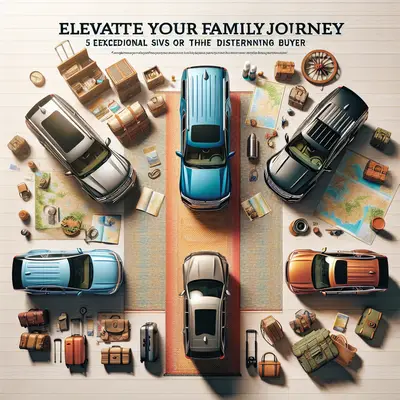
The internet is once again awash with stories of holiday travel unraveling in real time—overstuffed airports, missed connections, and parents attempting to entertain overtired toddlers beneath fluorescent departure boards. A recent viral roundup of “travel gadgets for anyone already mentally preparing for the chaos of holiday travel” captures the mood perfectly: it’s peak season for stress, delays, and improvisation. But while social feeds fixate on clever packing cubes and noise‑canceling headphones, there’s a more fundamental travel upgrade quietly reshaping how families navigate this season: the right SUV.
For many households, the family SUV has become the private lounge that begins where the boarding gate ends—a controlled, comfortable, and beautifully equipped space that shields children from crowds, manages luggage with ease, and turns long drives into something closer to a well‑planned escape than an ordeal. In a world where even short trips can feel like a logistical campaign, the priorities of discerning families are shifting. They’re less impressed by headline horsepower, and far more attuned to cabin calm, intuitive tech, and the small, thoughtful touches that keep chaos at bay.
Below are five exclusive, timely insights shaped by today’s viral travel anxieties—exactly what families should be looking for in their next SUV if they want holiday‑level resilience all year round.
1. Quiet Comfort Is the New First‑Class Upgrade
Scroll through today’s travel threads and a pattern emerges: everyone is chasing pockets of calm. Noise‑canceling headphones are selling out; parents are exchanging tips on how to create “a cocoon” for kids in the midst of crowded terminals. That same instinct should drive how you evaluate an SUV cabin.
In 2025, the most impressive family SUVs—from models like the BMW X5 and Genesis GV80 to the latest Toyota Grand Highlander—are engineered around acoustic serenity. Look for laminated side glass, extensive door and floor insulation, and active noise cancellation systems that function like built‑in headphones for the entire cabin. Sophisticated families are also paying close attention to seat design: multi‑way power adjustment, extendable thigh supports, supple leather or high‑grade synthetic upholstery, and heating/ventilation that works for both front and second rows. The difference on a five‑hour interstate run is profound. Pair that with dual‑zone (or ideally tri‑zone) climate control and discreet, roof‑mounted vents that don’t blast air directly at small passengers, and you begin to create something rare in family travel: a space where everyone, including the driver, can exhale.
2. Cabin Layout Now Matters More Than Cargo Specs on Paper
Holiday‑travel gadget lists obsess over how to stuff more into less. Families talk about modular packing cubes and “personal item Tetris.” In SUVs, that same psychology has led to a quiet but meaningful shift: savvy buyers now value interior flexibility over raw cargo‑volume bragging rights.
Instead of simply checking the cubic feet behind the third row, examine how intelligently space is used. Can the third row fold flat with a single pull, as in the Kia Telluride and Hyundai Palisade, or does it require wrestling with headrests and latches? Does the second row slide forward enough to balance legroom between teens and younger children in child seats, the way it does in the Volvo XC90 and Honda Pilot? Are there under‑floor storage wells for stowing wet boots, travel strollers, or the inevitable overflow of holiday gifts? Pay attention to how many configurations are realistically usable, not just theoretically possible. The best layouts feel almost choreographed: you can reconfigure the cabin with one hand while holding a coffee in the other, without waking a sleeping child or rearranging half the cargo area.
3. Seamless Tech Integration Is Worth More Than Another Screen
This season’s viral travel coverage is full of gadget fatigue: too many cables, too many apps, too many devices that don’t quite talk to each other. Families are becoming sharply aware that more technology does not automatically mean a better experience—on the road or in the air.
In SUVs, look beyond screen size and focus on refinement and integration. Wireless Apple CarPlay and Android Auto should connect quickly and stay stable; the premium experience is when your preferred navigation, playlists, and messaging just appear without negotiation every time you start the car. Multiple USB‑C ports—ideally in all three rows, as seen in the latest Chevrolet Traverse and Subaru Ascent—are no longer a luxury, but the digital equivalent of cupholders. Rear entertainment systems, once a centerpiece, are now less critical than the quality of the Wi‑Fi hotspot, the smoothness of Bluetooth audio handoff, and the simplicity of parental control settings. For the driver, a crisp head‑up display and a clean, configurable digital instrument cluster matter more than a visually overwhelming central screen. The true luxury is technology that fades into the background, doing its job flawlessly so you can focus on the road and the people in the car.
4. Real‑World Safety Systems Are the “Travel Insurance” You Actually Feel
As stories of airline disruptions and frazzled crowds trend across social media, there’s plenty of discussion about travel insurance and backup plans. Yet the most tangible “insurance” for family travel is embedded in modern SUVs: active safety and driver‑assistance systems that deliver quiet confidence when conditions are less than ideal.
Families should insist on a robust suite of advanced safety features—forward collision warning with pedestrian and cyclist detection, automatic emergency braking, blind‑spot monitoring that covers trailers, rear cross‑traffic alert, and adaptive cruise control with smooth, natural behavior. The latest systems from automakers like Toyota (Safety Sense), Honda (Sensing), and Hyundai/Kia (Drive Wise) demonstrate how far this technology has come; lane‑centering and traffic‑jam assist can meaningfully reduce fatigue in congested holiday traffic. But an elegant execution is critical. You want alerts that are clear but not shrill, steering assistance that feels collaborative rather than intrusive, and the option to tailor sensitivities. The sweet spot is an SUV that quietly supports you through a seven‑hour stormy drive, not one that constantly scolds you for minor infractions.
5. Premium Details That Turn “Travel Day” Into “Family Ritual”
The most compelling travel‑gadget pieces succeed because they understand something fundamental: families don’t just want to survive holiday chaos; they want to elevate it, turning necessary journeys into experiences with a touch of ceremony. The same is now true for high‑end family SUVs, where subtle details increasingly define perceived value.
Survey the options list through that lens. A panoramic sunroof that floods the cabin with winter light can transform a grey, late‑afternoon drive home. Ambient lighting—tastefully executed, as in Mercedes‑Benz and higher‑trim Hyundai and Kia models—creates a lounge‑like atmosphere when night falls. A truly high‑end audio system from brands like Harman Kardon, Bose, or Bowers & Wilkins makes shared playlists feel curated rather than chaotic. Small touches matter: a power liftgate with hands‑free operation when your arms are full of luggage, a rear sunshade for napping toddlers, a cooled center console for drinks, or a “quiet mode” audio setting that keeps front‑row podcasts from overwhelming rear‑seat sleepers. These are not mere indulgences; they’re the fine details that turn every departure—from the school run to the annual road trip—into something you anticipate instead of endure.
Conclusion
As today’s viral holiday‑travel stories make abundantly clear, modern family life is defined as much by the journeys between places as by the destinations themselves. While the internet races to recommend the cleverest new packing accessory, the most transformative travel upgrade for many families is parked in their driveway: a thoughtfully chosen SUV that tames chaos through comfort, design, and understated technology.
For those shopping right now, the lesson is simple. Don’t be distracted by spec‑sheet theatrics or oversized grilles; instead, evaluate an SUV the way you would a well‑run hotel during peak season. Is it calm when the world outside is not? Does it accommodate your family’s rhythms with grace? And does it feel, in the small, refined details, like it was engineered by people who have actually traveled with children? Choose well, and the next time holiday chaos trends online, your family’s story might feel very different—quiet, comfortable, and blissfully unremarkable.
Key Takeaway
The most important thing to remember from this article is that this information can change how you think about SUV Reviews.