For families who expect more than marketing headlines and crash-test stars, safety ratings are not simply numbers—they are signals. Beneath each symbol and score lies a story about how thoughtfully an SUV has been engineered to protect what matters most. This guide is crafted for the discerning family that values calm clarity over noise, and insight over hype. Rather than revisiting the usual talking points, we’ll explore five underappreciated dimensions of safety ratings that can elevate your next SUV decision from adequate to quietly exceptional.
Looking Beyond the Overall Score: The Anatomy of a “Safe” SUV
Most buyers focus on an SUV’s overall crash-test rating, but that single figure can obscure important nuances. The overall score is often an average of multiple tests—frontal, side, rollover, and, increasingly, advanced scenarios such as small-overlap crashes. A vehicle may perform superbly in frontal impacts but only moderately in side or rear evaluations, or vice versa. For a family that regularly carries children in the second and third rows, how the cabin holds its shape in side and rear crashes can be just as critical as frontal performance.
What truly matters is the consistency of the vehicle’s performance across categories, not one shining number masking weaker areas. When reviewing ratings, pay attention to sub-scores: front vs. side impact, head and neck injury metrics, and how the roof structure behaves in a rollover scenario. A refined choice often favors the SUV that avoids any clear weaknesses, offering well-balanced protection rather than flashy excellence in only one test. This more holistic reading turns safety from a checkbox into a carefully considered attribute of your family’s daily environment.
The “Invisible” Safety Engineering: Structural Integrity and Cabin Preservation
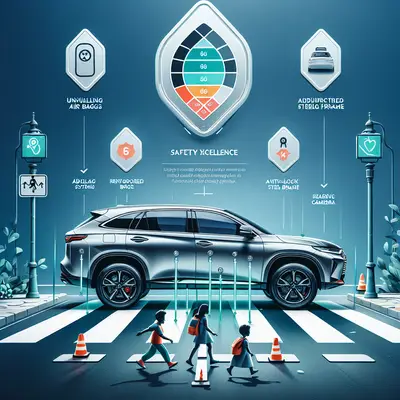
The most elegant safety feature is the one you never notice—because it quietly does its job long before airbags deploy. Safety ratings increasingly reward SUVs that preserve cabin space during impact, protecting the survival cell where you and your family sit. This is an area where engineering sophistication reveals itself: strategic use of high-strength steel or aluminum, thoughtfully engineered crumple zones, and reinforced door frames that work in concert to manage crash forces away from occupants.
Families should pay close attention to how well a vehicle maintains its interior geometry in crash tests. Details like intrusion measurements at the footwell or steering column, and how much the door frame deforms, can be telling. In a premium-minded SUV, engineers often tune the structure not only to pass tests, but to preserve occupant space with minimal deformation, reducing the likelihood of leg, chest, and head injuries. Safety reports that highlight “good structural performance” or “minimal cabin intrusion” are subtle but powerful indicators that the vehicle has been designed with a deeply considered safety philosophy rather than a bare-minimum approach.
Seating Position, Restraints, and the Reality of Family Use
Safety ratings tend to spotlight the front seating positions, but family life rarely confines itself to the first row. Children, grandparents, carpool passengers—most will be traveling in the second or third row, where protection can differ significantly. This is one of the most under-discussed aspects of safety ratings, and one that refined families increasingly prioritize.
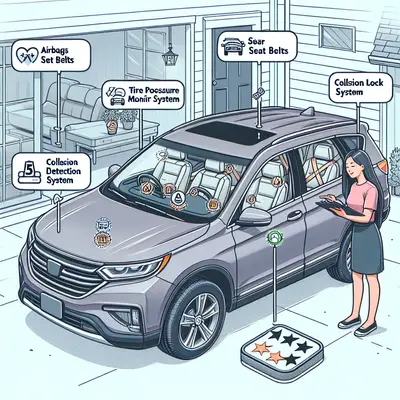
When considering an SUV, study how rating agencies assess second-row and, where tested, third-row protection. Look for evaluations of rear-seat restraints, head restraints, and side-impact protection for outboard and center seats. Some modern SUVs now incorporate advanced rear-seat seatbelt features (like load limiters and pretensioners) and rear side airbags, innovations that can markedly improve safety but are easy to overlook in a brochure. Additionally, if you use child seats, examine how well the LATCH anchor positions and seat design accommodate safe, tight installations. True safety for a family SUV is not just how well the driver is protected—it is how gracefully every seating position is considered and defended.
Advanced Driver Assistance: Distinguishing Support from Spectacle
Driver-assistance technology has become a core part of safety ratings, but not all systems are created or evaluated equally. While many SUVs list a familiar suite—automatic emergency braking, lane-keeping assist, blind-spot monitoring—the refinement of these systems and their real-world consistency are where ratings begin to diverge. Thoughtfully calibrated systems work quietly in the background, offering subtle corrections and well-judged alerts that reduce fatigue without constantly intruding on the driving experience.
When you review safety ratings, look for distinctions between basic availability and verified performance. Some evaluations now test how effectively a vehicle can avoid or mitigate collisions with vehicles, pedestrians, and cyclists, both during the day and at night. Ratings may also differentiate between systems that merely warn and those that actively intervene. For a family that often drives in changing weather, dense traffic, or busy urban environments, these nuances matter. The most reassuring SUVs pair high technical scores with a reputation for intuitive, predictable driver-assistance behavior—technology that feels like a composed co-pilot rather than a nervous backseat driver.
Long-Term Safety Confidence: Headlight Quality, Night Driving, and Future-Proofing
Many families underestimate how much night-time visibility contributes to real-world safety. Ratings increasingly include headlight performance, and the differences can be surprisingly significant. Well-rated headlights are not just brighter; they are more precisely shaped to illuminate the road without blinding oncoming drivers, enhancing your ability to spot hazards early. For families who drive before sunrise, after school activities, or on unlit suburban or rural roads, this is a quiet yet consequential factor.
Another subtle dimension is how well an SUV’s safety suite is positioned for longevity. Vehicles that earn top ratings today often feature over-the-air update capability for their driver-assistance systems, allowing refinements over time rather than locking you into the technology of the model year. Consider whether the SUV rigorously meets or exceeds current regulatory and independent standards, and whether its safety philosophy appears future-looking rather than just compliant. The most satisfying choice will feel not only safe on delivery day, but also reassuringly current several years into family life—a stable, evolving sanctuary on the road.
Conclusion
Safety ratings, when read with a practiced eye, reveal far more than a row of stars or a headline badge. For families who value discretion, refinement, and genuine protection, the goal is not simply to chase the highest number—it is to understand the character of a vehicle’s safety engineering. By looking past the overall score, examining structural integrity, considering every seat in the cabin, scrutinizing driver-assistance performance, and appreciating the nuances of night-time visibility and long-term relevance, you elevate your SUV choice from “well-reviewed” to deeply considered.
The result is not just a safer vehicle on paper, but a daily driving experience imbued with quiet confidence: a cabin where each journey, from school run to weekend escape, feels thoughtfully safeguarded by design.
Sources
- National Highway Traffic Safety Administration (NHTSA) – 5-Star Safety Ratings - Official U.S. government crash-test ratings and explanations of frontal, side, and rollover tests
- Insurance Institute for Highway Safety (IIHS) – Vehicle Ratings - Independent crash-test and crash-prevention evaluations, including small-overlap tests, headlight ratings, and child seat LATCH ease-of-use
- IIHS – Rear-Seat Safety Research - Discussion of evolving rear-seat crash testing and protection for second-row occupants
- U.S. Department of Transportation – Vehicle Safety Information - Overview of federal vehicle safety initiatives and regulatory frameworks
- European New Car Assessment Programme (Euro NCAP) – Safety Assist and Child Occupant Protection - Additional perspective on global safety assessment, including advanced driver assistance and child occupant ratings
Key Takeaway
The most important thing to remember from this article is that this information can change how you think about Safety Ratings.