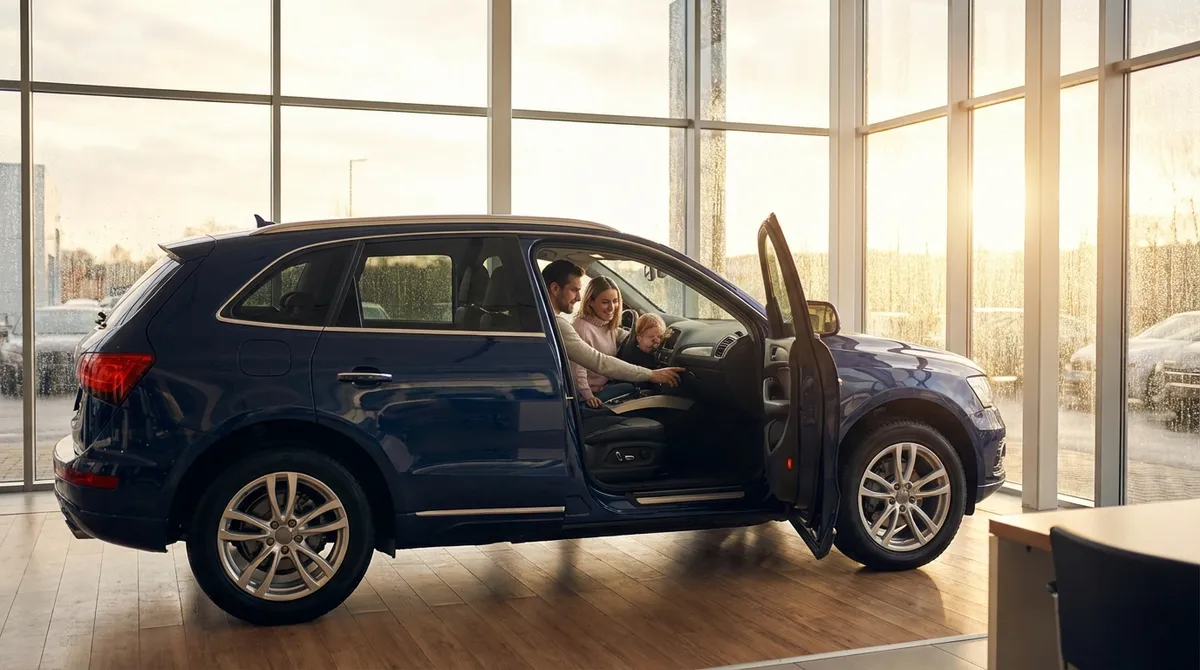
The most satisfying family SUVs rarely shout for attention. They glide through school runs and weekend escapes with a kind of quiet assurance—space exactly where you need it, safety that feels invisible until it matters, and a cabin that stays calm even when life does not. This guide is for families who value that understated excellence: you’re not chasing badges or hype, but a vehicle that will feel “right” a decade from now. Below are five exclusive, often-overlooked insights that will help you recognize that kind of lasting quality before you sign anything.
Insight 1: The “Third-Row Truth Test” (and Why It Matters Even If You Use It Rarely)
Most brochures celebrate third-row seating; few reveal how livable it actually is. The “Third-Row Truth Test” is about asking the questions spec sheets avoid and physically checking the answers in person.
Start by having an adult actually sit in the third row, then close the tailgate. Note knee angle, headroom, and whether feet can rest naturally under the second-row seats. If you need to slide the second row so far forward that those passengers become cramped, the third row is more marketing than mobility. Pay close attention to shoulder width—two seats that technically exist aren’t necessarily two seats you’d want your children or guests to endure on a two-hour drive.
Then, evaluate access with real-world conditions in mind: can a child climb into the third row independently with a booster installed in the second row? How easy is it for a grandparent with limited mobility to step in? Practice entering and exiting with a car seat in place; power-folding seats are pleasant, but the geometry of the opening is what decides whether school mornings feel composed or chaotic.
Even if you only plan to use the third row occasionally—for carpools, visiting family, or last-minute team outings—this test reveals whether your SUV is truly an adaptable family companion, or simply a two-row vehicle with ornamental extra seats.
Insight 2: Cabin Calmness as a Daily Luxury (Beyond Leather and Screens)
Families often fixate on materials and technology, but the real hallmark of a refined family SUV is cabin calmness: how the car sounds, feels, and behaves in motion. This is not a luxury for its own sake; it is what keeps small irritations from becoming daily fatigue.
Begin with noise levels. On a test drive, turn off the audio system and listen at highway speeds. Wind rustle around mirrors and roof rails, tire hum on rougher pavement, and engine noise during gentle acceleration all reveal how thoroughly the vehicle has been engineered. Some models employ acoustic glass, extra insulation, and active noise cancellation; you don’t need to know every technical detail, but you will feel the difference if you pay attention.
Next, focus on vibration and ride sophistication. Drive over expansion joints, patched asphalt, and a few mild potholes at realistic speeds. A well-tuned family SUV will absorb these imperfections with a single, controlled motion rather than bouncing or shuddering. Observe how the suspension behaves with a full load—if possible, bring family members along or at least simulate weight with cargo. A vehicle that rides beautifully when empty but loses composure when loaded will disappoint on holiday weekends.
Finally, pay attention to small ergonomic details: the “reach” to key controls, the angle of your wrist on the steering wheel, the ease of adjusting climate for rear passengers, and the intuitiveness of the infotainment system. True daily luxury is not just the number of features, but how effortlessly you can use them while your attention stays on the road and your family.
Insight 3: Future-Proofed Family Tech, Not Just Today’s Gadgets
Technology ages faster than sheet metal. A family SUV bought today will likely live through several generations of phones, software updates, and evolving expectations for connectivity. Rather than being dazzled by the current interface, look for signs that the vehicle is thoughtfully prepared for tomorrow.
First, examine smartphone integration. Native support for both Apple CarPlay and Android Auto—preferably wireless—helps keep the infotainment experience current as your phone updates. Confirm where wireless charging pads are located, whether they hold phones securely during spirited driving, and whether the cabin provides enough USB-C and 12V outlets for the entire family, not just the front row.
Next, consider the over-the-air (OTA) update capability. Some modern SUVs can receive software improvements—bug fixes, feature refinements, sometimes even efficiency and driver-assistance upgrades—without returning to the dealership. This matters more for families than it may appear: smoother driver-assistance behavior and updated navigation data contribute directly to day-to-day ease and safety.
Rear-seat entertainment should be evaluated with restraint. Built-in screens can be appealing, but they risk becoming obsolete faster than tablets or streaming devices you already own. Instead of focusing on factory screens, look at the quality of rear-seat USB power, available Wi‑Fi hotspot capability, and the ability to mount or stow your own devices safely. A flexible ecosystem will serve you longer than a single, expensive system that ages quickly.
In short, choose an SUV whose technology philosophy is modular and updatable. Your children will grow, devices will change, and a vehicle designed for adaptability will feel modern far longer than one that simply looks high-tech at the moment of purchase.
Insight 4: Subtle Safety: How the Best Protections Disappear Until You Need Them
Most modern SUVs boast a wall of safety acronyms, but the families who are best protected are usually the ones who understand how these systems behave in real traffic, not just in laboratory tests.
Start with the fundamentals: verify crash-test performance from independent organizations such as the National Highway Traffic Safety Administration (NHTSA) and the Insurance Institute for Highway Safety (IIHS). Look beyond overall ratings to details like small overlap frontal protection, roof strength, and head restraint performance. These nuances can be particularly important for front passengers and older children in booster seats.
Then examine the implementation of advanced driver-assistance systems (ADAS). Adaptive cruise control, lane-keeping assistance, blind-spot monitoring, and automatic emergency braking can reduce fatigue and improve safety—if tuned correctly. On your test drive, use these systems in varied conditions: dense traffic, open highway, gentle curves. Is the lane-keeping gentle or intrusive? Does adaptive cruise brake and accelerate smoothly, or does it lurch? Are warnings clear but not startling? The best systems feel like a calm co-pilot, not a nervous backseat driver.
For families with small children, look closely at car-seat friendliness. Inspect the visibility and accessibility of LATCH anchors, the number of full LATCH positions, and whether top tether anchors exist for all rear seating positions you might realistically use. Confirm that head restraints are adjustable enough for high-back boosters and that seat belt buckles are not buried so deeply that children struggle to buckle themselves.
Finally, consider visibility and lighting as safety features, not luxuries. High-quality LED headlights, available adaptive lighting, well-placed windows, and a thoughtfully tuned rearview camera (with clear resolution at night and in the rain) all contribute to feeling confident and aware in tight driveways, dim car parks, and late-night returns from activities.
Insight 5: The “Weekend Away” Simulation: The Only Test That Reveals the Whole Story
Specifications can tell you cargo volume in liters; only a “Weekend Away” simulation tells you whether your family’s life will actually fit. This is where the difference between a good SUV and the right SUV becomes unmistakable.
Before visiting the dealership, assemble a realistic set of items you would pack for a typical family weekend: a stroller or travel cot, sports bags, a cooler or food tote, duffel bags, maybe a musical instrument or folding chairs. Bring them with you. Ask to fold the third row (if available) and load everything exactly as you would on a Friday afternoon. Notice how many items need to be stacked, how much rear visibility you lose, and whether you can still access a small bag or jacket without unloading half the cargo area.
Examine the shape of the space, not just its size. A low, flat load floor will feel significantly more usable than a taller but awkwardly stepped area. Check whether there’s under-floor storage for smaller items you prefer to keep hidden, and whether the tailgate opening is tall enough for your family’s tallest member to stand beneath without stooping. Power tailgates with hands-free operation are more than a convenience when you’re carrying a sleeping child and a bag simultaneously.
Then, simulate the cabin environment for that same weekend: with all seats in use, can everyone adjust their own climate vents? Are there enough cupholders for water bottles, not just small coffee cups? Can two children in car seats coexist with a third passenger in the middle seat without conflict? How easy is it to retrieve a dropped toy or snack without contortions?
This practical, physical test transforms the buying process from theoretical comparisons into a tangible understanding of how each SUV will behave as part of your family’s real rhythm. The model that passes this simulation with composure is the one that will quietly prove its worth every time you pack up and go.
Conclusion
A truly refined family SUV is not defined by a single headline feature, but by the way dozens of subtle decisions come together to support your life without demanding constant attention. When you test third-row reality, seek cabin calmness, prioritize future-proofed technology, understand how safety systems behave in the real world, and stage a “Weekend Away” simulation, you move beyond marketing into something more meaningful: clarity.
That clarity is what allows you to choose with confidence—not the loudest option, nor the trendiest, but the vehicle that will feel naturally suited to your family on the thousand ordinary journeys that matter more than any spec sheet. In the end, quiet confidence on four wheels is the most premium feature of all.
Sources
- [National Highway Traffic Safety Administration (NHTSA) – 5-Star Safety Ratings](https://www.nhtsa.gov/ratings) - Official U.S. government crash-test ratings and safety information for SUVs and other vehicles
- [Insurance Institute for Highway Safety (IIHS) – Ratings](https://www.iihs.org/ratings) - Independent crash-test data, headlight evaluations, and safety technology assessments
- [U.S. Department of Energy – Fuel Economy Guide](https://www.fueleconomy.gov/feg/findacar.shtml) - Comparative fuel economy, range, and energy cost data for gasoline, hybrid, and electric SUVs
- [Edmunds – Car Seat Compatibility and LATCH Guides](https://www.edmunds.com/car-seat-fit-index.html) - Practical evaluations of car-seat installation ease and rear-seat usability across different SUVs
- [Consumer Reports – Guide to Advanced Safety Systems](https://www.consumerreports.org/cars-driving/guide-to-car-safety-features-a3374951883/) - Detailed explanations and comparative insights on ADAS features like automatic emergency braking and lane-keeping assist
Key Takeaway
The most important thing to remember from this article is that this information can change how you think about Buying Guide.