Selecting an SUV for your family is no longer a binary decision between “practical” and “aspirational.” The most compelling family SUVs now blend composure, craftsmanship, and clever engineering in ways that quietly elevate everyday life. At Family SUV Review, we look beyond brochure-friendly talking points and focus on how these vehicles behave during real family routines: tight school runs, late‑night airport pick‑ups, and long drives where tranquility is non‑negotiable.
Below, you’ll find five exclusive insights that shape how we approach SUV reviews for discerning families—subtle lenses that separate merely capable vehicles from genuinely civilized companions.
How We Review: A Family-Centric Lens with a Refined Edge
Our review philosophy begins with the assumption that your SUV is an extension of your home—only with more airbags and fewer sofas. That means we evaluate each vehicle less as a gadget and more as a living space that must remain graceful under constant use. We examine cabin layouts for intuitive movement: how easily a child can buckle themselves in, how naturally a grandparent can step into the second row, and whether the third row feels like an afterthought or a considered destination.
We scrutinize materials and build quality not just for first impressions, but for how they will age in the presence of car seats, sports equipment, and the occasional spilled juice. A stitched dashboard may look beautiful, but we ask how it feels under hand, how it resists glare on a bright afternoon, and whether the finishes invite touch rather than demand protection. Technology is evaluated with equal rigor. It must simplify, not distract; we favor systems that quietly serve a busy driver rather than compete for attention.
Driving dynamics are also judged through a family lens. We prioritize calm, predictable behavior: composed braking in the rain, stable lane changes with a full load, and steering that inspires confidence rather than drama. Finally, we look for coherence. The finest family SUVs exhibit a sense of internal harmony—where the way it drives, the way it feels, and the way the cabin is arranged all tell the same, quietly competent story.
Insight 1: The “Evening Calm Test” – Refinement When Everyone Is Tired
One of the most revealing moments for any family SUV happens late in the day, when the cabin is filled with fatigue rather than chatter. Our reviews pay particular attention to how a vehicle behaves during this “evening calm” period, when tensions are higher and patience is lower. We assess noise isolation at suburban speeds with real‑world conditions: coarse pavement, nearby traffic, and climate control operating at a realistic setting.
We pay close attention to the subtleties: Does the suspension absorb patchy asphalt without a jitter that wakes a dozing child? Does wind noise gently fade into the background, or does it intrude around the mirrors and roof rails? Are there faint rattles from the tailgate or third‑row mechanisms when the car is lightly loaded? The best family SUVs create a cocooned environment that allows soft conversations in the front row while children drift off behind.
Climate control calibration is another dimension of this test. We value systems that reach and maintain a comfortable temperature without dramatic fan noise or frequent, noticeable swings. Rear‑zone adjustments should be intuitive enough for older children to manage without involving the driver. When an SUV passes our “evening calm test,” it demonstrates a level of refinement that makes every end‑of‑day journey feel less like one more task and more like a gentle transition home.
Insight 2: Third-Row Integrity – Seating That Deserves to Be Chosen, Not Avoided
The third row is where ambitious promises and actual practicality often diverge. Our reviews treat the third row not as a technical specification, but as real seating that should be genuinely inhabitable. Legroom and headroom matter, of course, but we go further: we consider hip point height, toe clearance under the second row, and how naturally the seating position accommodates both growing children and occasional adult guests.
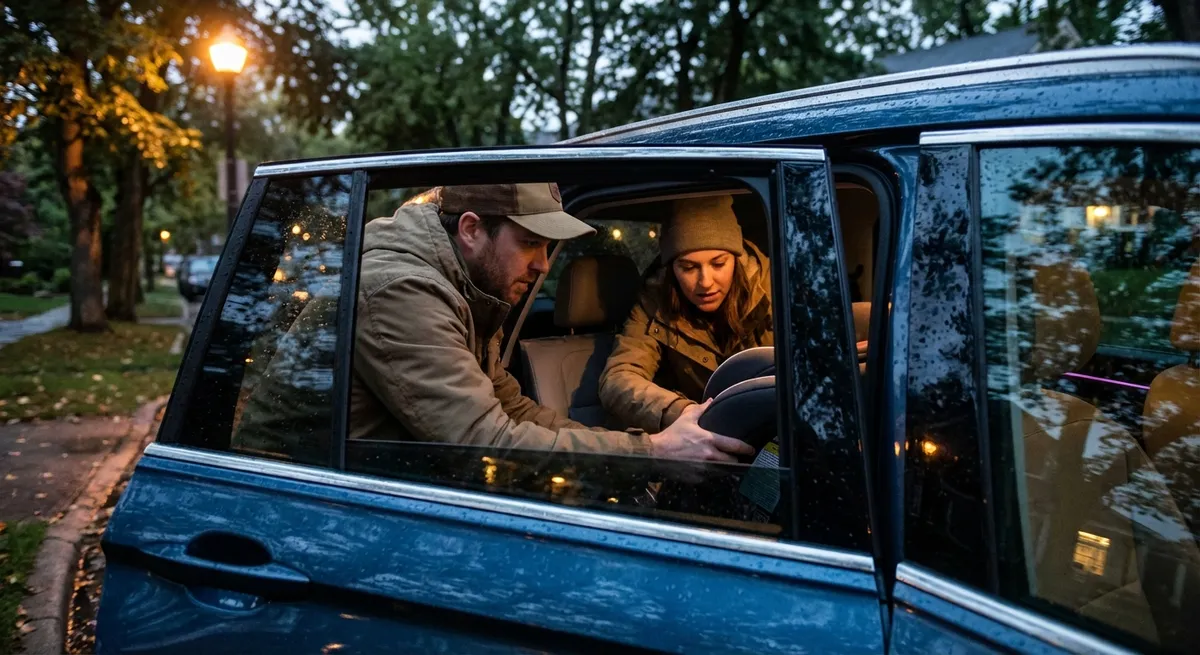
Access is equally important. We evaluate whether the second row slides and tilts in a way that allows easy entry without requiring contortions—especially with child seats installed. Does the mechanism allow access from both sides? Can a child operate it safely and comfortably? Are the steps and grab handles positioned thoughtfully to support older family members? The best SUVs manage to make third‑row access feel almost graceful.
Once seated, we look for genuine amenities: dedicated vents, cupholders that actually secure a drink, nearby USB ports, and windowlines that prevent the third row from feeling like a compartment. We also examine how the cargo area behaves with the third row in use. A family‑friendly SUV must allow at least a weekend’s worth of luggage or a grocery run without demanding that someone stay home. Our reviewers reward third rows that feel like intentional design, not a checkbox.
Insight 3: The Subtle Art of Storage – Spaces That Anticipate Real Life
Family SUVs with true finesse reveal their intelligence in the smallest storage decisions. We devote a surprising amount of time to exploring, measuring, and living with these spaces. Center consoles, for example, are assessed not just for volume but for usability: Can it discreetly hold a handbag out of sight? Does it keep everyday items—keys, parking cards, charging cables—organized rather than scattered?
Door bins are evaluated for bottle stability and reachability from a seated position, including by children in booster seats. We look for a logical “home” for every frequent item: sunglasses that don’t get scratched, devices that can charge without dangling cables, and bags that can be secured behind a seat without sliding into the footwell. Under‑floor cargo compartments are assessed for how well they can hide more valuable items during travel and whether the lids feel solid enough to support heavy luggage.
The rear cargo area is examined as a workspace. We consider loading height, how far you must lean to retrieve items, and whether the parcel shelf or cargo cover is intuitive enough to use daily. Seats that fold with a single, light movement are heavily favored, as are configurations that allow one side of the third row to collapse independently for mixed passenger‑and‑cargo duty. These details might seem modest, but for families, they determine whether an SUV feels polished or perpetually improvisational.
Insight 4: Graceful Technology – Assistance That Enhances, Never Overwhelms
In our reviews, advanced driver assistance systems and in‑car technology are only as impressive as their manners. We begin by examining how clearly the SUV communicates its assistance: lane‑keeping aids that gently nudge rather than abruptly correct, adaptive cruise control that behaves predictably in stop‑and‑go traffic, and blind‑spot systems that inform without startling.
We pay particular attention to interface hierarchy. Climate control, audio volume, defrost, and drive mode adjustments should never be buried behind multi‑layer menus. We favor thoughtful combinations of touchscreens and physical controls, with tactile knobs and switches for the functions drivers adjust most often while in motion. Screen clarity, response times, and logical menu layouts are evaluated from the perspective of a parent managing navigation, music, and hands‑free calls while remaining fully engaged with the road.
For rear passengers, we assess whether connectivity supports modern family life without turning the vehicle into a distraction chamber. Multiple USB‑C ports, well‑positioned charging pads, and optional rear entertainment must integrate cleanly with the cabin rather than dominate it. Over‑the‑air updates and digital keys are treated as welcome conveniences when implemented elegantly, but our reviews remain anchored in one question: Does the technology make driving with your family more serene, more secure, and more intuitive?
Insight 5: Composure Under Load – How the SUV Behaves When It Matters Most
Many SUVs feel impressive when driven lightly on a well‑paved test route. Our evaluations focus instead on how they perform when genuinely tasked with family duties. We examine ride quality and responsiveness with every seat occupied and the cargo area filled—weekend luggage, sports gear, or a full grocery haul. In this state, we look for consistent braking performance, steady body control through highway curves, and predictable acceleration from low speeds.
Powertrains are assessed not only for outright speed but for their ability to deliver smooth, unhurried progress. We notice how gearboxes respond to modest throttle inputs when merging onto a busy road or climbing a long hill with passengers on board. Hybrids and electrified options are scrutinized for the coherence between regenerative braking and traditional braking, especially at low speeds where lurching or inconsistency can unsettle both driver and passengers.
We also consider towing and seasonal conditions. An SUV may not spend every day hauling a trailer or driving on snow, but its composure during those infrequent yet consequential moments matters deeply. All‑wheel drive systems, drive modes, and traction management are evaluated for sophistication, not theatrics—they should instill confidence without drawing attention to themselves. The most outstanding family SUVs feel as calm and controlled at full capacity as they do on a solo Sunday drive.
Conclusion
Family SUVs occupy a uniquely intimate place in daily life. They host hurried mornings, quiet returns, celebrations, and the countless unremarkable journeys that quietly shape family memory. At Family SUV Review, our approach to SUV reviews is deliberately exacting yet quietly restrained, shaped by how these vehicles will truly be used rather than how they are marketed.
By focusing on evening calm, third‑row integrity, intelligent storage, graceful technology, and composure under load, we aim to help you identify the SUVs that do more than transport—they support, soothe, and subtly uplift every drive. In a market crowded with loud claims, we seek out the vehicles that speak in a lower, more confident register: the ones that simply work beautifully for the families who depend on them.
Sources
- National Highway Traffic Safety Administration (NHTSA) - Official crash test ratings and safety information for SUVs and other passenger vehicles
- Insurance Institute for Highway Safety (IIHS) – Ratings - Independent safety ratings and evaluations of crashworthiness and crash avoidance technologies
- Edmunds – How to Choose the Best Family Car - Practical guidance on evaluating family‑oriented features, seating, and storage
- Consumer Reports – Guide to Car Safety Features - Detailed explanations and expert assessments of modern driver assistance systems
- U.S. Department of Energy – Fueleconomy.gov - Official fuel economy data and efficiency comparisons for SUVs and other vehicles
Key Takeaway
The most important thing to remember from this article is that this information can change how you think about SUV Reviews.