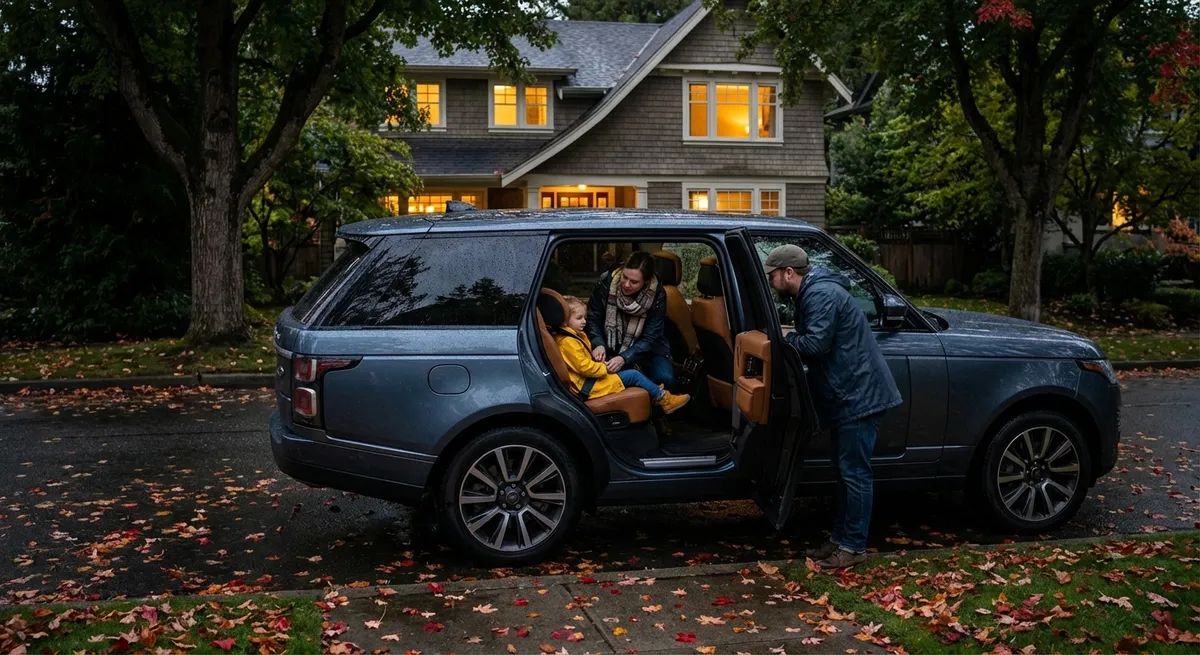
For families who notice the way a door closes, the hush of a cabin at 70 mph, or the ease with which a car-seat clicks into place, most SUV reviews feel strangely incomplete. Horsepower figures and cargo volumes have their place, but they rarely capture what it’s actually like to live with a vehicle through weekday chaos, weekend escapes, and everything in between. This is a refined look at SUV reviews through a more discerning lens—one that prioritizes quiet excellence, thoughtful engineering, and the understated details that genuinely elevate family life.
How We Read Between the Lines of Traditional SUV Reviews
Most mainstream reviews are written for a broad audience, which often means they prioritize numbers that are easy to compare: 0–60 times, towing capacity, and touchscreen size. Families with higher standards need more than that. We look for how those numbers translate into composure in a sudden lane change, how suspension tuning affects the way your kids sleep on a long drive, and how seamlessly safety systems assist without nagging.
Reading reviews with a more sophisticated filter means noticing what’s implied but not always stated. A vehicle described as “sporty” may be sharpened at the expense of ride comfort. An “upscale” interior might rely more on complex screens than intuitive physical controls. We look at how testers describe noise, vibration, and harshness, how they talk about visibility and seating position, and whether they mention fatigue on longer drives. These narrative details tell you far more about day-to-day livability than any spec sheet.
Insight 1: The Texture of Quiet — Beyond Simple Noise Levels
Families often say they want a “quiet” SUV, but in practice, it’s the quality of quiet that matters most. Traditional tests measure decibels, yet two cabins with similar readings can feel completely different. Premium family SUVs manage not just volume, but the texture and tone of sound. Engineers can tune door seals, acoustic glass, and even underbody panels to soften harsh frequencies from wind and road, leaving only a low, unobtrusive background hum.
In refined SUVs, you’ll notice how your own conversations sound—clear, without echo, even from the third row. You’ll hear how the engine integrates into the background rather than dominating it when merging onto the highway. Pay attention in reviews to mentions of “wind rustle around the mirrors,” “road slap over expansion joints,” or “tire noise on coarse pavement.” These details are clues to whether the vehicle’s calm ambiance will hold up under real-world use, from rain-slick commutes to long summer road trips on varied surfaces.
Insight 2: Seating That Respects Every Age and Stage
Seating is often reduced to simple headroom and legroom figures, yet families experience it much more personally. Premium SUVs distinguish themselves through seat shape, cushioning density, and subtle support that keeps everyone fresher at the end of a long day. Where a basic review might say “comfortable seats,” a more nuanced read focuses on thigh support for taller drivers, lumbar contour that doesn’t feel intrusive, and headrests that support without pushing your head forward.
For families, the second and third rows deserve the same scrutiny as the front. Look for reviews that discuss the angle of the backrest, the ease of adjusting it with one hand, and whether the seating surface remains supportive over hours, not just during a brief test drive. Reports that mention child-seat installation, how easy it is for kids to buckle themselves, and whether adults can genuinely tolerate the third row for more than a short trip are particularly revealing. Refined SUVs quietly excel here, creating a sense that no seat is an afterthought.
Insight 3: Climate Control as an Invisible Luxury
Many reviews praise “dual-zone climate control” as if it were the last word in comfort, yet families quickly discover how limited that can feel in an SUV filled with people. Carefully engineered three- or four-zone systems, discreetly placed vents, and smart airflow make an outsized difference to real-world harmony—especially when one child runs warm, another is always cold, and the sun happens to be on only one side of the vehicle.
Sophisticated SUVs pay attention to details that rarely get star billing: gentle fan ramps rather than abrupt blasts, rear vents positioned to avoid blowing directly on faces, and quick demisting performance on damp mornings. When reading reviews, notice references to how quickly the cabin heats or cools, whether the rear climate controls are intuitive, and if temperature remains consistent during longer drives. A family vehicle that manages climate unobtrusively creates a cocoon of comfort you appreciate more with every season.
Insight 4: Infotainment That Disappears Into the Background
Modern SUV reviews often obsess over screen size and app compatibility, but families benefit more from systems that are effortless rather than impressive. A sophisticated infotainment and driver-interface setup lets you operate essentials with minimal distraction: volume by a simple knob, core functions by physical buttons you can find by feel, and navigation with clear, restrained graphics rather than cluttered animations.
When evaluating reviews, pay close attention to comments about responsiveness, menu depth, and learning curve. Systems described as “intuitive within minutes” or “easy to use without a manual” are far more valuable than those called “feature-packed but complicated.” Notice whether reviewers mention lag, redundant submenus, or a reliance on touch surfaces for everything. In a genuinely well-designed family SUV, you’re not thinking about the technology at all once you’re underway—it supports you quietly, instead of demanding your constant attention.
Insight 5: Safety Systems Tuned for Trust, Not Theatre
Most SUVs in this segment now offer a broad suite of driver-assistance systems, and reviews often treat them as simple yes/no checkboxes. What matters just as much is how gracefully those systems behave over time. Families benefit most from assistance that’s calm, predictable, and easy to trust: lane-keeping that gently guides rather than tugs, adaptive cruise that brakes smoothly instead of abruptly, and forward-collision warnings that are thoughtful rather than panicked.
In nuanced reviews, look for descriptions of how these systems feel in real traffic. Are there mentions of “false alarms,” “overly sensitive lane warnings,” or “jerky braking in stop-and-go traffic”? Those are signs that the software calibration might be more tiring than reassuring. Conversely, phrases like “fades nicely in and out,” “feels like a natural extension of your driving,” or “easy to customize or disable with a single button” indicate a vehicle engineered for long-term comfort, not just for passing a checklist. This is where premium SUVs earn their keep—by making advanced safety an almost invisible companion.
Conclusion
For families who value refinement over flash, the most revealing aspects of an SUV rarely headline conventional reviews. They live in the quiet timbre of the cabin, the unhurried support of the seats, the calm reliability of the climate system, the unobtrusive ease of the infotainment, and the composure of the safety technology that surrounds you. When you start reading SUV reviews through this more sophisticated lens, you begin to see which vehicles are simply well-equipped—and which have been thoughtfully crafted for the way discerning families truly live.
Sources
- [National Highway Traffic Safety Administration (NHTSA)](https://www.nhtsa.gov/ratings) - Official U.S. government crash test ratings and information on advanced safety technologies
- [Insurance Institute for Highway Safety (IIHS)](https://www.iihs.org/ratings/suvs) - Independent crash test results and safety evaluations specifically covering SUVs and family vehicles
- [Edmunds Car Reviews](https://www.edmunds.com/suv/) - In-depth professional SUV reviews with driving impressions, comfort assessments, and technology evaluations
- [Consumer Reports: SUVs](https://www.consumerreports.org/cars/suvs/) - Testing-based reliability, comfort, and usability insights for a wide range of SUV models
- [Environmental Protection Agency (EPA) Fuel Economy](https://www.fueleconomy.gov/feg/findacar.shtml) - Official fuel economy and range data for SUVs and other light-duty vehicles
Key Takeaway
The most important thing to remember from this article is that this information can change how you think about SUV Reviews.