The most sophisticated family SUVs do more than move people from place to place—they quietly orchestrate comfort, safety, and ease with the precision of a well-run household. For discerning families, the true magic lies in the details you don’t notice immediately: the way the cabin absorbs chaos, how the technology anticipates needs rather than complicating them, and how every surface, latch, and seat feels purpose-built for real life. This is where family-focused features evolve from “nice-to-have” to indispensable, and where thoughtful design transforms every school run and weekend escape into something decisively more refined.
Below are five exclusive, often-overlooked insights that help distinguish an ordinary SUV from a truly elevated family companion.
Insight 1: The “Silent Sanctuary” Cabin Matters More Than Horsepower
For many families, the most valuable feature in a premium SUV isn’t under the hood—it’s in the hush of the cabin. True refinement shows up in how well an SUV manages sound, vibration, and harshness, especially under less-than-ideal conditions: rough asphalt, heavy rain, a fully loaded cabin.
Look for more than just “quiet” in brochure language. Brands that take sound seriously often talk about acoustic laminated glass, extra door seals, insulated wheel wells, and active noise cancellation. These aren’t marketing flourishes; they make the difference between arriving drained and arriving composed. A quieter cabin allows for lower conversation volumes, calmer children, and less fatigue on longer trips.
Pay attention on your test drive with all rows occupied and the climate system running. Can you talk in a normal tone with someone in the third row at highway speeds? Do you hear wind noise around the mirrors, or tire noise from the rear? The best family SUVs create what feels like a rolling sanctuary—where the world is present but gently muted, and your family’s voices, music, and quiet moments take priority.
Insight 2: Third-Row Architecture Is More Important Than Third-Row Existence
Many SUVs now advertise a third row, but not all third rows are truly family-ready. The difference lies in architecture, not just dimensions. Families should think about the third row as a “living space,” not an emergency bench.
Key questions to consider:
- Access without acrobatics: Can children reach the third row independently with child seats already installed in the second row? Look for tilt-and-slide mechanisms that work even when a child seat is latched in place, or wide-opening rear doors with low step-in heights.
- Adult-viable seating: If grandparents or teenage friends will occasionally ride in the back, knee clearance, foot space under the second-row seats, and headroom become non-negotiable. Sit back there yourself—shoes on, knees bent, seat belts fastened.
- Ventilation and light: Third-row occupants deserve their own vents and, ideally, their own fan or temperature controls. Side glass that extends far back or a panoramic roof reaching to the third row dramatically reduces the “tunnel” feel and motion discomfort.
- Storage with all rows in use: A third row is less impressive if it eliminates practical cargo area when upright. Evaluate how many weekend bags, strollers, or sports kits fit behind the raised third row. Thoughtful under-floor compartments and split-folding functionality can keep the vehicle liveable in everyday use.
The most refined family SUVs treat the third row as equal to the first two—not an afterthought, but a genuinely comfortable, accessible space for real people and real journeys.
Insight 3: Climate as a Craft—Fine-Tuned Comfort for Every Passenger
Climate control is often described in a single line on spec sheets, yet in family life it’s one of the most frequently used systems. The difference between a merely functional system and a truly sophisticated one reveals itself in daily routines: school drop-offs in winter, humid summers with a full cabin, and long drives with varying passenger preferences.
Details that define premium family climate:
- True multi-zone control: Beyond the usual “dual-zone,” advanced systems offer three or even four zones, giving rear passengers meaningful control. This reduces front-seat “thermostat negotiations” and keeps the peace.
- Subtle airflow management: Look for diffused or “soft” airflow modes that reduce direct drafts on young children. Rear vents positioned high on the pillar or in the ceiling distribute air more evenly than floor-only vents.
- Rapid cabin conditioning: A powerful yet refined system can quickly cool a sunbaked interior or warm a chilly cabin without sounding like a small aircraft. This is especially important if you use remote start or pre-conditioning features.
- Air quality as a priority: High-grade filtration, available HEPA or PM2.5 filters, and air quality sensors elevate health and comfort, particularly in urban areas or during allergy season. Some vehicles even offer cabin air ionization or pollen filters that make a tangible difference over time.
When you step from the house into your SUV, the ideal experience should feel like entering a private, well-tempered lounge—tailored to each occupant rather than dictated from the driver’s seat alone.
Insight 4: Family-Centric Storage Is About Access, Not Just Volume
Cargo volume numbers are helpful, but they don’t tell the full story for families managing strollers, school bags, laptops, groceries, sports gear, and the occasional formal wardrobe. The distinction between “big” and “brilliant” storage lies in how intelligently space is divided and accessed.
Consider these finer points:
- Layered cargo solutions: A two-level cargo floor can hide valuables, separate clean items from muddy shoes, and create flexible zones. A truly family-oriented design offers places for slim objects (like laptops or tablets), not just one large open trunk.
- Smart under-seat and door storage: Deep door pockets that comfortably hold water bottles and umbrellas, secure slots for devices, and sculpted seatback pockets for books or slim toys keep the cabin orderly without resorting to aftermarket organizers.
- Hands-free loading with real-world tuning: Hands-free liftgates are now common, but the best are tuned to work reliably even when you’re juggling children and bags. Pay attention to opening height (low garages), closing smoothness, and how quickly the system responds.
- Thoughtful grocery and gear management: Integrated hooks, small side bins, and straps or rails to secure bags and sports equipment are deceptively luxurious in practice. They prevent the rolling chaos that often greets you when you open the trunk after a spirited drive home.
Luxury for families isn’t about endless space; it’s about the confidence that everything has a place, remains accessible, and arrives precisely as you packed it.
Insight 5: Technology That Disappears Is the Real Luxury
The best family SUV technology is the kind you stop noticing—not because it’s uninspiring, but because it aligns so seamlessly with your habits. A sophisticated family vehicle doesn’t merely offer features; it curates them in a way that reduces friction.
Look for signs of “invisible intelligence”:
- Calm, intuitive interfaces: Large screens are impressive, but the measure of refinement is how few taps it takes to perform daily tasks—adjusting a playlist, setting a new navigation destination, or changing a drive mode. Clean menus, clear fonts, and minimal distraction are key.
- Profile-based personalization: Advanced systems can recognize family members via key fobs or phone profiles, then automatically adjust seat positions, mirror angles, climate preferences, radio presets, and even ambient lighting. Over time, this feels less like a car and more like a well-trained concierge.
- Rear-seat practicality without overload: Rear entertainment or device support should enhance, not dominate, family time. Multiple USB-C ports, well-placed charging surfaces, and simple parental controls for content go further than complicated systems no one uses after the first week.
- Driver assistance that feels natural: Adaptive cruise control, lane centering, and traffic jam assist can be invaluable in the family context, but only when tuned gracefully. The most polished systems accelerate and brake smoothly, intervene gently, and support the driver without undermining confidence.
When test-driving, notice your mental load. Does the vehicle ask you to learn around it—or does it quietly learn around you and your family?
Conclusion
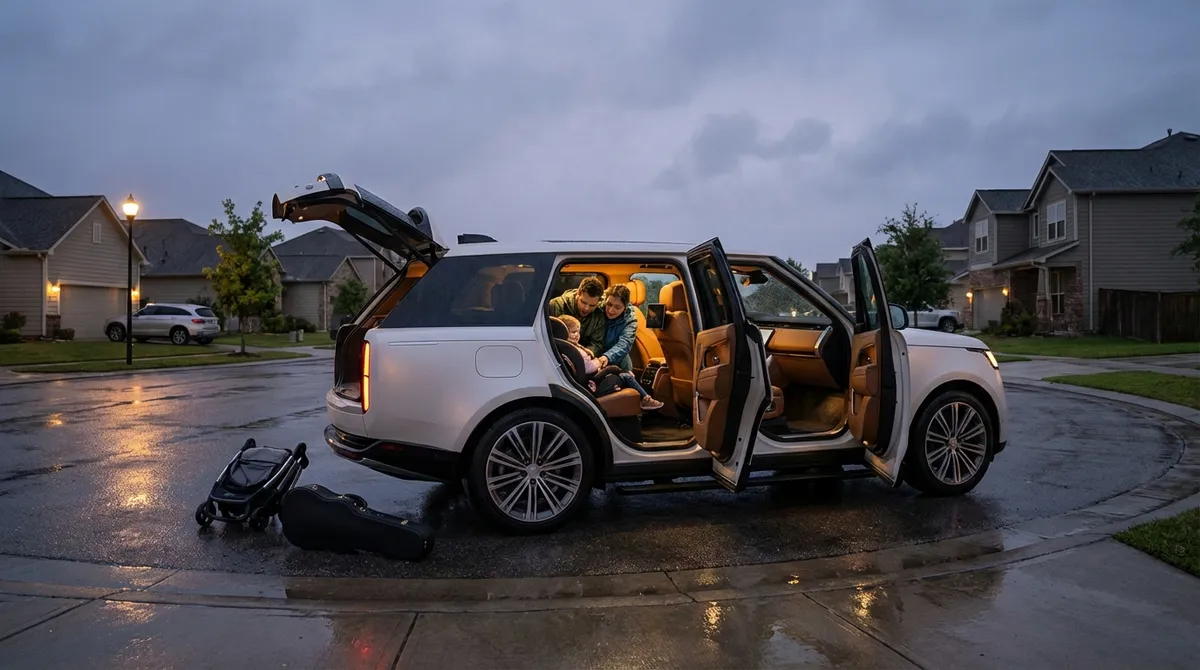
For modern families with refined expectations, a premium SUV is more than a status symbol; it’s an everyday environment where time, energy, and attention are either protected or depleted. The differentiator is rarely a single headline specification. Instead, it lies in a constellation of details: the hush of the cabin on a rainy evening, the sincerity of the third row as genuinely usable space, the effortlessness of the climate system, the quiet order of a well-designed cargo area, and technology that supports rather than competes with family life.
When you evaluate your next SUV, look beyond the obvious numbers and trims. Seek out the subtle engineering and design choices that respect your family’s routines, your need for calm, and your appreciation for understated, thoughtful luxury. Those are the features that will still matter—quietly, consistently—years after the novelty of a new vehicle has worn off.
Sources
- National Highway Traffic Safety Administration (NHTSA): Vehicle Shopping Tips - Official U.S. guidance on what to consider when choosing a vehicle, including family-focused safety and usability factors.
- Insurance Institute for Highway Safety (IIHS): Ratings & Research - Independent crash test data and evaluations of head restraints, LATCH usability, and other features critical for family SUVs.
- EPA Fuel Economy Guide - U.S. Department of Energy resource for comparing fuel economy and range, including larger SUVs frequently used by families.
- Consumer Reports: How to Choose the Best SUV for Your Family - In-depth, independent advice on family-oriented SUV features and configurations.
- Volvo Cars: Interior Air Quality and Climate Features - Example of how a major automaker approaches cabin air quality, filtration, and climate comfort technologies.
Key Takeaway
The most important thing to remember from this article is that this information can change how you think about Family Features.