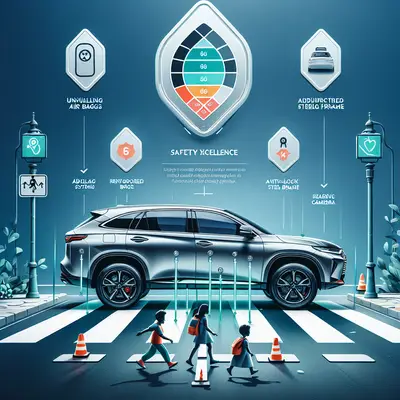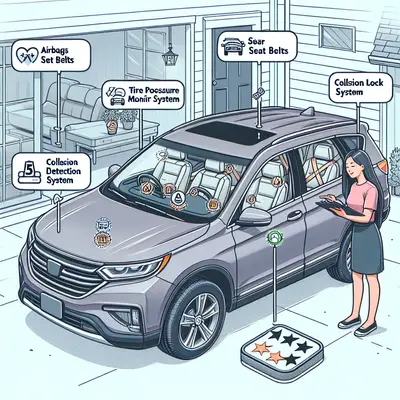
For families who value calm over chaos and discernment over impulse, safety ratings are less about numbers on a page and more about preserving a way of life. Yet the language of crash tests, acronyms, and test labs can feel clinical—far removed from school runs, evening recitals, and long-weekend escapes. This guide reframes safety ratings through a refined lens, translating lab results into lived confidence and highlighting five often-overlooked insights that matter deeply to families who expect more from their SUV than simple transportation.
From Lab to Lifestyle: Why Safety Ratings Are Only the Opening Chapter
Safety ratings from organizations such as the IIHS and NHTSA serve as a rigorous baseline, but they are not the full narrative. Tests are conducted in controlled environments with standardized dummies and prescribed speeds. Your family’s reality is far more textured: wet school-zone pavement, distracted drivers at dusk, or a fully loaded SUV heading to the airport.
Understanding the scope and limits of these tests is crucial. A five-star overall rating or a “Top Safety Pick+” award signals strong performance, yet families should look past the headline and into individual categories—frontal, side, rollover, and rear impact, as well as crash-avoidance technologies. The nuance lies in how consistently a model performs across these areas, and how that performance aligns with your daily routine. A vehicle that excels in frontal and side protection but only performs adequately in rear-impact tests, for instance, may influence how you think about third-row use for your youngest passengers.
The most sophisticated approach treats safety ratings as the foundation on which you layer judgment about size, seating configuration, driving environment, and technology. In other words, you are not buying a score; you are curating peace of mind.
Insight 1: How Your Family’s Seating Plan Changes What “Safe Enough” Means
Most safety charts assume a generic occupant layout. Your family does not. Where your children actually sit inside the SUV profoundly affects which parts of safety ratings deserve the most attention.
For families with infants and toddlers in rear-facing seats, rear crash protection and LATCH system usability become central. Look beyond the overall rating and examine seat-anchorage evaluations: Are the lower anchors easy to access without compressing leather upholstery? Are tether anchors clearly marked, or hidden behind trim? Premium SUVs often differentiate themselves here with thoughtful anchor placement that avoids contortionist-level effort during installation.
If your older children ride in the third row, side-impact protection and roof strength take on outsized importance. Laboratory diagrams may show dummies in the second row, but that third row—often closer to the tailgate and rear pillars—deserves extra scrutiny, particularly for side-curtain airbag coverage. When you review safety data, imagine your own seating map and ask: “Where are my most vulnerable passengers, and how is this part of the cabin actually protected in each test scenario?”
A sophisticated safety choice is less about the vehicle in the abstract, and more about how harmoniously its protective design aligns with your actual seating choreography.
Insight 2: The Real Meaning Behind “Advanced” Driver Assistance—Substance vs. Show
Advanced driver-assistance systems (ADAS) have rapidly shifted from indulgent extras to quiet guardians, but not all systems with similar names behave the same way. Safety ratings increasingly factor in crash-avoidance technology, yet the scoring can compress nuanced differences into seemingly similar results.
Automatic emergency braking, for example, is often evaluated at specific speeds with defined obstacles. However, how the system behaves in city traffic—where a child may dart from between parked cars—is heavily influenced by sensor quality, camera placement, and software tuning. Some systems react earlier and more smoothly, others intervene abruptly, compromising passenger comfort even as they avoid a collision.
Similarly, lane-keeping and lane-centering assistance can reduce fatigue on long journeys, but their refinement varies dramatically. A more premium execution will hold the vehicle naturally in the lane without constant minor corrections that can unsettle sensitive passengers. When you see high marks for crash-avoidance, treat them as a signal to test-drive with intention: activate the systems, feel their intervention, and decide if their tuning matches your preference for quiet, unobtrusive support rather than intrusive electronic “nagging.”
The most protective SUVs are those where safety technology feels like an elegantly integrated co-pilot—present, capable, and almost invisible until needed.
Insight 3: Why Crashworthiness Structure Matters More Than Sheer Size
It is easy to assume that a larger SUV is automatically safer. Safety ratings, however, tell a more nuanced story—especially when you look closely at crashworthiness structure and small-overlap tests. The integrity of the safety cage, energy-absorbing crumple zones, and how well the cabin resists deformation can matter more than a few extra inches of metal.
Tests such as the IIHS small overlap front evaluation are particularly revealing. They simulate collisions with objects like poles or trees—a relatively small area of impact that can bypass weaker structural designs. A vehicle that performs exceptionally in this test showcases not only strong materials, but thoughtful load paths that divert impact forces away from the passenger cell. For a family, that translates into doors that still open after a crash, intact footwells for front occupants, and a reduced risk of intrusion into the driver and passenger space.
This structural excellence also has daily-life implications beyond collisions. Robust chassis engineering often correlates with a more composed, less jittery ride—especially over broken pavement or during quick evasive maneuvers. The same rigidity that protects occupants in a crash can provide a stable, confident feel that helps you avoid the incident altogether.
In discerning SUV selection, prioritize models that pair an impressive size presence with demonstrable structural sophistication—not simply bulk.
Insight 4: Hidden Safety Differentiators You Rarely See in Brochures
Brochures and spec sheets naturally focus on features you can see and touch: screens, leather, panoramic glass. Yet within safety ratings and engineering notes lie subtler details that can meaningfully influence day-to-day security for your family:
- Head restraint geometry and whiplash protection: Often relegated to a single line item, high-performing head restraints help mitigate neck injuries in rear impacts—a scenario common in school-zone and urban driving.
- Pedestrian detection and protection: Ratings increasingly account for how vehicles interact with pedestrians and cyclists. Features like pedestrian automatic emergency braking and hood designs that reduce head injury risk are especially relevant in residential neighborhoods and near schools.
- Adaptive lighting and high-beam assist: Data shows that many serious crashes occur at night. Well-executed adaptive headlights that swivel into curves or automatically optimize the light beam can quietly expand your margin of safety during evening drives home.
- Tire and brake package choices: While not always labeled as “safety features,” tire compound and braking performance have a direct influence on stopping distances. Selecting a trim with better tires or larger brakes can subtly enhance real-world collision avoidance beyond what headline scores suggest.
These elements may only appear as abbreviated notes in rating documentation, but collectively they refine the safety character of an SUV in ways your family will feel over thousands of miles.
Insight 5: Matching Safety Ratings to Your Driving Environment, Not the Average One
Most safety testing is designed around generalized conditions and national averages. Your family, however, likely lives a pattern that is anything but average. Aligning safety ratings with your specific environment creates a more bespoke safety profile.
If your life is anchored in dense urban streets, prioritize crash-avoidance and pedestrian-centric technologies, city-speed braking performance, and rear visibility. In this context, top-tier frontal ratings at highway speeds, while still important, may be slightly less critical than systems that help you detect cyclists in blind spots or cross-traffic behind you in tight parking structures.
Families based in suburban areas or those who frequently take highway trips should pay closer attention to moderate- and small-overlap frontal tests, roof strength, and lane-keeping technologies that assist during long drives. If you regularly travel on mountainous or rural roads, rollover resistance, stability control tuning, and lighting performance become central considerations.
The most refined safety decision is not choosing the SUV with the highest rating in isolation, but the one whose strengths most closely mirror the risks your family is actually exposed to—day in, day out.
Conclusion
For families who approach decisions with intention, safety ratings are not simply a checkbox on a purchase sheet; they are a starting point for a deeper, more personal evaluation. When you look beyond the headlines—considering your seating layout, your driving environment, the subtle tuning of driver-assistance systems, and the structural sophistication behind the sheet metal—you begin to see safety not as a number, but as a lived experience.
The right family SUV is the one that feels effortlessly protective: calm in its responses, predictable in a crisis, and quietly watchful on every journey. By reading safety ratings with a connoisseur’s eye and layering those insights onto your family’s real life, you elevate your choice from merely safe to serenely assured.
Sources
- Insurance Institute for Highway Safety (IIHS) – Vehicle Ratings – Official crash test results, crashworthiness explanations, and advanced driver-assistance evaluations
- NHTSA – 5-Star Safety Ratings – U.S. government safety ratings, including frontal, side, and rollover tests, plus methodology details
- U.S. Department of Transportation – Vehicle Safety Information – Comprehensive overview of federal safety initiatives, regulations, and consumer resources
- National Safety Council – Motor Vehicle Safety – Data and analysis on crash causes, nighttime safety, and the role of advanced safety technologies
- IIHS – Frontal Crashworthiness and Small Overlap Test Explanation – Technical breakdown of frontal impact and small-overlap testing and why these evaluations matter for real-world protection
Key Takeaway
The most important thing to remember from this article is that this information can change how you think about Safety Ratings.