Selecting a family SUV today is less about sheer size or badge prestige and more about how elegantly the vehicle integrates into the subtleties of your life. The most satisfying choices are rarely the loudest on paper; they’re the ones that make every school run, weekend escape, and late‑night airport pickup feel composed, intuitive, and quietly well considered. This guide is designed for families who notice the details—those who value calibrated comfort, thoughtful technology, and understated confidence over flashy marketing claims.
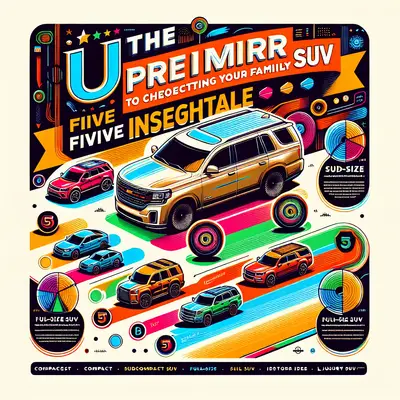
Below are five exclusive, often-overlooked insights that can transform a “good” SUV into the right one for your family, both now and several years (and many miles) from today.
Insight 1: The Comfort Envelope — Not Just Seats, but How the Cabin Works Around You
When most family buyers think “comfort,” the conversation stops at seat material, legroom, and perhaps the presence of seat heaters. The more revealing lens is to consider the entire “comfort envelope” of the cabin: how the vehicle supports your family across a full day of use, from dawn commute to late‑evening return.
Start by evaluating seat architecture rather than just softness. Look for multi-way power adjustment for the driver and front passenger, adjustable lumbar support (critical on longer drives), and well-shaped side bolsters that hold you gently in place without feeling restrictive. Families who share driving duties should prioritize memory seat and mirror positions—this small detail can turn every handoff of the keys into a seamless transition rather than a minute of fiddling.
Next, observe how the climate system behaves. Dual-zone is now common; tri- or quad-zone climate is where genuinely family-conscious SUVs distinguish themselves. Separate rear controls allow children or adult passengers to tailor their environment, while features like ventilated front seats or a heated steering wheel add genuine day-to-day relief in extreme climates.
Pay attention to noise, vibration, and harshness (NVH) as part of comfort. On a test drive, turn the audio system off and listen at highway speeds: Do you hear tire hum, wind rustle from the mirrors, or engine drone on inclines? A well-insulated cabin with laminated glass and well-tuned suspension will keep everyone calmer and less fatigued on long journeys—an advantage that only reveals itself over time, but one you will feel on every road trip.
Insight 2: The “Real Life” Space Test — Beyond Cargo Volume Numbers
Cargo volume specifications are a blunt instrument: useful on paper, misleading in practice. A sophisticated family SUV evaluation goes far deeper than a cubic-foot figure listed on a spec sheet. The question isn’t “How much space?” but “How useable is the space we have?”
Begin with a simple, practical test: bring your actual gear. Fold up the stroller, pack the sports bags, grab the musical instrument cases or travel crib, and see how naturally everything finds a place. An SUV that swallows your life without forcing a Tetris-level arrangement is far more valuable than one with theoretically larger capacity that’s awkwardly shaped.
Pay close attention to:
- Load height and opening: A lower load floor makes lifting heavier items easier, which you’ll appreciate with large suitcases, dog crates, or bulky grocery hauls. A wide, square tailgate opening reduces the struggle of angling items through a tapered aperture.
- Third-row usability vs. cargo trade-off: Many three-row SUVs dramatically shrink the luggage area when all seats are in use. If you frequently travel with six or seven people, open the tailgate with all three rows up and ask yourself: Can you still pack weekend luggage or a week’s worth of groceries without resorting to roof boxes?
- Seat folding elegance: One-touch or power-folding seats may sound indulgent, but when you’re juggling children, bags, and time pressures, the ability to reconfigure the cabin with a single pull or button transforms daily ease. Check whether the resulting floor is flat and continuous—lumps and gaps waste meaningful space.
The most refined family SUVs are the ones that feel like a well-designed apartment: every inch thoughtfully considered, every corner easy to use.
Insight 3: Subtle Safety — How the Vehicle Protects When You’re Tired, Distracted, or Rushed
Many family buyers know to look for top crash-test ratings and a suite of driver-assistance features, but the nuance lies in how gracefully those systems work in the moments when real life is imperfect. The goal is not to drive for you, but to quietly assist when fatigue, distraction, or chaos in the back seats make you less than ideal behind the wheel.
Look for a well-integrated advanced driver-assistance system (ADAS) that includes adaptive cruise control, lane-keeping assistance, forward collision warning with automatic emergency braking, and blind-spot monitoring. But go further: test how each system behaves in real traffic. Lane-keeping should nudge, not yank. Adaptive cruise should accelerate and decelerate smoothly instead of surging. Overly nervous or abrupt systems can be more stressful than helpful.
Families should also pay attention to less-advertised safety refinements:
- Rear occupant alerts that remind you to check the back seats when you exit—subtle but crucial for preventing tragic forgetfulness on hectic days.
- Surround-view cameras with clear, high‑resolution imagery and intuitive guidelines, especially helpful in tight school parking lots and crowded driveways.
- Safe-exit alerts that warn when a vehicle or cyclist is approaching from behind as doors are opened—something you’ll deeply appreciate on busy urban streets.
Ask the dealer to walk you through the safety menu on the infotainment system. A sophisticated SUV allows you to tailor warning sensitivity and feedback style, letting you calibrate the car’s “personality” to your comfort level. This customization is the difference between features that are switched off in frustration and those that become trusted partners over time.
Insight 4: Technology That Disappears — When Digital Features Feel Effortless, Not Showy
Technology in modern SUVs is abundant; the discerning question is whether it feels elegantly integrated or constantly demands your attention. For a family-focused vehicle, the highest compliment you can give the tech is that it quietly disappears into the background, doing its job without forcing you to think about it.
Start with the infotainment layout. Large screens are fashionable, but what matters is clarity and simplicity. Are core functions—navigation, audio, phone, climate—reachable with one or two taps? Are there physical knobs for volume and temperature, or is everything buried behind layers of menus? In a premium family environment, a well-balanced combination of tactile controls and touchscreens is often more satisfying than a full digital wall.
Wireless Apple CarPlay and Android Auto, multiple USB-C ports across all rows, and a reliable voice assistant that understands natural language are no longer indulgences; they’re the foundation of tech that supports daily life. Watch how easily rear passengers can charge devices and how neatly cables can be routed—these design details determine whether your cabin feels serene or perpetually entangled.
Pay special attention to the quality of the driver display. A crisp, configurable digital cluster that can prioritize navigation prompts, driver-assist status, and essential information keeps your eyes more focused and your mind less cluttered. Heads-up displays that project key details onto the windshield can further reduce distraction, especially on long night drives or in unfamiliar cities.
Ultimately, the most refined tech suites are those that enable you to settle in, cue a playlist, confirm the route, and forget about the interface entirely—because it simply works, every time.
Insight 5: The Long Horizon — Residual Value, Running Costs, and Future-Facing Powertrains
A premium family SUV is more than a purchase; it’s a multi-year companion. The way it ages—mechanically, financially, and technologically—matters profoundly. Evaluating the long horizon shifts the focus from “What excites us now?” to “What will still feel right in five years?”
First, consider the powertrain through the lens of your real-world driving. If most of your miles are urban or suburban, a hybrid or plug-in hybrid can significantly lower fuel costs while offering a quieter, smoother drive in traffic. Families who frequently travel long distances may still prefer a refined gasoline engine or a long-range EV with strong fast-charging capability along their usual routes.
Take time to understand expected maintenance schedules, warranty coverage, and likely resale value. Brands with strong reliability reputations and robust dealer networks often deliver lower total cost of ownership, even if the initial price is slightly higher. A longer warranty—especially on hybrid or EV components—offers meaningful peace of mind as technology becomes more complex.
Also consider how “future-proof” the SUV feels. Over-the-air software update capability can keep infotainment and driver-assistance systems fresh and secure over time. Some models can even receive new features post-purchase, prolonging the feeling of newness and relevance.
Finally, ask yourself whether the vehicle aligns with your family’s expected evolution: Will a growing teenager still be comfortable in the second or third row? Will your cargo needs expand with new hobbies or travel patterns? Choosing an SUV that has graceful room to grow can save you from an earlier-than-expected replacement and will make every passing year feel like a continued good decision rather than a compromise.
Conclusion
A truly satisfying family SUV is not defined by a single headline feature, but by the way hundreds of small decisions come together—the contour of a seat, the calm of the cabin at speed, the logic of its storage, the gentleness of its safety systems, the effortlessness of its technology, and the quiet confidence of its long-term ownership story.
When you shop with these refined, real-world insights in mind, you move beyond chasing specifications and towards selecting a companion that supports your family’s rhythm with composure and grace. The most rewarding SUVs are those that feel almost invisible in their competence—vehicles that let your family’s moments take center stage while they handle everything else with understated excellence.
Sources
- [National Highway Traffic Safety Administration (NHTSA)](https://www.nhtsa.gov/ratings) - Official U.S. government crash-test ratings and safety information
- [Insurance Institute for Highway Safety (IIHS)](https://www.iihs.org/ratings) - Independent safety ratings, crash tests, and evaluations for SUVs and other vehicles
- [U.S. Department of Energy – Fuel Economy Guide](https://www.fueleconomy.gov/feg/findacar.shtml) - Data on fuel economy, hybrid/EV options, and estimated running costs
- [Edmunds Car Buying Guides](https://www.edmunds.com/car-buying/) - Expert articles on ownership costs, resale value, and evaluating vehicle features
- [Consumer Reports: Car Reliability & Owner Satisfaction](https://www.consumerreports.org/cars/) - Long-term reliability data, owner satisfaction scores, and comparative insights on family vehicles
Key Takeaway
The most important thing to remember from this article is that this information can change how you think about Buying Guide.