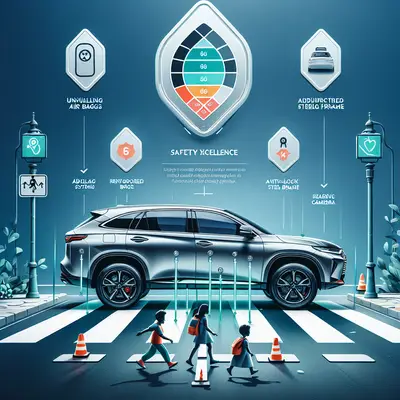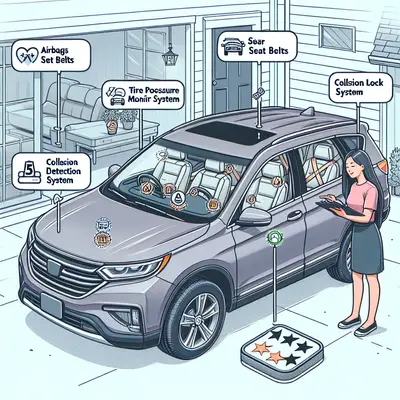
For families who expect more than merely “good enough,” safety ratings are a starting point—not the destination. Those familiar stars and scores offer reassurance, but they rarely capture the nuanced realities of school runs in the rain, late-night highway drives home from the airport, or a fully loaded weekend escape with children, grandparents, and luggage in tow. This is where a more discerning lens becomes invaluable: understanding what safety ratings reveal, what they conceal, and how to interpret them in the context of a refined, family-focused SUV.
Below are five exclusive, quietly powerful insights that help safety-conscious families look beyond surface-level scores and toward the deeper engineering and design decisions that truly shape daily security.
1. The Difference Between “Passing” and Truly Protective
On paper, many SUVs in the family segment wear similar badges of honor: five stars here, “Top Safety Pick” there. Yet, when you examine the underlying test data and methodologies, meaningful differences appear.
Organizations like the National Highway Traffic Safety Administration (NHTSA) and the Insurance Institute for Highway Safety (IIHS) publish more than just a headline score. Digging into how an SUV performs in specific crash modes—such as small overlap front crashes, side impacts at higher speeds, and rear impact tests—reveals how well the cabin remains intact and how effectively restraints control occupant movement. The most thoughtfully engineered SUVs tend to show consistent strength across all these scenarios rather than excelling in only one or two.
For a family, this distinction is crucial. Urban dwellers may face more intersection and side-impact risks. Frequent highway travelers should pay close attention to frontal crash performance and roof strength. A premium choice is one that doesn’t merely meet the testing threshold but demonstrates robust protection across the spectrum of plausible, real-world collisions.
2. Cabin Geometry: Why Seat Shape, Spacing, and Layout Quietly Matter
Safety ratings can validate crash performance, but they cannot fully describe how a family will physically inhabit the space. This is where cabin geometry—the precise relationship between seats, doors, pillars, and windows—becomes a defining factor.
Consider second-row and third-row seating. Many SUVs accommodate child seats, but not all do so gracefully. The distance between seating positions, the contour of the seatbacks, and the placement of head restraints influence how securely child seats install and how comfortably adults can sit beside them. A well-designed family SUV offers outboard seats positioned to maximize airbag coverage, with head restraints and belt anchorages tuned for both tall adults and smaller passengers.
Equally important is how accessible those seats are in an emergency. Wide-opening rear doors, thoughtful step-in heights, and clear pathways into the third row can make a vital difference when you must exit the vehicle quickly with children, belongings, and possibly a stroller in one hand. While test agencies can’t rate such details in a single number, the most family-attuned SUVs treat cabin geometry as a safety feature in its own right—balancing structural integrity with visibility, grace of access, and ease of movement.
3. Advanced Driver Assistance: Calibration Over Checkboxes
Modern SUVs are filled with acronyms—AEB, ACC, LKA, BSW—and safety ratings increasingly acknowledge the presence of advanced driver-assistance systems (ADAS). Yet, a subtle truth often goes unspoken: how these systems are calibrated can be more important than whether they exist at all.
Automatic emergency braking (AEB) is a prime example. It might score well in controlled tests, but the day-to-day experience is defined by how smoothly it intervenes, how early it warns, and how reliably it recognizes complex situations such as pedestrians stepping off a curb at dusk, or cyclists in low-contrast clothing. Some premium SUVs deliver a near-seamless blend between human and machine input, working in the background with minimal false alarms. Others feel abrupt or overcautious, which can encourage drivers to switch features off—a silent erosion of safety.
Similarly, lane-keeping and adaptive cruise systems should complement a driver’s natural rhythm rather than fight it. For families who often drive with sleeping children on board, measured, predictable intervention is far preferable to sudden steering corrections. The most sophisticated SUVs allow you to fine-tune the sensitivity and behavior of these systems, transforming safety technology from a blunt instrument into a tailored, quietly reassuring co-pilot.
4. Child-Centric Safety: ISOFIX/LATCH Execution, Not Just Availability
Most modern SUVs advertise ISOFIX or LATCH anchors for child seats. The difference between a merely compliant installation and a truly family-centric solution lies in the details you only notice once you live with the vehicle.
Look closely at anchor accessibility: Are the lower anchors buried deep within the seat bight, or elegantly exposed with subtle guides that make installation near-effortless? Are the top tether anchors clearly labeled and conveniently positioned, including for the third row if you intend to seat young children there? Some of the most family-conscious SUVs design their rear seating with a flat, supportive cushion profile, which keeps child seats stable and reduces the need for improvisational rolling towels or aftermarket supports.
Beyond anchors, consider how the SUV manages overlapping needs: a rear-facing infant seat behind a tall driver, for instance, or two child seats plus an adult in the second row. Safety ratings confirm that the vehicle protects occupants in a crash; the best family SUVs go further by making correct child-seat use intuitive, repeatable, and compatible with real-world family seating patterns. This is the unsung layer of safety that rarely appears in marketing materials yet profoundly influences everyday security.
5. Real-World Testing: Headlights, Night Driving, and All-Weather Confidence
Formal safety scores often highlight crashworthiness and frontal collision avoidance, but many family journeys take place in conditions where visibility is the first line of defense: early-morning commutes, rainy evenings, snow-swept roads, and dimly lit suburbs.
The quality of an SUV’s headlights is more consequential than many buyers realize. IIHS research has shown that good-rated headlights can significantly reduce nighttime crashes, especially those involving pedestrians. Premium family SUVs increasingly pair adaptive LED headlights with high-beam assist, reshaping the beam pattern according to steering angle, speed, and oncoming traffic. The result is a more confident, less fatiguing drive after dark—particularly valuable when returning home from a late practice or weekend trip.
Equally important are elements that interact with visibility and control: well-tuned windshield wipers, effective rear defoggers, heated side mirrors, and stability systems calibrated for slippery surfaces. These features rarely headline safety documentation, yet they fundamentally shape your margin for error in adverse conditions. For a family-oriented SUV, genuine safety leadership is measured not only by how it behaves in a controlled crash, but also by how gracefully it helps you avoid one in challenging real-world weather and lighting.
Conclusion
For families seeking a refined, safety-first SUV, ratings and stars are essential—but they are only the opening chapter. The true measure of a protective, confidence-inspiring vehicle lies in how coherently its engineering, cabin design, child-seat integration, driver-assistance calibration, and visibility solutions work together for your specific lifestyle.
By examining the nuances beneath the scores—how seats are shaped, how driver aids behave, how children’s needs are accommodated, and how the vehicle performs in the quiet, demanding moments of daily life—you move from simply purchasing a “safe” SUV to selecting one that feels innately protective, composed, and reassuring for every occupant, on every journey.
Sources
- NHTSA 5-Star Safety Ratings - Official U.S. government crash test results and explanations of testing procedures
- IIHS Vehicle Ratings - Detailed crashworthiness, crash avoidance, and headlight performance ratings for SUVs and other vehicles
- CDC Child Passenger Safety Guidelines - Evidence-based recommendations for child seats, boosters, and seat belt use
- SaferCar.gov: Car Seats and Booster Seats - U.S. NHTSA guidance on proper child seat installation and vehicle compatibility
- IIHS Research on Headlights and Nighttime Crashes - Research explaining the link between headlight quality and real-world crash outcomes
Key Takeaway
The most important thing to remember from this article is that this information can change how you think about Safety Ratings.