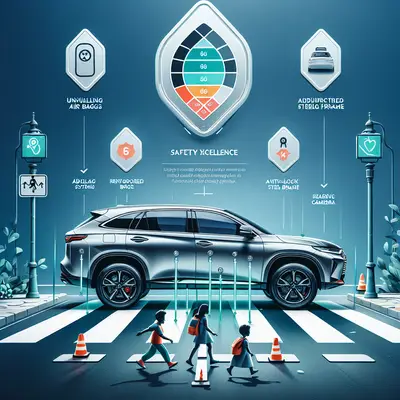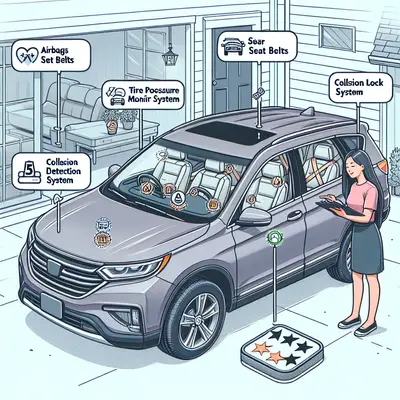
Safety ratings may appear as neat rows of stars and scores, but truly safeguarding your family requires looking beyond the obvious. For discerning parents, the artistry lies in understanding what those ratings conceal as much as what they reveal. A family SUV is not merely transportation; it is a moving sanctuary, and its safety credentials deserve the same scrutiny you’d give to a home, a school, or a neighborhood.
This guide explores how to interpret safety ratings with a more refined lens—highlighting five exclusive insights that help you distinguish an objectively safe SUV from one that is thoughtfully engineered for the realities of modern family life.
Why Safety Ratings Are Only the Beginning
At first glance, crash-test scores from organizations like the NHTSA and IIHS offer a reassuring shorthand: 5 stars, “Top Safety Pick,” green check marks. Yet these labels, while essential, compress an extraordinary amount of nuance into a handful of symbols.
Each test simulates specific crash types under controlled conditions. Real life is rarely so tidy. The angle of impact, vehicle load (children, strollers, luggage), road conditions, and driver reaction all influence outcomes in ways ratings alone cannot fully capture. A model that earns excellent scores on paper may behave quite differently when fully packed for a weekend away with bikes, pets, and grandparents.
Understanding the methodology behind those stars—how tests are performed, where their limits lie, and what they do not measure—is the starting point for a more intentional choice. Think of formal ratings as the framework. Your job is to layer in context: your family’s size, ages, driving environment, and daily patterns.
Insight 1: The Geometry of Protection Matters More Than You Think
Most buyers glance at “side-impact rating” and move on. Very few consider the actual geometry of the cabin—how the structure, seating positions, and restraints work together in three dimensions to protect each occupant.
In a family SUV, small decisions in the design studio translate into large consequences in a collision. The distance between a child’s head and a side window, the height of the beltline, the contouring around the second row, and how closely the third row sits to the rear hatch all influence real-world protection. Two SUVs can share an identical five-star side-impact rating, yet offer very different spatial margins around an outboard child seat or a rear-facing infant in the second row.
When you evaluate safety:
- Observe how far your child’s seating position is from doors, pillars, and rear glass.
- Check whether head restraints align naturally with children in boosters and pre-teens who no longer use child seats.
- Look at how the roofline slopes—an elegant taper may reduce headroom or alter curtain airbag coverage in the third row.
This is the quiet engineering most spec sheets ignore: the invisible buffer zones that turn a good rating into an environment that feels genuinely protective for each age and stage of childhood.
Insight 2: Advanced Driver Assistance Is Only as Good as Its Tuning
Nearly every modern SUV boasts an impressive checklist of driver-assistance systems: automatic emergency braking, lane-keeping, blind-spot monitoring, adaptive cruise control. The temptation is to compare by quantity—who offers the longest list.
A more cultivated approach focuses on tuning and behavior. How early does forward-collision warning intervene? How smoothly does adaptive cruise modulate speed in traffic? Does the lane-keeping assist gently guide or abruptly jerk the wheel? Does the system adapt gracefully in rain, darkness, or poorly marked roads?
These subtleties matter, particularly for families:
- If a system is overly intrusive or unpredictable, drivers are more likely to disable it—erasing its safety benefit.
- Calibrations that are thoughtful and unhurried reduce stress, which is critical during school runs, long trips, and late-night drives with sleeping children.
- Better-integrated systems tend to work in concert—blind-spot alerts, cross-traffic warnings, and 360° cameras creating a single, coherent safety “halo” rather than a cacophony of beeps.
During any test drive, treat driver-assistance behavior as carefully as you would leather quality or sound insulation. The most valuable safety technology is the one your family actually tolerates—and trusts—every day.
Insight 3: Child-Seat Compatibility Is a Hidden Safety Differentiator
Ratings rarely account for the sheer complexity of modern child restraints. Yet for many families, the interplay between vehicle and car seat is the most critical—and most frequently overlooked—safety variable.
Premium SUVs can disappoint if latch anchors are hard to access, seat belts are awkward to route, or the second-row contouring fights against a proper install. Similarly, a seemingly modest model may be brilliantly executed for child-seat use, with wide door openings, flat cushion surfaces, and thoughtfully placed anchors.
Consider these nuances:
- Latch anchor accessibility: Are they buried deep behind upholstery, or cleanly exposed with minimal effort?
- Rear-facing clearance: With a tall driver or front passenger, is there enough room for an extended rear-facing seat without forcing knees into the dashboard?
- Third-row reality: If you plan to seat children in the third row, can you access it with installed second-row seats, and are there tether anchors where you need them?
- Belt path logic: For boosters and forward-facing seats, do belt paths lie flat and unobstructed, or twist and wander around cushions and trim?
In a world of polished showrooms and glossy brochures, car-seat compatibility feels decidedly practical—and distinctly unglamorous. Yet this quiet detail often separates SUVs that are theoretically safe from those that are elegantly optimized for actual family use.
Insight 4: Crash Performance Evolves; Safety Is a Moving Target
A five-star SUV from five years ago is not equivalent to a five-star SUV today. As vehicle fleets grow heavier and taller, and as test protocols evolve to address new real-world crash patterns, safety standards rise in ways the casual shopper rarely notices.
This has significant implications:
- An older “Top Safety Pick” may not meet today’s more stringent side-impact or pedestrian-protection criteria.
- Some manufacturers move quickly to respond to new tests (e.g., updated side-impact or small-overlap evaluations), reinforcing structures or recalibrating airbags mid-generation. Others lag behind.
- Facelifts and mid-cycle refreshes may introduce meaningful safety updates—additional airbags, improved driver-assistance cameras, better headlights—quietly elevating a model’s performance.
Families who plan to keep an SUV for many years should pay attention to where it stands in its life cycle. A model that has just been redesigned typically embeds the latest thinking in structural safety and sensor technology. When you research, compare not only star ratings but also the year and version of each test, and whether the model has received recent safety-related revisions.
Insight 5: Everyday Usability Is an Underrated Safety Feature
True safety is not confined to the moment of impact; it lives in the thousand small interactions that help prevent accidents in the first place. This is where ergonomics, visibility, and cabin calm play a decisive role.
Consider how subtly thoughtful design underpins safe driving:
- Clear, uncluttered instrumentation makes it easier to glance and return eyes to the road.
- A naturally intuitive infotainment layout reduces the temptation to “hunt and tap” while moving.
- Generous glass areas, slim roof pillars, and well-positioned mirrors improve situational awareness, especially in tight urban streets or busy school parking lots.
- Refinement—low noise levels, compliant ride quality, supportive seats—helps reduce fatigue on longer drives, supporting better judgment and quicker reactions.
In many ways, the most sophisticated family SUVs treat safety as an ambiance rather than a checklist: calm parents, content passengers, and a cabin that never demands more attention than it deserves. When the basics of comfort and usability are executed at a high level, families are simply better positioned to avoid the kind of lapses that lead to crashes.
Conclusion
Safety ratings are indispensable, but they are not the full story. For families choosing an SUV as their daily companion, the real measure of protection is woven through cabin geometry, child-seat harmony, the demeanor of driver-assistance systems, the evolutionary pace of crash performance, and the everyday ease with which parents can simply drive.
Approach safety not as a static score, but as a living ecosystem that must align with your family’s unique rhythms and priorities. When you pair excellent formal ratings with these quieter, more refined insights, you move beyond checking boxes—and into the realm of choosing an SUV that feels, in every sense, like a well-engineered sanctuary for the people who matter most.
Sources
- [National Highway Traffic Safety Administration (NHTSA) 5-Star Safety Ratings](https://www.nhtsa.gov/ratings) - Explains federal crash-test procedures, rating categories, and vehicle safety information
- [Insurance Institute for Highway Safety (IIHS) Vehicle Ratings](https://www.iihs.org/ratings) - Provides detailed crash-test results, methodology, and “Top Safety Pick” criteria for SUVs and other vehicles
- [Centers for Disease Control and Prevention (CDC): Child Passenger Safety](https://www.cdc.gov/transportationsafety/child_passenger_safety) - Offers research-based guidance on child restraints and factors influencing child injury risk in crashes
- [SaferCar.gov – Car Seats and Booster Seats](https://www.nhtsa.gov/campaign/right-seat) - U.S. DOT/NHTSA resource on car-seat selection, installation, and compatibility considerations
- [IIHS: Advanced Driver Assistance Systems (ADAS) Research](https://www.iihs.org/topics/advanced-driver-assistance) - Summarizes current findings on the effectiveness and limitations of driver-assistance technologies
Key Takeaway
The most important thing to remember from this article is that this information can change how you think about Safety Ratings.