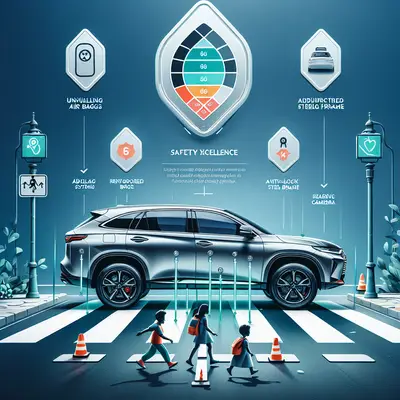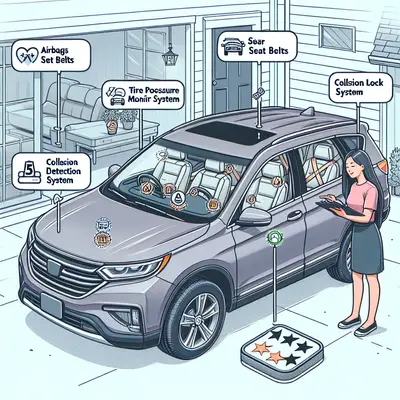
For families who approach a vehicle purchase with the same care they’d bring to choosing a home or school, safety ratings are not a headline—they are the foundation. Yet the polished “5-star” or “Top Safety Pick+” badges only tell part of the story. Beneath the icons lies a world of nuance that can profoundly shape how your SUV will protect your family in the moments that matter most. This guide invites you to step beyond surface-level reassurance and into a more refined understanding of how safety ratings truly work—and how to use them with quiet confidence.
How Safety Ratings Are Really Built
Safety ratings are the product of carefully engineered crash tests, controlled variables, and evolving standards, not just a star count on a spec sheet. Agencies such as the National Highway Traffic Safety Administration (NHTSA) and the Insurance Institute for Highway Safety (IIHS) evaluate SUVs across multiple dimensions: frontal crashes, side impacts, rollovers, roof strength, head restraints, and increasingly, advanced driver assistance systems.
The important nuance is that a single “overall” rating can mask meaningful differences in specific tests. An SUV might perform beautifully in frontal impact but only adequately in small-overlap crashes—or vice versa. Test speeds, angles, and dummy sizes are standardized to allow comparison but can never perfectly mirror your family’s real-world driving environment. A sophisticated shopper looks at the full testing matrix rather than settling for the summary badge.
It’s also vital to understand that safety standards evolve. A “5-star” rating from a decade ago is not equivalent to a “5-star” rating earned today because tests are continuously getting tougher. Treat ratings as a moving benchmark, not a static seal of approval. When comparing vehicles, focus on the most recent model-year results and be cautious about drawing conclusions from outdated or incomplete data.
Advanced Driver Assistance: The New Safety Battleground
Modern safety ratings increasingly incorporate not just how a vehicle behaves in a crash, but how effectively it helps you avoid one. Features such as automatic emergency braking, lane-keeping assistance, blind-spot monitoring, and adaptive cruise control are now assessed in more detail, especially by IIHS and Euro NCAP. This shift reflects a subtle but critical emphasis on prevention over protection.
However, not all systems are created equal. Some brands tune their systems conservatively, intervening gently and early, while others are more abrupt and assertive. This can dramatically change your day-to-day experience—particularly on long commutes, in dense traffic, or on winding suburban roads. Ratings will tell you whether a feature exists and how well it performs in controlled testing, but they won’t necessarily convey how natural or fatiguing it feels over time.
A discerning family will look for both breadth and refinement: which driver assistance features come standard, how they’re rated by independent organizations, and how intuitively they integrate into the driving experience. Where possible, a properly structured test drive—night driving, highway merging, congested city streets—can reveal whether the system’s real-world behavior aligns with your expectations of calm, confident assistance rather than intrusive overcorrection.
Five Exclusive Safety Insights for the Refined SUV Buyer
For families who prefer to look beyond marketing slogans, the following five insights can transform the way you interpret safety ratings and, ultimately, what you choose to drive.
1. Side-Impact Sophistication Often Matters More Than You Think
Many buyers focus instinctively on frontal crash scores, but for a family SUV frequently used in city traffic, intersections, and school zones, side-impact performance can be just as critical. Modern tests increasingly simulate collisions with taller, heavier vehicles such as pickups and SUVs, which behave very differently from compact cars in a crash.
Look beyond the generic “side” label and study performance in tests that simulate a higher-riding vehicle striking the side of an SUV. Pay attention to injury measures for both front and rear occupants, especially if your children will regularly occupy the second row. The best family SUVs show consistent, low injury risks across all seating positions—not just for the driver.
2. Rear-Seat Safety Is No Longer an Afterthought
Historically, crash testing has focused on front occupants. But as child seats and older children occupy the second row, rear-seat protection has become a decisive factor. Newer small-overlap and moderate-overlap frontal tests are beginning to place enhanced emphasis on rear-occupant kinematics, seatbelt performance, and airbag coverage.
For a family SUV, prioritize models that demonstrate strong rear-occupant protection in recent tests, not just acceptable front-seat performance. Look for clear mention of rear-seat dummy results in IIHS or similar reports. A thoughtfully engineered SUV will feature advanced belt tensioners, load limiters, and carefully calibrated seat structures that work together to protect younger and smaller passengers in the back.
3. Roof Strength and Rollover Resistance Quietly Separate the Best
Rollover risk may feel like a distant concern, but it matters particularly for taller vehicles such as SUVs. Ratings typically assess both a vehicle’s propensity to roll and the ability of the roof structure to maintain survival space in such an event. This is one of the most revealing measures of underlying engineering quality and body rigidity.
A premium-feeling SUV with a panoramic roof or sleek design still needs to demonstrate robust roof strength in objective tests. When browsing ratings, note vehicles that excel significantly above minimum criteria in roof-crush tests. Stronger structures do more than protect occupants in rollovers—they often correlate with better overall body integrity, improving crash energy management in a wide range of scenarios.
4. The Calibration of Safety Systems Is as Important as Their Presence
It is easy to be impressed by a long list of safety technologies, but the true mark of thoughtful engineering is how seamlessly those systems work together. A safety suite that constantly chimes, flashes, or corrects your steering can increase stress and lead to driver disengagement, undermining its purpose.
When safety ratings report on advanced driver assistance systems, they usually focus on core performance: did the vehicle avoid or mitigate a crash in controlled conditions? As a discerning buyer, you should also consider the sophistication of user interfaces—how clearly the system communicates its status, how easily it can be tailored to your preferences, and whether assistance feels anticipatory rather than reactive.
An SUV that earns high marks in preventative safety and pairs that with calm, intuitive behavior on the road is a subtle but meaningful differentiator for families who value serenity as much as security.
5. Weight, Size, and Compatibility: The Nuanced Trade-Off
There is a long-standing perception that heavier, larger vehicles are always safer. While there is some truth in the laws of physics, modern safety ratings introduce a more nuanced perspective—particularly around crash compatibility, pedestrian safety, and maneuverability.
A larger SUV may offer greater protection in certain multi-vehicle collisions but could also require a longer stopping distance and impose higher risks to occupants of smaller vehicles or pedestrians. Contemporary rating systems increasingly reward vehicles that not only protect their own occupants but also reduce harm to others through carefully designed front-end structures and advanced braking technologies.
For a family, the ideal is a balanced SUV: substantial enough to provide a sense of stability and presence, but engineered thoughtfully to minimize aggressivity and maximize active safety. Comparing ratings across size classes, and reading the associated test notes, can help identify vehicles that achieve this equilibrium with understated excellence.
Bringing It All Together for Your Family
Safety ratings, when viewed with a discerning eye, form a powerful lens through which to evaluate family SUVs. They reveal not just how a vehicle performs in a crash, but how seriously a manufacturer treats the complex business of occupant protection and crash avoidance. By looking beyond the headlines into side-impact details, rear-seat protection, roof strength, system calibration, and the subtleties of size and weight, you elevate your decision from “safe enough” to genuinely well-judged.
The most compelling family SUVs are not simply those with the right badges on the brochure, but those whose underlying engineering philosophy aligns with your priorities: quiet assurance, thoughtful protection for every seat, and assistance systems that feel like a well-trained co-pilot rather than an anxious supervisor. With a deeper understanding of how safety ratings are built—and how to interpret their nuances—you can choose an SUV that doesn’t just perform well on paper, but feels unshakeably composed in the real world your family inhabits every day.
Sources
- [NHTSA 5-Star Safety Ratings Overview](https://www.nhtsa.gov/ratings) – Explains how U.S. federal crash tests and star ratings are conducted and what each category measures
- [IIHS Vehicle Ratings](https://www.iihs.org/ratings) – Detailed crash test data, including small overlap, side impact, roof strength, and evaluations of advanced driver assistance systems
- [Euro NCAP Safety Explained](https://www.euroncap.com/en/safety-explained/) – Insight into European testing protocols, including pedestrian protection and active safety assessments
- [CDC – Motor Vehicle Safety](https://www.cdc.gov/transportationsafety/index.html) – Public health perspective on crash injury patterns and the importance of occupant protection
- [National Safety Council – Defensive Driving & Advanced Safety Tech](https://www.nsc.org/road/safety-topics/advanced-driver-assistance-systems) – Independent overview of driver assistance technologies and their role in crash avoidance
Key Takeaway
The most important thing to remember from this article is that this information can change how you think about Safety Ratings.