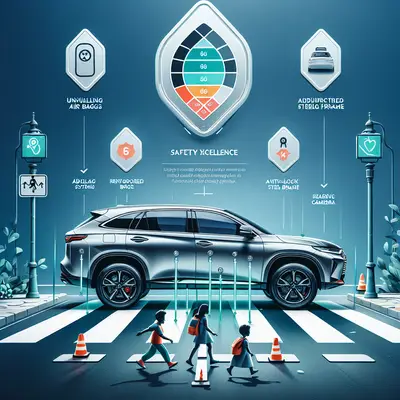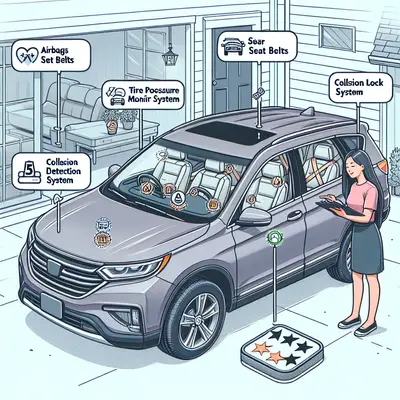
Choosing a family SUV is no longer just about space, style, or badge prestige. For discerning families, true luxury now includes something far less visible yet infinitely more valuable: how intelligently and comprehensively a vehicle protects the people inside it. Safety ratings are often presented as simple stars or scores, but beneath those symbols lies an ecosystem of engineering decisions, crash-test philosophies, and real-world performance that can dramatically shape your daily experience. Understanding that nuance transforms a routine purchase into a considered investment in your family’s comfort, confidence, and peace of mind.
Why Safety Scores Are Only the Beginning
Most families encounter safety information through the familiar shorthand of 5-star ratings or “Top Safety Pick+” badges. These are immensely helpful, but they are also summaries—elegant abbreviations of a complex story. Agencies such as the National Highway Traffic Safety Administration (NHTSA) and the Insurance Institute for Highway Safety (IIHS) evaluate different dimensions of crashworthiness and crash avoidance, yet their tests are not identical, nor are their scoring philosophies.
A sophisticated approach begins by seeing these ratings as complementary rather than interchangeable. A vehicle that performs strongly with both NHTSA and IIHS is not merely “safe”; it is resilient across a broader range of impact types and scenarios. The distinction matters: for example, the IIHS small overlap test mimics a relatively common real-world crash configuration that older rating systems ignored. A family that looks beyond the overall star or single label, and instead cross-references multiple test programs, gains a more accurate sense of how a given SUV will behave in unexpected, imperfect, real-world situations.
Exclusive Insight 1: The Geometry of Protection Matters More Than You Think
Underneath every safety rating is a less discussed element: structure and geometry—how the vehicle’s body is shaped, braced, and reinforced. For families, this translates into how well the cabin maintains its integrity when the unexpected happens. In detailed crash reports, you’ll find references to “survival space,” “intrusion measurements,” and “A-pillar deformation.” These are not merely technical curiosities; they describe whether seat rails shift, footwells collapse, or door frames warp under impact.
A refined safety evaluation pays close attention to these specifics. For example, a vehicle may technically earn a high star rating, yet show concerning levels of intrusion around the driver’s legs or the front passenger’s footwell in detailed test documentation. Families with taller drivers, or those frequently traveling with an adult in the front passenger seat, may wish to prioritize SUVs that demonstrate minimal cabin deformation in both frontal and small-overlap crash tests. Safe structure is a silent luxury—it does nothing most days, and everything when it matters.
Exclusive Insight 2: Child Seating Realities Don’t Always Align with Scores
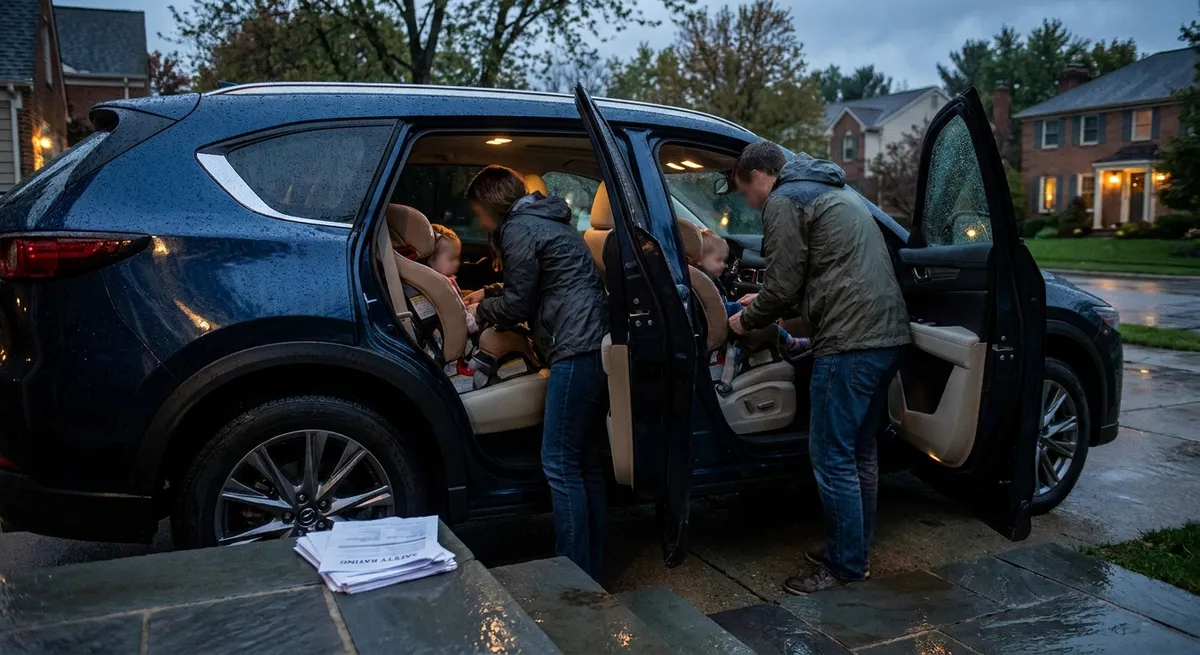
For families with infants, toddlers, or booster-age children, safety is not only about crash tests; it’s also about the daily ritual of properly installing and using child seats. Many ratings don’t fully capture how intuitive, accessible, and flexible an SUV’s LATCH (Lower Anchors and Tethers for Children) system really is in daily life. Some models hide their excellence in subtle details: clearly marked anchor points that are easy to reach without compressing the seat cushion, rear head restraints that adjust or remove without tools, and second-row sliding mechanisms that allow you to leave child seats installed while accessing the third row.
Sophisticated buyers look for vehicles whose safety evaluations explicitly discuss child seat compatibility or that have been assessed for child-seat ease-of-use by independent organizations. In practice, this can mean choosing a model with anchors that accommodate a variety of premium child seats without resorting to frustrating workarounds. When anchors are well-designed, you reduce the risk of misinstallation, which is an underappreciated factor in real-world child safety. In this sense, an SUV that quietly simplifies every install, every belt path, and every tether routing is offering a form of safety that exceeds its printed scorecard.
Exclusive Insight 3: Advanced Driver Assistance Is Only as Good as Its Tuning
Many modern family SUVs now arrive with a suite of advanced driver-assistance systems (ADAS): automatic emergency braking, lane-keeping assistance, adaptive cruise control, blind-spot monitoring, and more. The presence of these features is increasingly reflected in safety ratings and awards, but the nuance lies in how these systems behave. An elegantly tuned system supports the driver with smooth, predictable interventions; a poorly calibrated one may startle, overcorrect, or generate so many false alerts that the driver is tempted to disable it.
A sophisticated interpretation of safety ratings considers not only whether ADAS features exist but also how independent testers and reviewers characterize their refinement. Does the automatic emergency braking react confidently in pedestrian scenarios? Is lane centering precise yet unobtrusive, or does it “ping-pong” between lane markings? For family use, the best systems are those that remain almost invisible, stepping in calmly when needed but otherwise receding into the background of a relaxed, confident drive. Families who tour test-drive routes that include curves, varied speeds, and traffic can better evaluate whether a vehicle’s technology truly enhances safety or simply adds complexity.
Exclusive Insight 4: Nighttime and Headlight Performance Are Underestimated Essentials
Even the most safety-conscious families can overlook one critical dimension: how the SUV behaves after dark. Many organizations now test and rate headlight performance, including brightness, beam pattern, and glare to oncoming traffic. These evaluations may appear secondary, but for families frequently driving at night—returning from sports practice, late flights, or weekend getaways—they are essential.
Premium SUVs increasingly feature adaptive headlights that pivot with the steering angle, automatically adjust high beams based on detected traffic, and offer advanced LED or matrix technology. What matters is not just the sophistication of the hardware, but the consistency of illumination across curves, elevation changes, and inclement weather. A family-focused interpretation of safety ratings will seek out models with strong formal headlight scores and, ideally, driver impressions that speak to clear visibility without eye fatigue. In real terms, superior headlight performance is a quiet yet profound safety advantage, reducing strain and improving reaction time in precisely the moments when you and your family are most vulnerable.
Exclusive Insight 5: Crash Tests Rarely Capture Everyday Stability
Crash ratings necessarily focus on impact events, but many of the scenarios families encounter most—emergency lane changes, evasive maneuvers, sudden braking on wet pavement—are better described as near misses. The way an SUV responds in these moments is tied to its chassis tuning, electronic stability control calibration, tire choice, and brake performance. While formal safety ratings do capture some of this through rollover resistance or braking tests, they cannot fully convey the intuitive sense of poise or predictability that defines a truly secure-feeling family SUV.
Discerning buyers look for evidence of strong stability-control performance, short and repeatable braking distances, and well-Regarded wet-weather behavior from reputable testing outlets. A vehicle that tracks straight and confidence-inspiring under hard braking, resists excessive body roll when you must swerve, and communicates grip levels clearly through the steering wheel reduces both incident risk and driver fatigue. For family use, that translates to a more composed school-run, less anxiety in heavy rain, and a calmer experience when the unexpected car in front stops more abruptly than expected. Safety, in this dimension, is the byproduct of engineering that prioritizes control and predictability as much as protection.
Weaving Ratings into a Holistic Safety Portrait
When viewed in isolation, safety ratings can appear definitive—an elegant numerical solution to a complex problem. Yet for families who treat their SUV as an extension of their home, a more nuanced perspective proves invaluable. The geometry of the cabin structure, the thoughtfulness of child-seat integration, the tuning of advanced driver aids, the quality of nighttime visibility, and the composure in evasive maneuvers together form a more complete safety profile than any single star or label can provide.
The most rewarding approach is to treat official ratings as a foundation and then layer on real-world considerations that align with your family’s rhythms. Study the detailed test reports, pay attention to headlight and ADAS evaluations, and physically test child-seat installations during your shopping process. When a vehicle feels intuitively secure, simplifies your daily routines, and is backed by strong, multi-angled safety data, you are no longer just buying an SUV—you are curating a mobile environment that embodies protection as a quiet, enduring form of luxury.
Sources
- NHTSA 5-Star Safety Ratings - Official U.S. government crash-test ratings and detailed test results for vehicles sold in the United States
- IIHS Vehicle Ratings - Comprehensive crashworthiness, crash-avoidance, and headlight performance evaluations, including small overlap and child seat assessments
- Euro NCAP Safety Ratings - European crash-test and safety-assistance evaluations, offering a complementary perspective on global vehicle safety performance
- Edmunds Car Safety Features Guide - Consumer-focused explanations of modern safety and driver-assistance technologies, with testing impressions
- National Safety Council – Motor Vehicle Safety - Research, statistics, and guidance on road and vehicle safety, including the impact of technology and driver behavior
Key Takeaway
The most important thing to remember from this article is that this information can change how you think about Safety Ratings.