For discerning families, safety ratings are not a box to tick—they are a language to be read, interpreted, and translated into everyday peace of mind. Yet the way those stars, scores, and acronyms are presented can feel more like marketing than meaningful guidance. This is where a more refined lens matters. When you understand what safety ratings truly measure—and what they don’t—you can separate polished brochure talk from genuine engineering substance.
Below, we explore how modern SUV safety ratings actually work, and share five exclusive, nuanced insights that help families look beyond the obvious and toward the genuinely protective.
How Crash Tests Really Translate to Real Life
Most families recognize organizations like the National Highway Traffic Safety Administration (NHTSA) and the Insurance Institute for Highway Safety (IIHS), but few understand how differently they evaluate vehicles. NHTSA primarily uses a five‑star system derived from frontal, side, and rollover tests; IIHS relies on a series of “Good” to “Poor” and “Superior” to “Basic” ratings across multiple, evolving crash scenarios. Both matter—but they emphasize different questions.
Frontal crash tests, for instance, are conducted at fixed speeds and angles, often simulating impacts between similarly sized vehicles. That means a midsize SUV with a strong rating is optimized for a fairly specific, controlled event. Real life is messier: speed varies, impact angles are imperfect, and the vehicles involved rarely match in size or weight. This is why newer small overlap front tests and updated side-impact protocols have become so critical—they better reflect real-world crashes where only part of the vehicle’s front or side actually takes the hit.
Understanding this context shifts the conversation. Instead of asking, “Does this SUV have five stars?” a more powerful question emerges: “Which tests have been updated, and how did this SUV perform under the latest, more demanding standards?” That single reframing often narrows the field dramatically.
The First Exclusive Insight: Updated Tests Are the True Differentiator
Not all five‑star or “Top Safety Pick” badges are created equal in time. Safety standards evolve, and top ratings from several model years ago may not carry the same meaning today. IIHS, for instance, has tightened criteria for awards multiple times, adding more stringent side-impact tests, nighttime pedestrian-detection assessments, and enhanced headlight requirements.
For families, the subtle but critical insight is this: prioritize SUVs that excel in the most recent crash tests and award criteria, not just those that advertise an older accolade. A model boasting a “Top Safety Pick” from a previous generation may ride on the prestige of the badge, yet fail to meet the tougher, current benchmarks for occupant protection and crash avoidance.
When evaluating, look for language such as “updated test,” “redesigned protocol,” or “new criteria.” If a manufacturer highlights awards without clearly indicating model year and test version, it’s worth examining the official IIHS or NHTSA report directly. The SUVs that still stand out under the newest, harshest conditions are the ones that offer truly future‑proof safety.
The Second Exclusive Insight: Head Restraints and Seats Quietly Protect Your Neck
Seat and head restraint design is rarely the hero of an SUV showroom tour, but it quietly plays a decisive role in rear-impact safety. Whiplash injuries, though often categorized as “minor,” can be long-lasting and life-disrupting, especially for frequent commuters and parents who spend hours each week on school runs and highway drives.
IIHS specifically evaluates the geometry and performance of seats and head restraints in rear crash tests, rating them on how well they mitigate neck injury risk. Many families focus on airbags and structural scores while overlooking this quietly protective component. Yet properly engineered seats can significantly reduce the severity of soft-tissue and spinal injuries in even moderate collisions.
An elevated approach is to treat head restraint quality as part of the comfort conversation rather than a separate, clinical safety topic. If a seat feels thoughtfully contoured, provides genuine support without forcing an awkward posture, and offers precise vertical and fore‑aft adjustment for a wide range of occupants, it’s often a sign that the brand has invested in more than aesthetics. Combine that with “Good” or “Acceptable” ratings in official rear-impact tests, and you’ve found a rare intersection of comfort and protection.
The Third Exclusive Insight: Child Seating Geometry Matters as Much as Airbags
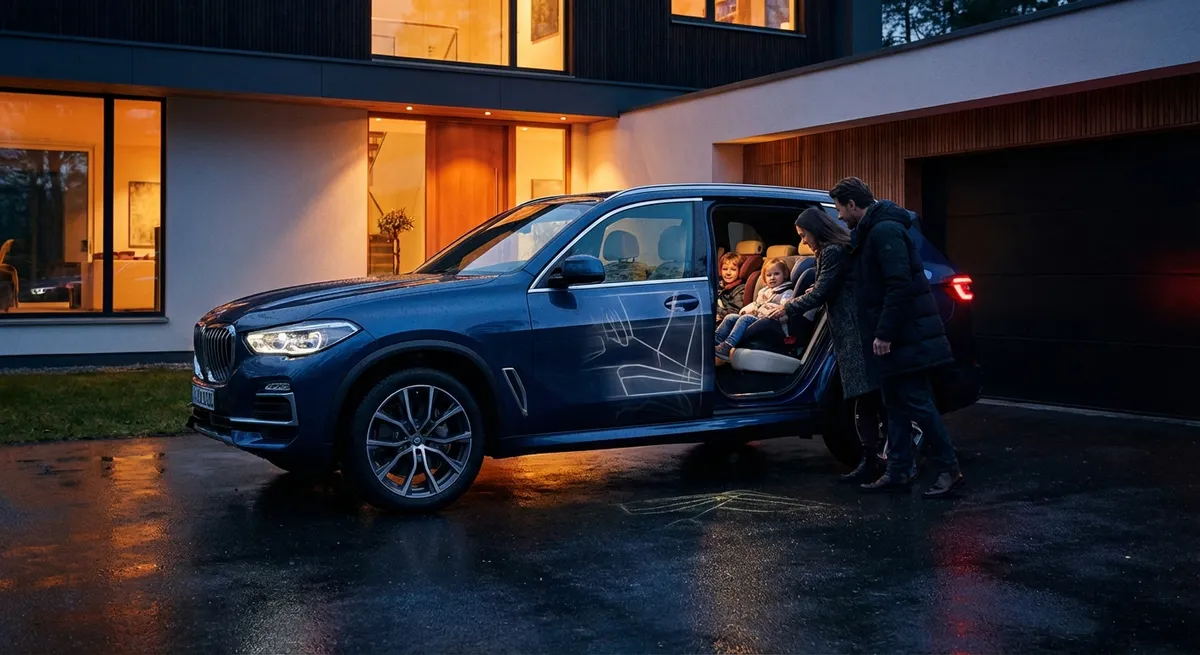
All the airbags in the world cannot compensate for a poorly situated or hard‑to‑install child seat. For families with young passengers, the true sophistication of an SUV’s safety lies in its child seating geometry—how the vehicle’s shape, seat design, and anchoring systems work together to support safe installation.
Look beyond the presence of ISOFIX/LATCH anchors and consider their placement and accessibility. Anchors buried deep between cushions, or tether points placed awkwardly on the floor or ceiling, invite rushed or imperfect installations. IIHS conducts child seat anchor ease-of-use evaluations, which can offer a remarkably practical window into real-world family safety.
Equally important is seat contour. Highly sculpted or aggressively bolstered seats may impede secure, level positioning of a child seat, especially for bulkier models or combination boosters. A refined family SUV quietly balances style with flat-enough, supportive seating surfaces that accommodate a range of child restraints without awkward compromises. In practice, this means your child’s seat is more likely to be installed correctly every time—arguably one of the most meaningful safety advantages any family vehicle can offer.
The Fourth Exclusive Insight: Not All “Advanced Safety Tech” Is Equal
The modern SUV spec sheet reads like a catalogue of acronyms: AEB, LDW, LKA, ACC, BSW, RCTA. These fall under a broad category known as advanced driver-assistance systems (ADAS). While most buyers understand that features like automatic emergency braking and lane-keeping assistance are beneficial, few realize how dramatically their real-world performance can vary between brands and models.
IIHS and other organizations have begun testing not just whether these systems exist, but how well they detect pedestrians, cyclists, and other vehicles under differing lighting and speed conditions. Some systems excel in daytime but falter at night; others struggle to recognize pedestrians crossing from the side or small children near the roadway. For a family SUV that will frequently operate in school zones, suburban streets, and at twilight, these distinctions matter.
The refined approach is to ask specifically about independent performance ratings for pedestrian automatic emergency braking, cyclist detection, and lane-centering at highway speeds. The truly advanced systems feel almost invisible—quietly supportive, predictable, and rarely intrusive—yet ready to intervene when a momentary distraction coincides with an unexpected hazard. That subtle reliability is as much a hallmark of a premium SUV as leather upholstery or ambient lighting.
The Fifth Exclusive Insight: Structural Sophistication Shows Up in the Details
Beneath every five‑star badge lies a story of structural engineering—how crumple zones, load paths, and high-strength materials work together to manage crash forces. In luxury-adjacent SUVs, you’ll often see greater use of ultra-high-strength steel or mixed-material construction (including aluminum and tailored blanks) to direct energy around the cabin rather than through it.
Families should pay quiet attention to how a brand talks about structure. References to “ring-shaped reinforcement,” “multi-load path architecture,” or “safety cage” concepts are more than marketing flourishes; they indicate an intentional strategy to keep the occupant compartment intact under stress. This is especially vital in small overlap and oblique impacts, where only part of the vehicle’s front end is engaged and weaker designs tend to deform unpredictably.
Equally telling is how the doors, pillars, and roof contribute to overall rigidity. Strong roof-crush performance not only protects in rollovers but also enhances everyday stability and refinement: fewer squeaks, better ride composure, more solid-feeling doors. Safety, in this sense, becomes something you can feel every time you drive—manifesting as a calm, unflustered structure that instills confidence long before it’s ever put to the test.
Conclusion
For families choosing a new SUV, safety ratings are not merely a checklist—they are a carefully coded summary of engineering philosophy, structural integrity, and human‑centered design. Reading them with discernment reveals a richer narrative than stars and badges alone can convey.
By focusing on updated test protocols, seat and head restraint performance, thoughtful child seating geometry, genuinely capable driver‑assistance systems, and structurally sophisticated designs, you move beyond surface assurances into the realm of meaningful, lived-in safety. In that space, the right family SUV is not only a means of transport, but a quiet guardian—protective, composed, and engineered with your family’s everyday reality in mind.
Sources
- [NHTSA 5-Star Safety Ratings](https://www.nhtsa.gov/ratings) - Official U.S. government crash test ratings and explanations of test procedures
- [IIHS Vehicle Ratings](https://www.iihs.org/ratings) - Detailed safety ratings, crash test results, and award criteria for SUVs and other vehicles
- [IIHS: Evaluating Child Seat LATCH Hardware](https://www.iihs.org/ratings/latch) - Explains how child seat anchors are rated for ease of use and why it matters for family safety
- [CDC: Road Traffic Injury Prevention](https://www.cdc.gov/transportationsafety/index.html) - Public health perspective on motor vehicle injuries and prevention strategies
- [FHWA: Automated Vehicle Safety and ADAS](https://highways.dot.gov/research/operations/automated-vehicles) - U.S. Federal Highway Administration overview of advanced driver-assistance technologies and their safety implications
Key Takeaway
The most important thing to remember from this article is that this information can change how you think about Safety Ratings.