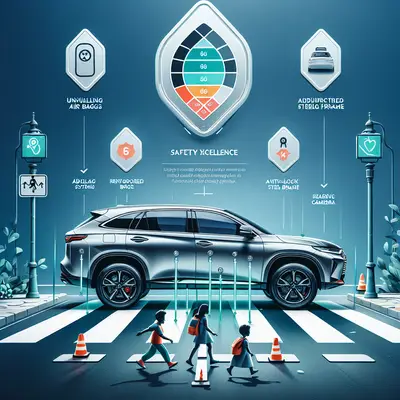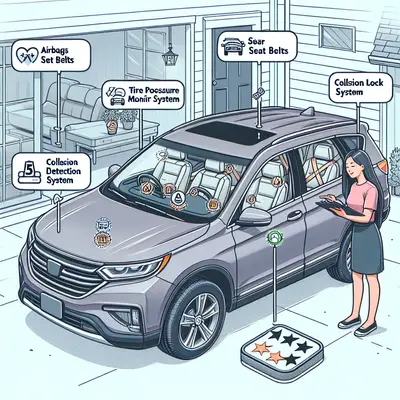
Families rarely shop for an SUV purely with their hearts. Somewhere between the leather options and panoramic sunroof, there is a quieter, non‑negotiable question: “Will this protect the people I love most?” Safety ratings exist to answer that question—but the story they tell is far more nuanced than a simple 5-star score.
This is a refined look at SUV safety ratings for families who expect more than marketing copy. Beyond the headline numbers, there are subtle, often overlooked details that reveal how an SUV will behave in the moments that matter most.
Why Safety Ratings Are Only the First Chapter
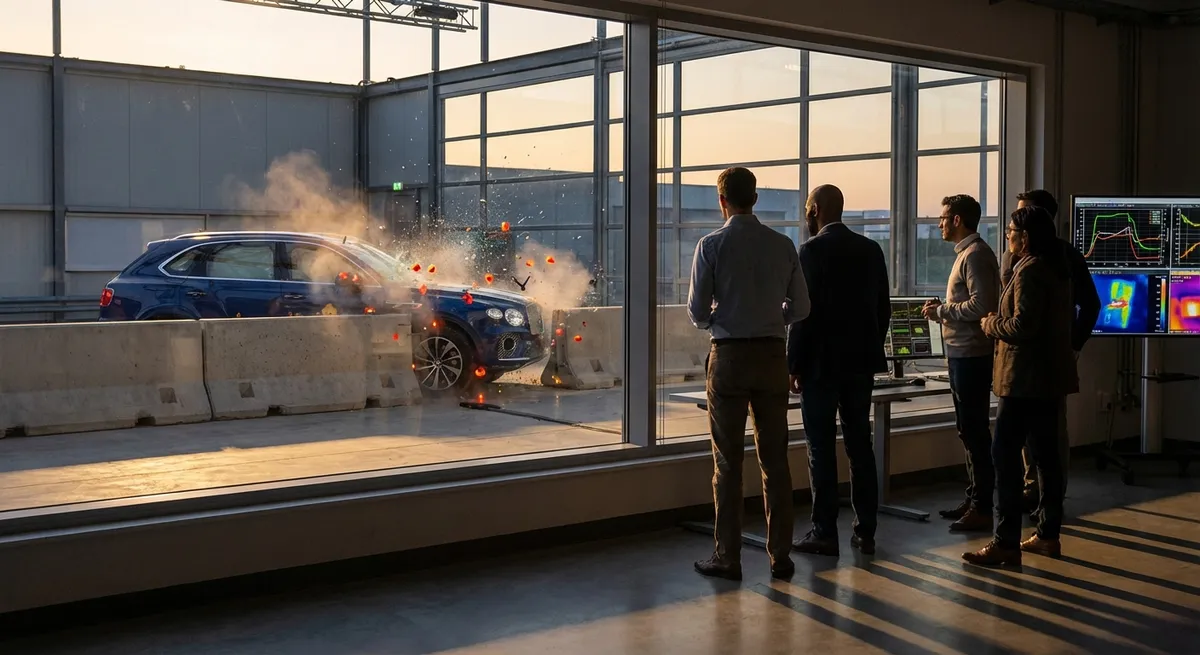
Public crash-test ratings from organizations like the National Highway Traffic Safety Administration (NHTSA) and the Insurance Institute for Highway Safety (IIHS) offer an essential starting point. They evaluate how a vehicle protects occupants in standardized crashes and how effectively it avoids or mitigates collisions in the first place.
Yet, for a discerning family buyer, these ratings are a baseline—necessary but not sufficient. A vehicle might excel in one type of impact but show weaknesses in another. Some SUVs hide significant differences between trims: the safety performance in a photograph-laden brochure may rely on advanced driver assistance features that are optional on lower trims. Ratings also evolve; a model that once aced every test can quietly fall behind as protocols become more stringent and real-world crash data accumulates.
Understanding these subtleties transforms you from a passive reader of safety labels into a curator of protection for your family. The ratings give you the vocabulary; your job is to interpret the dialect.
Exclusive Insight 1: Side-Impact and Small Overlap Tests Reveal Real-World Discipline
Head-on collisions have historically captured the most attention, but the most telling scores for many modern SUVs now come from side-impact and “small overlap” frontal tests. These scenarios reflect the complex geometry of real-world crashes—glancing blows at intersections, or an impact with a tree or pole that misses the main structural rails.
Advanced side-impact tests measure how well a vehicle protects both adults and children when struck by a heavier, higher-riding vehicle (like another SUV or pickup). Key indicators include torso and head injury metrics, plus how effectively curtain airbags deploy to protect occupants in all seating rows.
Small overlap frontal tests, meanwhile, probe the outer edges of the front structure—areas that cheapen quickly if engineers cut corners. When an SUV performs well here, it signals an investment in robust structural design throughout, not just in the obvious load paths. For families, strong performance in these tests suggests integrity in more than the “perfectly controlled” collision; it hints at resilience in messy, unplanned impacts where angles and speeds are far from textbook.
Exclusive Insight 2: Child Seat Realities Often Hide Behind Adult Ratings
Many safety ratings prioritize adult occupants, but families know the real question is: “How well does this SUV work with actual car seats, in actual life?” This is where child-specific evaluations come into their own.
Look beyond overall crashworthiness and seek out ratings that measure child occupant protection and car-seat usability. Expert tests that examine LATCH anchor accessibility, the number of usable positions for forward- and rear-facing seats, and how well booster seats fit can be revealing. An SUV can be structurally excellent yet frustratingly impractical for families with multiple young children.
Anchors buried under stiff leather, sloping seatbacks that distort car seat installation angles, and limited headroom when a child seat is placed behind taller front occupants—all these realities rarely appear in the brochure, yet profoundly influence the safety you achieve day to day. A premium choice is one that makes correct installation intuitive, repeatable, and stable, so your theoretical safety on paper converts into real protection on the school run.
Exclusive Insight 3: The Nuance Behind “Advanced” Driver Assistance
Modern SUVs increasingly rely on advanced driver assistance systems (ADAS) to prevent accidents before they occur. Automatic emergency braking, lane-keeping support, blind-spot monitoring, and adaptive cruise control all contribute to ratings in crash avoidance and mitigation categories.
However, the sophistication of these systems varies dramatically. Some work smoothly at highway speeds but disengage in stop-and-go traffic. Others are tuned so aggressively that they become intrusive, encouraging drivers to disable them. Ratings that consider pedestrian and cyclist detection, low-light performance, and intersection-specific braking scenarios are particularly revealing for family use, where urban and suburban driving are the norm.
For families, the question is not simply, “Does this system exist?” but, “Is it standard, and has it been tested in conditions that resemble our everyday life?” A truly refined safety package offers consistent, predictable behavior across varying conditions—and does so without demanding excessive effort or technical knowledge from the driver.
Exclusive Insight 4: Roof Strength and Roll-Over Metrics Matter More in SUVs
The elevated ride height and higher center of gravity that make SUVs so appealing also alter their behavior in extreme maneuvers. This is where roof strength and rollover metrics become especially meaningful for family buyers.
Roof-crush tests assess how much force the roof structure can withstand relative to the vehicle’s weight. Strong performance here suggests better protection for all occupants in the event of a rollover—one of the most violent crash scenarios. For three-row SUVs, this is especially critical: passengers in the second and third rows are more exposed if the roof deforms significantly.
Rollover resistance ratings, informed by both physical tests and dynamic measurements, help you gauge how stable a vehicle is when you must swerve suddenly to avoid an obstacle. For families who regularly drive with a full load of passengers and luggage, these ratings are not abstractions; they are a preview of how the vehicle responds when its mass is fully exercised.
Exclusive Insight 5: Consistency Across Trims Is the Mark of a Serious Safety Philosophy
Many SUVs advertise their most advanced safety technologies in flagship trims, even as entry-level models make quiet compromises. This creates a gap between the tested vehicle and the one that actually enters your driveway.
When reviewing ratings and test results, note whether the tested configuration includes optional equipment, such as upgraded headlights, expanded airbag coverage, or advanced driver assistance packages. Some safety bodies now differentiate scores based on the presence or absence of particular features, especially headlights and crash avoidance tech.
A brand that makes core safety systems standard across the lineup demonstrates more than marketing savvy; it signals a philosophy. For families, this consistency is a subtle but powerful marker of intent: a promise that your safety does not depend on checking the right box or stretching to a higher trim simply to access the protection that should have been there from the beginning.
Conclusion
A family SUV’s safety story is written in more than stars and badges. It lives in the understated details: the integrity of its side structures, the usability of its child-seat anchors, the grace with which its driver assistance systems intervene, and the unwavering stability of its roof and chassis under stress.
When you approach safety ratings as a discerning reader rather than a casual observer, you begin to notice which manufacturers treat protection as a core discipline rather than an accessory. The most compelling family SUVs do not shout about safety; they embody it quietly, consistently, and comprehensively—so that in the unexpected moments, your vehicle behaves precisely as you hoped it would.
Sources
- [National Highway Traffic Safety Administration (NHTSA) — 5-Star Safety Ratings](https://www.nhtsa.gov/ratings) - Official U.S. government crash-test results, rollover ratings, and explanations of testing protocols
- [Insurance Institute for Highway Safety (IIHS) — Ratings & Research](https://www.iihs.org/ratings) - Detailed crash-test data, small-overlap and side-impact results, child seat and crash avoidance evaluations
- [European New Car Assessment Programme (Euro NCAP)](https://www.euroncap.com/en/ratings-rewards/latest-safety-ratings/) - Independent European safety ratings, including advanced driver assistance and vulnerable road-user protection
- [Centers for Disease Control and Prevention — Child Passenger Safety](https://www.cdc.gov/transportationsafety/child_passenger_safety/index.html) - Evidence-based guidance on child restraints, booster use, and common misuse patterns
- [National Highway Traffic Safety Administration — Rollover Prevention](https://www.nhtsa.gov/vehicle-topics/rollover) - Background on rollover risks, vehicle dynamics, and the importance of roof strength and stability metrics
Key Takeaway
The most important thing to remember from this article is that this information can change how you think about Safety Ratings.