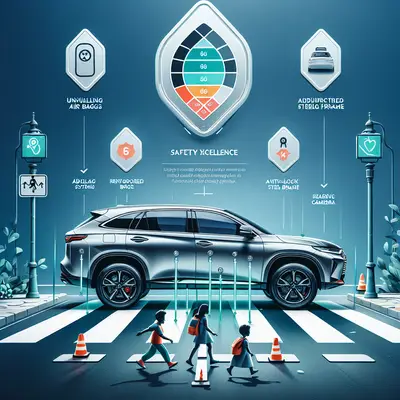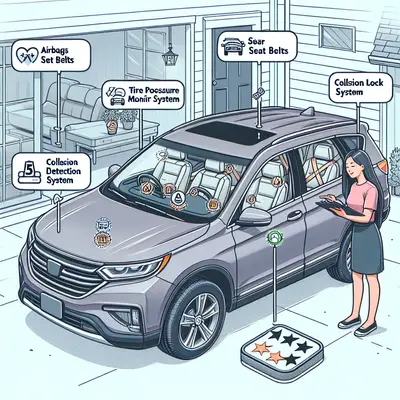
For many families, safety ratings are the quiet backbone of every SUV decision—a sophisticated filter that shapes what even makes the shortlist. Yet the stars, scores, and acronyms can feel strangely blunt for something so profoundly personal. Behind each rating lies nuance: how a vehicle behaves in unforgiving moments, how tech intervenes before impact, and how thoughtfully the cabin protects every passenger, from infant to grandparent. This is where a discerning family can move beyond the brochure and start reading what the ratings are really telling you—and what they are not.
Below are five exclusive, detail-rich insights that help you interpret safety ratings with the same care you bring to every other aspect of your family’s life.
1. Why “Top” Ratings Are Not Truly Equal Across Brands or Regions
Many family SUVs carry some variation of “Top Safety Pick,” “5-Star Overall,” or their local equivalent. It is tempting to treat these badges as interchangeable, but they exist within specific testing philosophies. In the United States, the Insurance Institute for Highway Safety (IIHS) emphasizes real-world crash patterns and adds demanding evaluations like small overlap front crashes and advanced headlight testing. The National Highway Traffic Safety Administration (NHTSA), on the other hand, uses the familiar 5-star system and focuses heavily on frontal and side impacts and rollover resistance.
European and other global markets introduce their own variables. Euro NCAP, for example, incorporates more stringent pedestrian and cyclist impact standards and an evolving suite of driver-assistance evaluations. A “5-star” badge in Europe may place comparatively greater emphasis on vulnerable road users, while a similar label in the U.S. may reflect more detail around rollover and occupant protection in specific crash geometries.
For a globally savvy family, this means two things. First, cross-referencing ratings from different agencies offers a more three-dimensional safety picture, especially for vehicles sold in multiple markets. Second, “perfect” scores lose their meaning without context: the test protocols change over time, the thresholds for awards rise, and a top rating from five years ago may not match the rigor of today’s benchmarks. Sophisticated safety shopping starts with asking not just, “What’s the rating?” but “Which test, which year, and under which criteria?”
2. The Emerging Role of “Pre-Crash” Safety in Modern Ratings
Traditional safety ratings were built around how well a vehicle protects you once a crash is already in motion. Today’s top-tier evaluations increasingly ask a more forward-looking question: how effectively can the SUV help you avoid or mitigate that crash in the first place? For a family navigating school runs, late commutes, and weekend highways, this is where active safety turns into a quiet form of everyday luxury.
Advanced driver-assistance systems (ADAS) such as automatic emergency braking, pedestrian and cyclist detection, lane-keeping assistance, blind-spot monitoring, and adaptive cruise control are no longer lavish extras; they now feed directly into many safety rating systems. IIHS, Euro NCAP, and others score vehicles on how reliably these systems detect hazards, how early they intervene, and how gracefully they integrate with human drivers.
Yet the nuance lies in execution. Two SUVs may both “have” automatic emergency braking, but one might only respond to vehicles, while another recognizes pedestrians at night or cyclists approaching from the side—critical distinctions for dense urban neighborhoods or dimly lit suburban streets. Some ratings break out sub-scores for daytime vs. nighttime performance, junction scenarios, and speed differentials; others still apply a broader label. A refined approach to safety evaluation involves interrogating these details: What specifically does the system detect? At what speeds does it function? Which scenarios were tested?
For families, this pre-crash lens transforms driver assistance from marketing checklist to tangible risk reduction. The ideal is not simply having more features, but having them tuned thoughtfully to the way your family really lives and drives day to day.
3. Child Seating and Rear-Seat Safety: The Understated Rating Dimension
Child safety in SUVs is often discussed in sweeping terms—“great for families,” “spacious second row”—but safety ratings are becoming more discriminating. Some programs now evaluate how easy and secure it is to fit child seats, how clearly anchors are labeled, and how accessible they are without awkward contortions that compromise installation quality. For parents who have wrestled with a misaligned ISOFIX or LATCH connector in a dim garage, this is not a trivial detail; it is a daily reality with genuine safety implications.
Rear-seat crash protection is also entering a more nuanced chapter. Historically, safety engineering concentrated on the driver and front passenger, assuming that rear occupants were inherently safer. Newer testing approaches and research reveal that rear-seat injury patterns can be complex, particularly for older children, teenagers, and smaller adults seated behind a larger driver. As a result, agencies like IIHS are evolving their crash tests and ratings to examine rear-seat restraint performance more closely.
For a family SUV, the refined questions become: How do the rear seats perform in updated crash configurations? Are there side-curtain airbags that comprehensively cover all rows, including optional third rows? Does the vehicle’s rating commentary mention rear-seat belt tensioners, load limiters, or specific rear occupant protection enhancements? The most family-conscious choice you can make is not just selecting a high-rated vehicle, but ensuring that its safety excellence explicitly extends to the seats your children actually occupy.
4. Headlights, Night Driving, and the Often-Ignored Safety Score
Night driving is where safety ratings quietly diverge. The same SUV that performs impeccably in daytime crash tests can become meaningfully less protective at night if its headlights are under-engineered. Poor illumination shortens reaction time, makes pedestrians and cyclists harder to detect, and increases the likelihood of lane deviations on unlit roads—all factors that rarely make marketing headlines, yet have a direct connection to family safety.
Leading safety organizations have begun to fold headlight performance into their top awards. IIHS, for example, now incorporates headlight ratings into its highest designations, evaluating both the SUV’s low- and high-beam reach, glare for oncoming drivers, and how consistently performance is delivered across trim levels. Some models earn strong scores only with specific headlight options or higher trims, which means a base model may not carry the same level of nighttime reassurance as the brochure’s hero photography suggests.
For the discerning family, this introduces a new layer of sophistication to the buying process. It becomes essential to verify which exact variant was tested and whether your chosen configuration includes the same lighting technology. Adaptive headlights, corner-following beams, and automatic high-beam assist are not mere conveniences; in some rating systems, they are central to achieving top-tier recognition. In practical terms, choosing an SUV with thoughtfully engineered headlights can be as impactful as stepping up to a new generation of airbags—just far less obvious at first glance.
5. When “More Tech” Is Not Automatically “More Safe”
Advanced safety technology is often marketed in escalating layers: basic, advanced, premium, and beyond. It can be tempting to view this hierarchy as a simple ladder—more features equals more safety. Modern ratings tell a subtly different story. The quality, calibration, and human-centered design of these systems matter as much as the sheer number of functions they perform.
Some safety evaluations now include measurements of system usability: how clear the alerts are, whether the driver remains engaged, and whether the assistance behaves predictably rather than erratically. Poorly tuned lane-keeping or intrusive driver monitoring can encourage drivers to switch systems off entirely, erasing any potential benefit. Conversely, a carefully considered, less “busy” suite of technology might deliver a calmer, more confidence-inspiring experience—one that drivers actually use consistently.
There is also growing attention to how safety systems integrate with each other. Does adaptive cruise control coordinate smoothly with lane-centering, or do they feel like separate entities competing for control? Does automatic emergency braking interact sensibly with pedestrian detection and blind-spot monitoring, or does it produce abrupt surprises that undermine trust? These subtleties rarely show up in star counts, but they increasingly influence how top ratings are awarded and maintained over time.
For a family, the premium approach is to look beyond whether a feature is present and instead consider how thoughtfully it has been executed. Test drives that focus on how these systems behave in real traffic, at night, and in inclement weather will add lived nuance to the formal ratings, helping you determine whether a highly rated SUV feels not just safe, but intuitively safe for the drivers in your household.
Conclusion
Safety ratings have become far more than a single star score or a reassuring badge; they now reflect a layered conversation about crash protection, collision avoidance, child safety, nighttime visibility, and technology that either supports or overwhelms the driver. For families, this evolution is an opportunity to select an SUV with the same deliberation you might bring to a school choice or a home—balancing data, design, and day-to-day lived experience.
By understanding which agency tested what, how pre-crash systems are evaluated, how rear-seat and child protection are evolving, why headlights matter more than ever, and where technology can both elevate and erode real-world safety, you move from passive recipient of ratings to active curator of your family’s protection. In that space, the safest SUV is no longer just the one with the highest score, but the one whose nuanced strengths align meticulously with the way your family truly lives and travels.
Sources
- IIHS – Vehicle Ratings - Official crash-test results, headlight ratings, and safety award criteria used widely in North America
- NHTSA – 5-Star Safety Ratings - U.S. government crash-test and rollover ratings, plus explanations of test procedures
- Euro NCAP – Ratings & Protocols - European safety ratings, including pedestrian/cyclist protection and advanced driver-assistance evaluations
- CDC – Child Passenger Safety - Evidence-based guidance on child seats, restraints, and rear-seat protection
- U.S. Department of Transportation – Nighttime Visibility - Research and policy information on how lighting and visibility affect crash risk at night
Key Takeaway
The most important thing to remember from this article is that this information can change how you think about Safety Ratings.