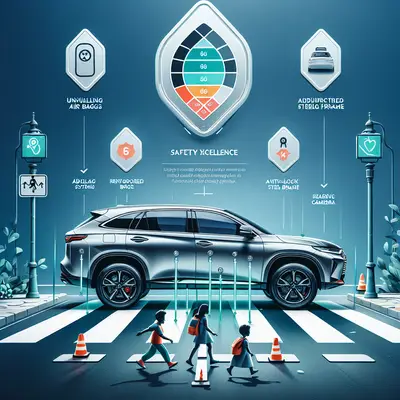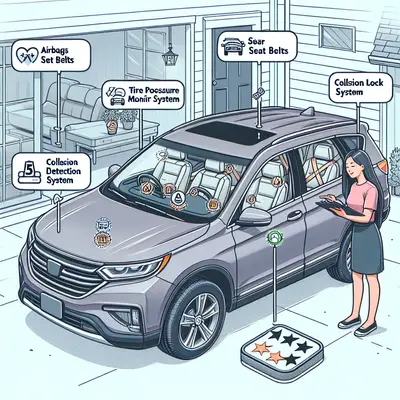
For families who value both serenity and security, safety ratings are more than a number on a window sticker—they are a quiet promise. Yet behind every star, score, and acronym lies nuance that many buyers never see. When you look past the headlines and marketing soundbites, safety ratings can reveal which SUVs are genuinely engineered for calm confidence, and which merely perform well in a brochure.
This guide distills safety ratings through a more discerning lens—highlighting subtle, often-overlooked details that sophisticated families will appreciate. Consider this your roadmap to reading safety not as a statistic, but as part of an overall ownership experience that respects your time, your passengers, and your standards.
How to Read Safety Ratings Without Being Misled
On paper, many family SUVs appear equally “safe.” A field of five‑star badges and “Top Safety Pick” accolades can blur distinctions that are very real in day‑to‑day driving. Understanding who tests what—and how—helps you separate genuine engineering excellence from clever positioning.
Organizations such as the National Highway Traffic Safety Administration (NHTSA) and the Insurance Institute for Highway Safety (IIHS) evaluate different crash configurations and occupant protection scenarios. NHTSA’s familiar star system focuses on frontal, side, and rollover performance, while IIHS uses a tiered structure (Good/Acceptable/Marginal/Poor) plus “Top Safety Pick” designations for models that excel in multiple areas. European tests (like Euro NCAP) add further layers, particularly around active safety and vulnerable road users.
The key is to examine the test breakdown, not just the headline label. A vehicle may be exemplary in frontal protection yet merely adequate in rear impacts or small overlap crashes—the kind that occur when a vehicle clips a barrier or pole. When comparing SUVs, review front, side, and rollover scores individually, and pay particular attention to rear occupant and child-specific metrics. These are the quiet indicators of engineering thoroughness that matter long after the test lab lights go dark.
Exclusive Insight 1: Rear-Seat Safety Is the New Frontier
For families, the second and third rows are the true living spaces. Yet, for many years, crash testing focused primarily on the driver and front passenger. That balance is now shifting—and discerning parents should be paying close attention.
Recent evaluations have shown that some SUVs protect front occupants impeccably while offering only average restraints and structural performance for rear passengers. In updated crash tests that incorporate rear-seat dummies, differences in belt tensioners, load limiters, and airbag positioning can translate into markedly different outcomes for children and teens. A model can still wear an impressive overall rating while masking rear-seat compromises in the fine print.
When comparing family SUVs, look specifically for rear-seat occupant protection scores, not just the frontal rating. Seek models that perform well in tests that explicitly measure rear crash forces and injury criteria, and note whether the automaker calls out rear-belt pretensioners, load limiters, or advanced rear airbag designs. These are frequently found on more thoughtfully engineered models, and they signal that your children’s seats aren’t an afterthought, but a design priority.
Exclusive Insight 2: Not All Advanced Driver Assistance Systems Are Equal
Almost every modern SUV lists a roster of driver assistance features—automatic emergency braking, lane-keeping assist, blind-spot monitoring, and more. To the untrained eye, they can all sound similar. For a family that prizes both safety and refinement, the distinction lies in calibration, coverage, and consistency.
Independent organizations increasingly factor active safety into their awards, recognizing that avoiding a crash altogether is preferable to surviving one. Yet a “checklist complete” approach can be misleading. Some lane-keeping systems nudge the wheel abruptly, while others respond with a smooth, almost imperceptible correction. Certain pedestrian or cyclist detection systems function only in daylight or at lower speeds; others expand protection into night driving and cross-traffic scenarios.
When you evaluate a safety rating, look beneath the umbrella term “automatic emergency braking” or “driver assist.” Does the system detect pedestrians and cyclists? Does it function at highway speeds? Are junction turns, cross-traffic warnings, and evasive steering assists included or only present in higher trims? Ratings that consider this level of detail can guide you toward SUVs that quietly partner with you, rather than intrude on your driving.
Exclusive Insight 3: Headlights Are a Safety System, Not a Styling Element
Headlights are one of the most understated but influential safety components on a family SUV. Elegant LED signatures and intricate light designs may catch your eye, but the real luxury is how well they illuminate the road—without dazzling oncoming drivers.
Many ratings now include headlight performance as a formal test category, and the differences can be substantial. Some models provide excellent low-beam reach and high-beam clarity only in their most expensive trims, while base models settle for average lighting and more glare. These distinctions may not be obvious in a showroom, but they matter on an unlit highway with precious cargo asleep in the back.
When reading safety reports, look for explicit headlight ratings and note whether they apply across all trims or just select variants. Prioritizing SUVs with “Good” or equivalent top-tier headlight performance can pay daily dividends: reduced fatigue on night drives, clearer visibility of road edges, pedestrians, and animals, and a more composed driving experience after dark. True safety luxury is the comfort of not needing to strain to see what’s ahead.
Exclusive Insight 4: Child Seat Integration Reveals Design Philosophy
For families, the relationship between an SUV and a child seat is intimate and ongoing. Safety agencies and independent testers increasingly score vehicles on child seat installation ease, LATCH (ISOFIX) anchor accessibility, and compatibility across multiple seating positions. These scores are less glamorous than crash test videos—but more telling about an automaker’s mindset.
An SUV may offer robust crash protection but make it awkward to secure a child seat correctly, especially in the third row. Hidden anchors behind thick cushions, limited legroom when rear‑facing, or belts that are difficult to route properly can all undermine day-to-day safety. A carefully thought-out interior often features clearly marked anchors, generous door openings, and seat contours that support a variety of child seats without contortions.
When reviewing safety ratings, seek out the child seat evaluation section and note how many positions are rated “easy to install.” Look for mention of accessible lower anchors, straightforward top tether locations, and enough flexibility to accommodate two or three seats across. This is where premium design shows its practical side: not just protective in a crash, but gracious in your daily morning routine.
Exclusive Insight 5: Structural Sophistication Shows in the Edge Cases
The most forward-thinking safety engineering often appears in “edge case” tests—those that simulate real-world collisions beyond the classic frontal impact. Small-overlap front crashes, side impacts at higher speeds, roof strength in rollover scenarios, and compatibility with taller or lower vehicles all probe how thoroughly an SUV is engineered.
A robust safety rating will often break down performance across these nuanced scenarios. Look for models that perform consistently well in the most demanding tests: small-overlap impacts for both driver and passenger sides, updated side-impact tests with heavier barriers and higher speeds, and strong roof-crush resistance scores. These are indicators of a cohesive safety cell, not just a reinforced front bumper.
For families, this structural poise translates into confidence in the unexpected: a glancing blow in an intersection, a side impact from an SUV or pickup, or a rollover on a rural road. When you see uniformly high marks across newer, more stringent test protocols—not just legacy tests—that is a sign you are looking at an SUV engineered with a margin of safety that aligns with a more refined standard of care.
Conclusion
A sophisticated approach to SUV safety looks beyond stars and badges to the subtleties that shape every mile with your family. Rear-seat protection, the nuance of driver assistance systems, headlight performance, child seat usability, and structural strength in demanding tests together form a richer portrait than any single number can offer.
By reading safety ratings with intention—examining the “where” and “how,” not just the “how much”—you align your purchase with a deeper set of priorities: quiet confidence, thoughtful engineering, and an ownership experience that respects both your family and your expectations. In the end, the most luxurious safety feature is peace of mind that feels as considered as the rest of your life.
Sources
- [NHTSA 5-Star Safety Ratings Overview](https://www.nhtsa.gov/ratings) – Explains U.S. government crash tests, star ratings, and what each test measures
- [IIHS Vehicle Ratings and Test Descriptions](https://www.iihs.org/ratings) – Details crashworthiness, crash avoidance, headlight, and child seat evaluations
- [Euro NCAP Safety Ratings](https://www.euroncap.com/en/ratings-rewards/latest-safety-ratings/) – Provides additional context on active safety and vulnerable road user protection (particularly useful for global models)
- [CDC – Child Passenger Safety Guidelines](https://www.cdc.gov/transportationsafety/child_passenger_safety/index.html) – Discusses the importance of correct child seat use and vehicle compatibility
- [Consumer Reports – Guide to Car Safety Features](https://www.consumerreports.org/cars/car-safety-features-guide-a1163153514/) – Offers independent explanations of advanced driver assistance systems and their real-world performance
Key Takeaway
The most important thing to remember from this article is that this information can change how you think about Safety Ratings.