Selecting a family SUV today is less about chasing badges and more about understanding what truly protects the people you love most. Safety ratings are often reduced to stars and scores, but the real story lives beneath those simple symbols. For families with a refined eye, the difference between a merely “safe” SUV and a thoughtfully engineered one comes down to details that rarely make the brochure—but profoundly shape every drive.
Below are five exclusive, under-discussed safety insights that help discerning families read beyond the rating and toward real-world peace of mind.
1. Crash Test Scores Are the Beginning, Not the Benchmark
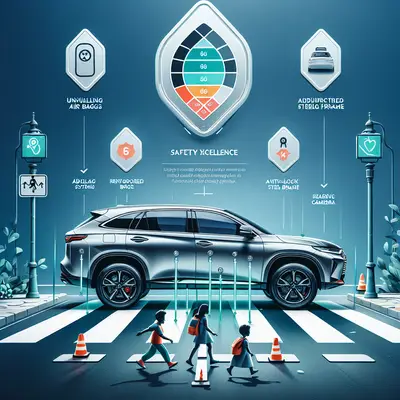
Most shoppers stop at a 5-star NHTSA rating or a “Top Safety Pick+” badge from IIHS. Those are valuable indicators, but families seeking a genuinely protective SUV should go several layers deeper. The key is not just the headline rating, but how consistently an SUV performs across all tested scenarios.
Look at the specific sub-scores: frontal offset, small overlap crashes, side impacts, roof strength, head restraint performance, and pedestrian protection. An SUV that excels uniformly across these tests signals balanced engineering, not just strategic reinforcement in a few areas. Also consider how the vehicle protects occupants of different sizes and seating positions—especially second- and third-row passengers, who are often children or grandparents.
Equally important is the date of the test. Standards evolve rapidly; an older “Top Safety Pick” may not meet the expectations set by more recent criteria. A sophisticated selection process treats safety badges as a starting filter, then compares detailed test results across a short list of contenders, focusing on consistency, recency, and performance in family-relevant scenarios like side-impact and rear crash protection.
2. Structural Integrity: The Hidden Architecture of Safety
Beneath the leather and ambient lighting, your SUV’s structure is doing silent, essential work. For families, understanding the skeleton of a vehicle can be as important as the safety tech displayed on the window sticker.
Advanced high-strength steel, thoughtful crumple zones, and a rigid passenger cell together dictate how force is managed in a collision. SUVs that use tailored blank welding, hot-stamped steel, and strategic reinforcements around door frames, pillars, and the floor often deliver better real-world protection than their spec sheets suggest. This structural sophistication helps the cabin maintain its shape, keeping occupant space intact even in severe impacts.
Discerning shoppers should review manufacturer disclosures on body construction, often found in technical brochures or engineering overviews. Look for mentions of multi-load path structures, ring-shaped reinforcement, and integrated battery protection in hybrid or electric SUVs. For families who regularly carry a full complement of passengers, a rigid structure pays dividends in side-impact and rollover scenarios—those moments when the integrity of the cabin becomes everything.
3. Active Safety: When the SUV Helps You Avoid the Crash Entirely
Modern family SUVs increasingly serve as quiet co-pilots, stepping in before a momentary lapse becomes a life-altering event. Active safety systems—often bundled under names like “driver assistance” or “safety suites”—are not interchangeable, and their subtle distinctions matter.
Forward collision warning and automatic emergency braking are now table stakes; sophisticated buyers look beyond them. Does the lane-keeping system feel precise yet unobtrusive, or does it ping-pong between lane lines? Is adaptive cruise smooth enough to use with children sleeping in the back, or abrupt in its braking? How well does blind-spot monitoring account for adjacent lanes when towing, merging, or driving in heavy rain?
Families should also pay close attention to pedestrian and cyclist detection, particularly for school runs and urban driving. Nighttime detection performance is especially critical in winter or low-light environments. A refined safety decision accounts not only for which features are present, but for how elegantly they intervene—minimizing false alarms while still actively preventing collisions. The best systems create a sense of calm competence rather than constant correction.
4. Airbag and Restraint Sophistication: Beyond “How Many?”
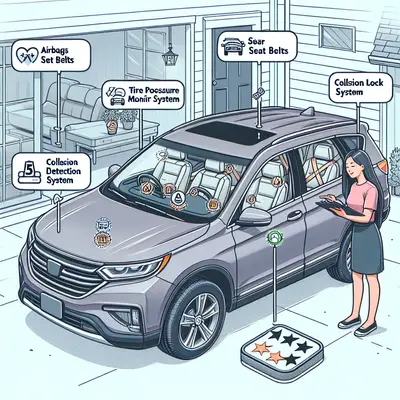
Advertised “airbag counts” can be misleading. For a family SUV, restraint strategy matters far more than sheer quantity. Curtain airbags that extend fully to the third row, front-seat center airbags to reduce occupant-to-occupant contact, and well-placed side-impact airbags for outboard passengers can make a significant difference in complex crash scenarios.
Equally crucial are seatbelt technologies. Load limiters and pretensioners that work in tandem help manage the forces on both adults and older children in booster seats. Some premium SUVs now employ multi-stage deployment that adjusts to occupant size, seating position, and crash severity—subtle sophistication that rarely makes ad headlines, yet deeply influences outcome.
Families with car seats should go a step further and consider how well the vehicle’s restraints integrate with child safety systems. Are the LATCH anchors easy to access without contorting your hands? Does the seat design allow for tight, stable installations in the second and third rows? A family-focused safety evaluation treats airbags and belts not as line items, but as part of a holistic occupant protection ecosystem, especially for mixed passenger groups spanning infants to grandparents.
5. Child-Centric Design: Safety as a Daily, Practical Experience
For families, true safety is not just what happens in a crash—it’s every loading, buckling, and school-drop-off moment in between. Seemingly small design choices can meaningfully shape your ability to keep everyone properly secured every time you drive.
Door openings that are wide yet controlled, making it easier to load a rear-facing infant seat without bumping heads or twisting spines, are quietly luxurious in daily use. Rear door child locks that are simple to engage yet resistant to accidental changes matter more than most option packages. Window switches with anti-pinch technology and thoughtful placement help prevent wandering fingers from becoming a hazard.
Look for rear-seat reminder systems that help prevent a child being inadvertently left in the vehicle, especially in busy households with rotating schedules. Some SUVs now offer internal cameras that let you glance at rear passengers without taking your eyes off the road for more than a fraction of a second. Others integrate advanced climate controls that maintain comfortable temperatures throughout the cabin—more than a comfort feature, this can be crucial in extreme heat or cold with very young children.
A sophisticated safety evaluation treats these practical details as part of the SUV’s protective character. The safest family SUV is not merely the one that performs well in a lab, but the one that quietly encourages correct, consistent, and effortless use of its safety features every single day.
Conclusion
For families who value both refinement and responsibility, safety ratings are not the end of the conversation—they are a curated invitation to look deeper. The true measure of a family SUV lies in how cohesively its structure, technology, restraints, and everyday usability work together to protect. By examining not only the stars and badges, but also the engineering philosophy and child-centric design behind them, you can choose an SUV that feels as carefully considered as the life you are building within it.
In a market crowded with claims of “class-leading safety,” the real advantage belongs to the family that knows precisely what to look for—and insists that safety be as elegantly executed as every other aspect of the drive.
Sources
- [National Highway Traffic Safety Administration (NHTSA) – 5-Star Safety Ratings](https://www.nhtsa.gov/ratings) - Official U.S. government crash test ratings, including detailed sub-scores and test procedures
- [Insurance Institute for Highway Safety (IIHS) – Ratings & Research](https://www.iihs.org/ratings) - Independent crash test results, Top Safety Pick information, and explanations of evolving safety criteria
- [Centers for Disease Control and Prevention – Child Passenger Safety](https://www.cdc.gov/transportationsafety/child_passenger_safety/index.html) - Evidence-based guidance on car seats, booster seats, and seatbelt safety for children
- [SaferCar.gov – Car Seats and Booster Seats](https://www.nhtsa.gov/equipment/car-seats-and-booster-seats) - U.S. government resource on proper installation, LATCH systems, and child restraint recommendations
- [Volvo Cars – Safety Innovations](https://www.volvocars.com/intl/v/safety) - Example of a manufacturer’s detailed presentation of structural safety, restraint systems, and advanced driver assistance technologies
Key Takeaway
The most important thing to remember from this article is that this information can change how you think about Safety Ratings.