Safety ratings are often presented as a neat set of stars or scores, inviting quick decisions in a busy showroom. Yet for families who expect more from their SUV than a glossy brochure and a crash-test badge, those ratings are only the beginning of the story. Beneath the surface lies a far more nuanced picture—one that speaks to real‑world protection, everyday confidence, and the subtle engineering choices that separate “good enough” from truly exceptional.
This is a considered look at how to interpret safety ratings with a more refined lens, anchored in five exclusive insights that matter deeply to families who refuse to compromise.
Beyond Star Counts: Understanding the “Type” of Safety Promised
Most families are familiar with the shorthand: five stars good, fewer stars less desirable. But safety ratings are not a single dimension of quality; they are an aggregate of different crash scenarios and technologies, each emphasizing a particular philosophy of protection.
Regulatory bodies like the National Highway Traffic Safety Administration (NHTSA) and independent organizations such as the Insurance Institute for Highway Safety (IIHS) don’t simply assign stars at random—they conduct distinct tests that prioritize different aspects of safety. NHTSA’s 5-Star Safety Ratings program focuses on frontal, side, and rollover resistance. IIHS, by contrast, has become known for its demanding small-overlap crash tests, advanced headlight evaluations, and detailed scoring of crash-avoidance technologies.
For a family, this means a “top-rated” SUV may be exceptional in front-impact performance but less impressive at protecting occupants in more complex crashes, or in preventing those crashes altogether. A premium interpretation of safety ratings asks: What type of safety is this SUV optimized for—impact survival, collision avoidance, or both? Looking past the headline star count toward the specific tests and sub-scores is where a truly informed choice begins.
Exclusive Insight #1: Small-Overlap Tests Reveal Structural Integrity
One of the most telling indicators of a family SUV’s underlying engineering is how it performs in small-overlap front crash tests—where only a corner of the vehicle strikes an object, mimicking a real-world scenario like clipping a tree or a pole.
These tests are technically demanding for manufacturers. The impact bypasses the primary front crumple zones and instead challenges the vehicle’s ability to redirect energy away from the cabin. When an SUV scores well in this category, it often signals a structure reinforced in a way that benefits every occupant: rigid passenger cells, carefully managed deformation paths, and thoughtful use of high-strength materials.
For families, this translates to a critical question that rarely appears in sales brochures: How does this SUV protect us when the crash is imperfect and unexpected, not textbook and head‑on? Reviewing IIHS small-overlap results—and favoring SUVs with consistently “Good” ratings—offers a deeper assurance that the safety engineering has been optimized for more than just passing the easiest tests.
Exclusive Insight #2: Rollover and Roof Strength—Quiet Guardians in Tall Vehicles
Family SUVs sit higher than sedans, providing better visibility and easier ingress for children and grandparents alike. The trade-off is a higher center of gravity and, therefore, a different rollover profile. While modern stability control systems have dramatically reduced rollover incidents, they haven’t eliminated them—particularly in evasive maneuvers or on compromised roads.
Rollover ratings and roof-strength tests are the quiet guardians of SUV safety. NHTSA’s rollover resistance assessments, combined with IIHS roof-strength testing, provide a more complete picture of how the vehicle behaves if it tips and how it protects occupants in that scenario. A high roof-strength rating doesn’t just help in a dramatic rollover; it can also be a proxy for overall structural robustness in various crash modes.
Families who travel frequently on highways, in inclement weather, or with a full load of passengers and luggage should pay particular attention here. A premium family SUV should offer not only electronic safeguards to prevent rollovers, but also a cabin structure that retains its shape and survival space if the worst occurs. When you see top marks for roof strength and rollover resistance, you are effectively seeing proof of engineering that anticipates the unexpected.
Exclusive Insight #3: Child Safety Is More Than a Checkbox on the Spec Sheet
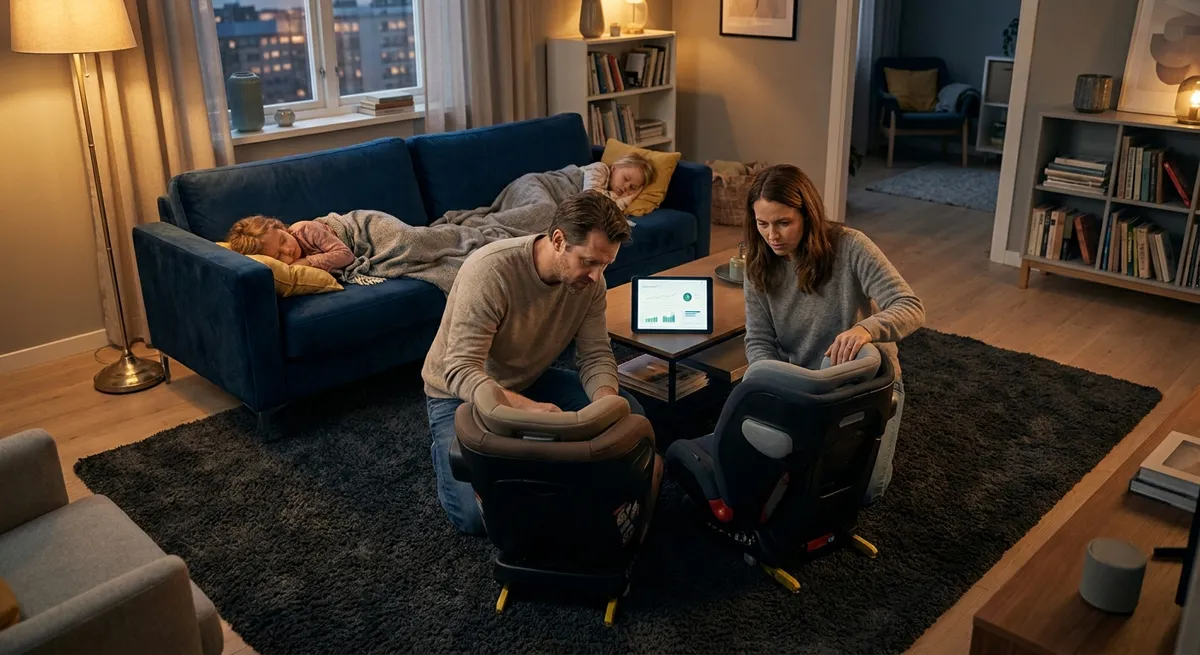
Child safety is often reduced to a simple confirmation: “Yes, it has LATCH anchors.” Yet the sophistication of a family SUV’s safety performance for younger passengers goes far beyond that baseline.
Leading safety organizations pay close attention to child occupant protection—how easily and securely child seats can be installed, how belts route across smaller frames, and whether airbag behavior is appropriate for younger occupants. Some rating systems, such as Euro NCAP, explicitly score child occupant protection, while U.S.-based testing increasingly highlights child-seat installation ease and compatibility.
For families, a deeper look involves three quiet but crucial details:
- Anchor Accessibility and Positioning: Well-designed LATCH anchors are located for intuitive, firm installation without contorting yourself in the rear seat.
- Rear-Seat Belt Geometry: Belts should rest comfortably and securely on a child in a booster, without cutting across the neck or slipping off the shoulder.
- Rear Airbag and Curtain Coverage: Side-curtain airbags that extend fully to the third row, and thoughtful rear airbag calibration, indicate careful consideration of younger passengers.
When safety ratings reference child occupant protection or rear-seat evaluations, they are hinting at how much attention the brand has given to the passengers who may speak the quietest, but matter the most.
Exclusive Insight #4: Not All Driver-Assistance Systems Are Equal—Even If the Checkboxes Match
Advanced driver-assistance systems (ADAS)—automatic emergency braking, lane-keep assist, blind-spot monitoring—are now common enough that spec sheets can appear nearly identical across brands. Yet how well these systems perform, and how gracefully they integrate into everyday driving, varies tremendously.
Organizations like IIHS and Euro NCAP have begun to fold crash-avoidance performance into their highest awards. This is critical for families because a system that reacts a split second earlier, or detects pedestrians at night with greater accuracy, is more than a gadget; it is a reduction in risk every single mile.
Premium-minded families should look for:
- Independent Testing of AEB (Automatic Emergency Braking): Vehicles that earn top marks in vehicle-to-vehicle and vehicle-to-pedestrian tests, including at night, offer a discernible safety edge.
- Lane-Assist Quality: Gentle, predictable steering corrections reduce fatigue and encourage drivers to keep the system engaged rather than switching it off out of frustration.
- False-Alert Discipline: High-quality systems minimize nuisance alerts, which helps drivers retain trust and remain engaged rather than tuning the car out.
The simplest way to translate ratings into real-world confidence is to favor SUVs that not only list these systems but receive explicit commendation from independent evaluators for their performance and refinement. In a premium family SUV, technology should feel like a reassuring co-pilot, not a nervous backseat driver.
Exclusive Insight #5: Headlights and Nighttime Safety—An Underrated Luxury
The conversation around family SUV safety often centers on crashes and protective structures, yet one of the most effective safety features is deceptively simple: excellent illumination. The ability to see and be seen—especially on unlit roads, in rain, or during long evening drives—is a hallmark of a thoughtfully engineered vehicle.
IIHS headlight evaluations have transformed this once-overlooked detail into a measurable safety factor. SUVs that receive “Good” headlight ratings typically offer better beam pattern, more consistent coverage, and reduced glare for oncoming drivers. For families returning from weekend trips or evening activities, this translates to earlier recognition of hazards, clearer lane definition, and less visual strain.
Premium family SUVs increasingly pair high-quality LED or matrix headlights with adaptive functionality—automatically adjusting beam height, width, and even selectively dimming segments to avoid dazzling other drivers. These may seem like luxuries, but they are also subtle safety multipliers, extending the protective envelope well beyond the crash barrier.
When comparing safety ratings, paying special attention to headlight scores is a quiet way to prioritize how your family will experience safety not just in a lab, but on a dark, wet road after a long day.
Conclusion
Safety ratings were never meant to be the full story; they are the table of contents to a far richer narrative. For families selecting a premium SUV, the opportunity lies in reading beyond the summary—examining how the vehicle performs in nuanced crash tests, how it protects children, how intelligently its driver-assistance systems behave, and how well it illuminates the road ahead.
By focusing on structural integrity in small-overlap crashes, rollover and roof strength, meaningful child occupant protection, genuinely capable driver-assistance technologies, and top-tier headlight performance, families can move beyond merely “safe enough” toward something more deliberate: a safety profile that feels as considered and composed as the rest of their lives.
In a marketplace where many SUVs can claim five stars, it is this deeper, more discerning perspective that sets a truly exceptional family choice apart.
Sources
- NHTSA 5-Star Safety Ratings - Official U.S. government crash-test and rollover ratings, including detailed test procedures and results for specific vehicles.
- IIHS Vehicle Ratings - Independent safety evaluations covering crashworthiness, crash-avoidance systems, and headlight performance for a wide range of SUVs.
- Euro NCAP Safety Ratings - European crash-test data with dedicated child occupant protection and advanced safety technology assessments.
- CDC Motor Vehicle Safety - Research and data on crash injuries, including information on child passenger safety and risk factors.
- SaferCar – Child Passenger Safety - U.S. Department of Transportation guidance on child seats, LATCH systems, and proper restraint use, relevant to rear-seat safety in SUVs.
Key Takeaway
The most important thing to remember from this article is that this information can change how you think about Safety Ratings.