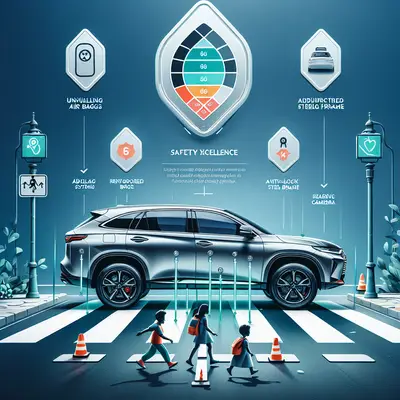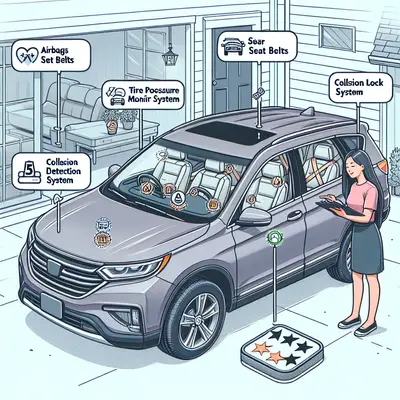
For many families, that tidy five-star badge or “Top Safety Pick+” label feels reassuringly definitive. But beneath those polished icons lies a complex language of physics, priorities, and compromises that can dramatically reshape how safe an SUV feels in everyday family life. Understanding that language doesn’t require an engineering degree—only a more discerning eye and a willingness to look past the marketing gloss.
This is where safety ratings become less about numbers and more about nuance. When read carefully, they can reveal which SUVs are engineered for real families, real roads, and real mishaps—not just for controlled laboratory tests.
How Crash Tests Really “Imagine” Your Family
Crash ratings may appear universal, but each test imagines a slightly different scenario—and, in doing so, a slightly different family.
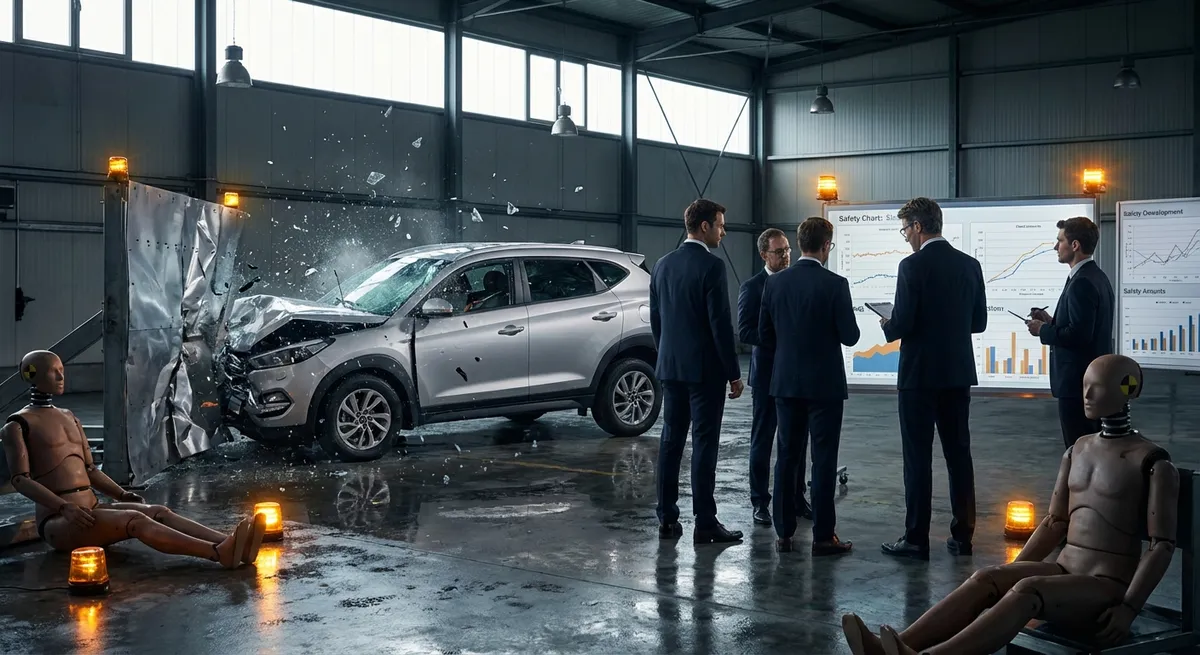
The National Highway Traffic Safety Administration (NHTSA) focuses primarily on frontal and side impacts plus rollover resistance, assigning familiar one to five-star scores. The Insurance Institute for Highway Safety (IIHS) goes further, probing vulnerabilities with small overlap frontal tests, roof-strength evaluations, headlight performance, and, more recently, rear-occupant protection. These aren’t academic distinctions; they shape how an SUV’s structure is engineered, where reinforcements are placed, and which occupants are prioritized in a crash.
For a family SUV, this matters intensely. A vehicle that fares well in frontal tests but shows weakness in small-overlap or rear-occupant evaluations may protect the driver admirably while leaving second-row passengers less well shielded. Likewise, strong roof-strength scores are especially important for taller vehicles, where rollovers—though less common than frontal collisions—can be devastating if the structure deforms.
The refined approach is simple: don’t treat a single rating as a verdict. Instead, look across different tests and organizations, focusing on how consistently an SUV protects all seating positions, not just the person behind the wheel.
Exclusive Insight #1: Rear-Seat Safety Is the Next Quiet Revolution
For years, conventional wisdom held that “the back seat is safest.” Modern testing is quietly rewriting that assumption.
Recent IIHS research and updated moderate-overlap tests have begun scrutinizing the protection afforded to rear passengers, often represented by a child-sized dummy. The findings: in some newer vehicles, the front occupant now receives superior protection compared with those in the second row, especially when advanced restraints and airbags are concentrated up front.
For families, this is transformative. Children in high-back boosters, tweens in seat belts, or grandparents in the rear bench all depend on carefully tuned belt tensioners, load limiters, and side-curtain airbags. When a model is explicitly recognized for strong rear-occupant protection, that typically signals attention to:
- Belt systems that reduce chest forces in smaller or older bodies
- Airbag deployment patterns that consider a range of seating positions
- Structural strategies that help manage crash forces throughout the cabin, not only at the front
In practice, this means combing through detailed ratings—not just star counts—for mentions of rear-seat injury measures, especially for newer model years. Families who primarily use the back row for younger passengers should treat this as a non-negotiable design priority.
Exclusive Insight #2: Headlights and Night Vision Are the New Seatbelts
For decades, safety was defined by what happened after impact. Today, a more sophisticated view embraces what happens before: seeing and being seen.
IIHS now evaluates headlight performance independently, grading how well a vehicle illuminates curves, straightaways, and oncoming traffic without excessive glare. It’s an often-overlooked element that strongly influences real-world crash risk, especially for suburban and semi-rural families navigating unlit roads after school events, late dinners, or early-morning activities.
Premium family SUVs that earn top marks in headlight testing typically offer:
- Well-calibrated LED or matrix-style lighting with consistent coverage
- Intelligent high beams that adapt to other vehicles
- Beam patterns that light the periphery where pedestrians, cyclists, or animals may appear
When comparing models, don’t assume that a high overall safety score includes top-tier lighting. Headlight ratings are often trim-dependent, meaning the safer lighting setup may belong only to specific configurations. For a family that frequently drives at dusk or night, prioritizing trims with superior headlight ratings may quietly outperform a long list of more conspicuous “safety features.”
Exclusive Insight #3: Not All Active Safety Suites Are Created Equal
From glossy brochures to splashy social media teasers, “advanced driver assistance systems” (ADAS) can sound remarkably similar—until you examine how they perform in independent tests.
Forward-collision warning, automatic emergency braking (AEB), lane-keeping assist, and blind-spot monitoring are now nearly ubiquitous in family SUVs. But their sophistication, refinement, and reliability vary dramatically. IIHS and European counterparts have begun evaluating how these systems recognize pedestrians, cyclists, and crossing traffic, particularly in lower-light conditions or complex urban environments.
A truly family-focused SUV tends to demonstrate:
- Strong performance in AEB pedestrian tests, not just vehicle-to-vehicle scenarios
- Systems that intervene smoothly rather than abruptly, supporting confident driving rather than startling the driver
- Clear, intuitive alerts that help parents remain calmly in control, rather than overwhelmed by beeps and warnings
A subtle but important detail: active safety can be overruled by poor interface design. A vehicle that technically offers superior AEB but buries critical settings in convoluted menus—or bombards the driver with false alarms—may see those systems turned off in frustration. Seek out models whose safety tech has been praised in independent reviews for usability and tuning, not just presence.
Exclusive Insight #4: Rollover and Roof Strength Matter More for Taller Families’ Vehicles
SUVs inherently ride higher than sedans, a trait many families appreciate for the commanding view and easier child-seat loading. But with height comes a nuanced risk profile: while modern stability control has dramatically reduced rollovers, the consequences when they do occur remain severe.
NHTSA’s rollover resistance ratings and IIHS roof-strength tests provide complementary perspectives. Rollover ratings estimate the likelihood of a vehicle tipping based on its center of gravity and stability systems, whereas roof-strength tests measure how well the structure holds during a rollover event, preserving precious survival space inside the cabin.
For a family SUV, discerning shoppers look for:
- Strong rollover resistance scores relative to class, especially for three-row models
- Roof-strength ratings that meet or exceed “Good” standards
- A track record of stability control and robust side-curtain airbag design that covers all three rows
The refined consideration here is holistic: a taller vehicle that pairs a low rollover risk with a strong roof and comprehensive side-curtain airbags offers a more reassuring environment for every occupant, from front seat to third row.
Exclusive Insight #5: Child-Seat Compatibility Is the Unspoken Safety Test
Crash tests may simulate child-sized bodies, but they don’t evaluate how child seats actually install and function in daily use—yet this is one of the most practical determinants of family safety.
LATCH (Lower Anchors and Tethers for Children) systems are now standard, but their execution varies widely. Anchors buried deep in the seat crease, obstructed by firm cushions, or awkwardly aligned can transform every installation into a compromise. IIHS conducts specific LATCH usability evaluations, rating how accessible and intuitive these systems are in real-world use.
For families, an SUV with truly child-centric design often reveals itself through:
- Clearly exposed lower anchors and easily reached top tether points
- Thoughtful placement of anchors across multiple seating positions, including the third row where possible
- Adequate seat contouring that allows a secure, level installation without resorting to improvised fixes
The premium detail is not just whether a child seat can be installed, but whether it can be installed correctly and consistently, by any caregiver—grandparents, babysitters, older siblings—without elaborate guidance. That reliability is, in many ways, the most “everyday” form of crash protection your family will ever use.
Conclusion
Safety ratings are often presented as neat, digestible scores, but for discerning families choosing an SUV, they’re better read as a layered narrative. Beneath the stars and badges lie telling chapters about rear-seat protection, night-time visibility, active safety tuning, rollover resilience, and the practical art of installing child seats gracefully and correctly.
The most sophisticated choice is not simply the SUV with the highest headline rating, but the one whose safety story aligns with the way your family truly lives—late-night drives, crowded school runs, multi-generational road trips, and everything in between. When you read ratings as a language rather than a label, you begin to see which vehicles are engineered not just to pass tests, but to quietly, consistently safeguard the people you love most.
Sources
- NHTSA 5-Star Safety Ratings – Official U.S. government crash test results, rollover ratings, and safety information for new vehicles
- IIHS Vehicle Ratings – Independent crash test data, headlight evaluations, rear-occupant protection updates, and LATCH usability assessments
- IIHS: Rear-seat safety in modern vehicles – Research and testing focused on evolving rear-seat protection standards
- IIHS: Headlight evaluations and their impact on safety – Analysis of headlight performance and its relationship to real-world crash risk
- CDC Child Passenger Safety Guidelines – Evidence-based recommendations on child restraints, seating positions, and best practices for family vehicles
Key Takeaway
The most important thing to remember from this article is that this information can change how you think about Safety Ratings.