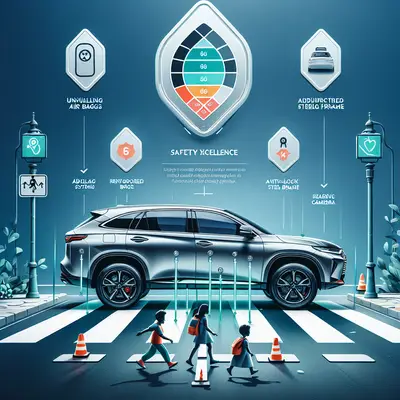
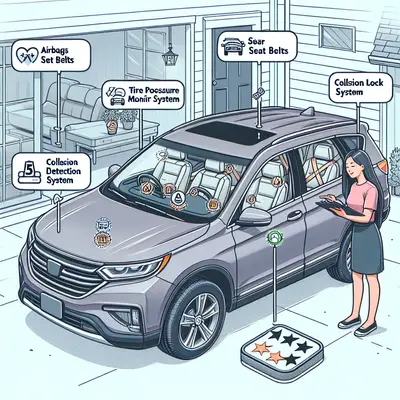
For families who value quiet confidence over conspicuous flash, safety ratings are less about fear and more about assurance. Yet the sleek badges and star icons only tell part of the story. The real substance of SUV safety lives in how technology, engineering, and design converge to protect your family in unplanned moments. Understanding that nuance can transform a test score from a simple metric into a meaningful decision-making tool.
This guide explores how to interpret safety ratings with a more refined lens—going beyond the obvious and toward the quietly consequential details that genuinely elevate family protection.
Why Safety Ratings Are Only the Beginning
Safety ratings from organizations like the National Highway Traffic Safety Administration (NHTSA) and the Insurance Institute for Highway Safety (IIHS) provide an essential baseline. They distill complex crash tests into digestible scores and labels, giving families a starting point in a crowded market. A five-star rating or a “Top Safety Pick+” designation signals that a vehicle has performed well under rigorous, standardized conditions.
However, those symbols are deliberately simplified. They cannot fully express how an SUV behaves in edge‑case scenarios, how its active safety systems intervene in real-world driving, or how its interior layout supports safe daily use with children. Two SUVs can share similar ratings yet feel very different to live with: one may simply be compliant, while the other feels thoughtfully engineered around family realities—late-night drives, distracted passengers, unpredictable traffic, and changing weather.
Approaching safety ratings as a first filter rather than a final verdict allows you to look deeper, asking not just “Is this SUV safe?” but “How, exactly, does this SUV keep my family safe—and in which situations?”
Exclusive Insight 1: The Quiet Power of Structure and Crash Geometry
Beneath the design language and LED signatures lies the most fundamental safety feature: the vehicle’s underlying structure. While crash-test scores touch on outcomes, they do not always detail why a particular SUV performs well. For families, that “why” matters.
SUVs that excel in safety often use a sophisticated mix of high-strength and ultra-high-strength steel, aluminum, and carefully engineered crumple zones. These structures are designed to channel crash forces away from the cabin, preserving what engineers call the “survival space.” Pay attention to how manufacturers describe their platforms—terms like “rigid passenger cell,” “multi-load path structure,” or “ring-shaped reinforcement” are not marketing poetry; they are clues to real safety intent.
Crash geometry—how the SUV’s height, frame, and front-end design interact with other vehicles—is equally critical. Models that perform strongly in IIHS’s small overlap tests, including driver- and passenger-side evaluations, usually demonstrate superior front-end engineering. For families, this translates into better protection in those off-center frontal impacts that mimic clipping a barrier or another vehicle.
When researching, look beyond the rating and read the test notes. If a model’s structural performance is described as “good” with minimal cabin intrusion, that’s an understated but meaningful endorsement.
Exclusive Insight 2: Child Restraint Realities Hidden Behind the Score
Official safety ratings typically assume adult-sized crash dummies; your daily life likely involves child seats, boosters, and teenagers somewhere in-between. This is where a sophisticated safety assessment must include what ratings do not fully capture: how easily and securely you can install child restraints in the real world.
Two SUVs with identical crash scores may differ dramatically in:
- The accessibility and visibility of LATCH anchors
- The ability to install multiple car seats without conflicts
- Whether rear-seat belt buckles are recessed or fixed (a major factor for booster users)
- The practicality of the third row for children versus adults
IIHS offers a dedicated LATCH usability rating that often goes unnoticed, yet it is invaluable for families. A “Good” or “Acceptable” LATCH score signals that the SUV is more likely to support consistently correct child seat installation—arguably as important as any airbag in a real collision.
When you test-drive, treat child seat installation as a non‑negotiable part of the evaluation. Bring your own seats, attempt both LATCH and belt installations, and check for issues like belt routing obstructions, sloping cushions, and limited headroom. This is the unglamorous yet essential side of safety that rarely appears in brochures but defines your day-to-day peace of mind.
Exclusive Insight 3: ADAS That Assists, Not Agitates
Advanced Driver Assistance Systems (ADAS) have become the new frontier of automotive safety: automatic emergency braking, lane-keeping assistance, adaptive cruise control, blind-spot monitoring, and more. Many safety ratings now incorporate these technologies, particularly front crash prevention performance. However, the manner in which these systems operate is just as vital as their mere presence.
Some systems intervene abruptly, chime excessively, or deliver steering corrections that feel intrusive. Over time, this can lead drivers to switch features off—undermining the very protection they offer. The most thoughtfully tuned SUVs, by contrast, provide support that feels almost intuitive: subtle steering nudges rather than abrupt grabs, gentle deceleration instead of jarring stops, calibrated alerts that distinguish between genuine danger and harmless proximity.
Seek vehicles with:
- Forward collision warning and automatic emergency braking tested as “Superior” or “Advanced” by IIHS
- Lane-centering features that can be adjusted or temporarily overridden without fighting the system
- Driver attention monitoring that is discreet rather than punitive
During a test drive, deliberately explore how the SUV behaves: allow a safe gap to close with adaptive cruise control engaged, graze the lane marker, and approach stopped traffic with caution. You are not testing technology in isolation—you are assessing how gracefully it integrates into your driving style and how likely you are to leave it switched on for the long term.
Exclusive Insight 4: Nighttime, Weather, and the Often-Ignored Art of Visibility
Many families drive most cautiously in the rain or at night, yet these conditions receive far less attention than crash stars and badges. Visibility is one of the most understated aspects of SUV safety, and recent rating systems have begun to acknowledge this.
IIHS now evaluates headlight performance, including brightness, beam pattern, and glare for oncoming drivers. An SUV that earns “Good” headlight ratings across its trims has a tangible advantage in real-world safety: better illumination of pedestrians, lane markings, and potential hazards without blinding others. This matters during late returns from sports practice or long winter commutes.
But visibility extends beyond headlights:
- Slimmer roof pillars and well-designed mirrors improve sightlines at intersections and during lane changes
- Rear-view camera quality and lens cleaning features support safe reversing in bad weather
- Available surround-view camera systems make parking lots and school drop-off zones far less stressful
Consider these elements as quietly critical safety tools. When reviewing a potential SUV, look for detailed discussion of headlight performance and test it yourself: night-drive if possible, observe how confidently you can see the road edge, and assess how much you rely on artificial aids just to feel secure.
Exclusive Insight 5: Stability, Control, and How an SUV Behaves Under Stress
Crash tests capture what happens after a collision becomes inevitable. A more holistic view of safety also considers what happens in the seconds beforehand—how readily an SUV helps you avoid or mitigate impact. This is where chassis tuning, braking performance, and electronic stability systems enter the conversation.
Even within the SUV segment, some models feel composed and predictable during sudden maneuvers, while others feel top-heavy or unsettled. NHTSA’s rollover resistance ratings offer a useful indicator of inherent stability, but they do not entirely convey the subjective sense of control a particular SUV provides.
For family buyers who value refinement:
- Look for SUVs with strong braking test results from independent reviews and a reputation for consistent pedal feel
- Pay attention to standard electronic stability control and traction systems calibrated for wet and snowy conditions
- Consider tire choice; touring or all-season tires from reputable brands can dramatically affect real-world stopping distances and grip
On your test drive, find a safe opportunity to perform a firm—but controlled—brake test, a brisk lane change, and a quick merge onto a highway. Listen for composure: how much body roll occurs, how promptly the vehicle settles, and whether the steering remains reassuringly precise. These subtler sensations often predict how an SUV will respond when a child runs into the road or traffic ahead stops abruptly.
Conclusion
Safety ratings exist to simplify complexity, but families shopping thoughtfully for a premium SUV know that the most meaningful protection often lies in the details behind those scores. Structural integrity, child-seat practicality, the refinement of driver assistance systems, nighttime visibility, and dynamic stability all combine to create a sense of subtle certainty behind the wheel.
Choosing an SUV with care is not about chasing the most impressive badge; it is about understanding which engineering decisions, design choices, and technologies quietly safeguard your family in the small, unplanned moments that define real-life driving. When ratings become the starting point instead of the destination, your decision gains both nuance and confidence—and your family gains a vehicle that feels reassuringly capable, long after the showroom lights fade.
Sources
- National Highway Traffic Safety Administration (NHTSA) 5-Star Safety Ratings - Official government crash-test results, rollover ratings, and explanations of how safety scores are calculated
- Insurance Institute for Highway Safety (IIHS) Ratings - Detailed crash-test outcomes, headlight evaluations, LATCH usability scores, and Top Safety Pick designations
- U.S. Department of Transportation – Vehicle Safety Overview - Federal perspective on vehicle safety technologies, regulations, and research priorities
- IIHS: Evaluating Child Seat LATCH Systems - In-depth explanation of how LATCH usability is tested and why it matters for families
- National Safety Council – Advanced Driver Assistance Systems (ADAS) - Clear overview of ADAS features, their benefits, and best practices for real-world use
Key Takeaway
The most important thing to remember from this article is that this information can change how you think about Safety Ratings.