For discerning families, an SUV is no longer just a people-mover; it’s a mobile extension of your home—part lounge, part office, part nursery, part sanctuary. Beyond the obvious metrics of space, power, and price lies a quieter layer of refinement: the details that shape how you and your children actually feel during every school run, weekend escape, and cross-country holiday.
This is where the conversation becomes truly interesting. Below, we explore five under-the-radar, premium family features that rarely make headlines—but profoundly elevate everyday life on the road.
1. The Art of Cabin Zoning: Climate, Sound, and Light as Family Tools
In a well-considered family SUV, “comfortable cabin” means much more than dual-zone climate and a sunroof. Thoughtful models now treat the interior as a series of zones—each with different expectations and needs.
Look for tri- or quad-zone climate control that allows rear passengers to set independent temperatures without relying on a driver’s guesswork. Rear air vents placed at shoulder height (not just on the floor) help maintain a more consistent temperature for children in car seats, whose feet may not reach floor-level vents. When evaluating a test drive, run the climate from a cold start and notice how quickly and evenly the cabin stabilizes; this is a proxy for real-world winter mornings and late-night airport pickups.
Sound is another layer of zoning. Premium SUVs with laminated glass, additional insulation, and active noise cancellation can transform the rear of the cabin into a quieter, calmer space—vital when younger children nap while older siblings chat or game. Pay attention to how clearly you can hear a soft voice from the third row without raising your own volume; this subtle detail often separates truly refined cabins from merely spacious ones.
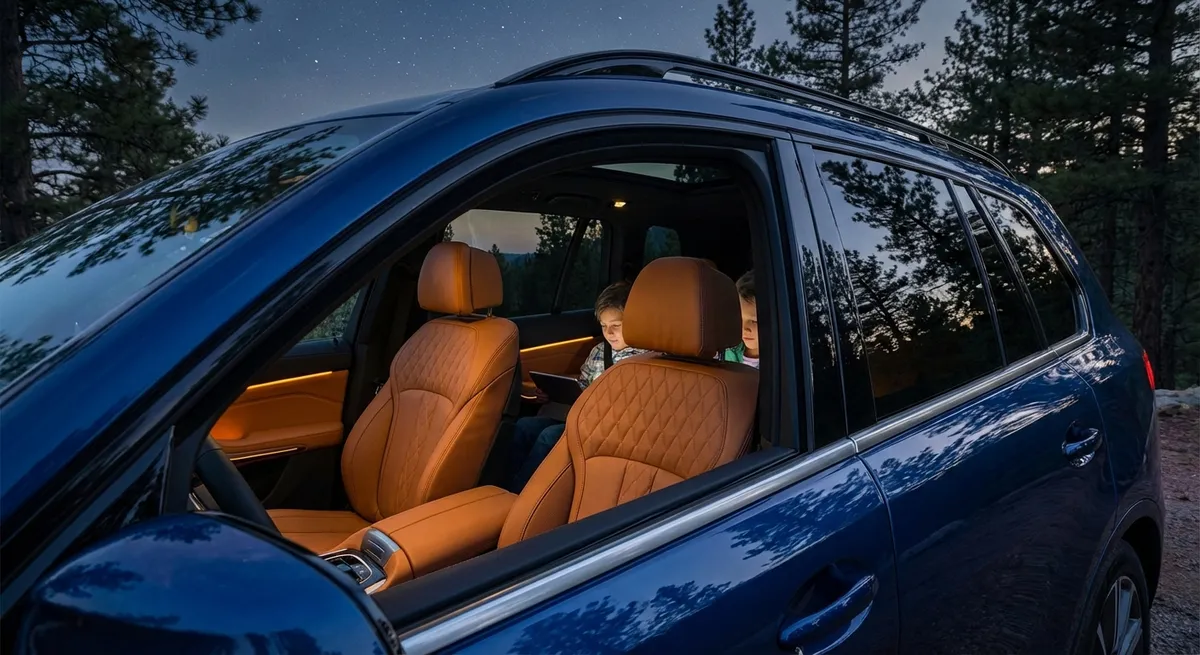
Finally, consider light. Panoramic roofs with sunshades that fully block light help prevent rear-seat glare during nap time, while ambient interior lighting can reduce strain during night drives. Some models even offer customizable colors and brightness, allowing a soothing evening ambiance rather than the harsh starkness of typical dome lights. This convergence of climate, sound, and light isn’t cosmetic—it’s the difference between “we got there” and “we arrived rested.”
2. Quiet Organization: Thoughtful Storage That Respects Your Aesthetic
Family life brings clutter; premium SUVs manage it discreetly. The best designs give you an almost invisible framework for order—so snacks, devices, sports gear, and school essentials are always within reach, yet never on display.
Focus on storage that is deep, lined, and softly damped. Felt- or rubber-lined door bins and console compartments prevent rattles from water bottles, chargers, and loose items. Hidden underfloor storage in the cargo area is invaluable for emergency kits, umbrellas, spare shoes, and picnic blankets—practical items that you always need but never want visible when you open the tailgate at a dinner party or valet stand.
Look closely at second-row solutions: are there clever slots for tablets or books? Do the seatbacks include robust pockets that won’t sag after a single school term? Are there cupholders that can securely hold both juice boxes and larger reusable bottles without tipping? These small elements reveal whether a manufacturer truly understands family rhythms.
Magnetic or softly closing lids on center consoles, elegantly integrated bag hooks in the cargo area, and expandable side compartments for strollers or sports bags all contribute to a cabin that can transition from “weekday chaos” to “weekend elegance” in moments. When evaluating options, imagine the SUV on Monday at 7 a.m. and Saturday at 7 p.m.—the right storage design should make both scenes feel equally composed.
3. Seating That Ages Gracefully with Your Children
Seat configuration is often discussed in terms of “how many people” instead of “which people and at what stage of life.” Sophisticated family SUVs approach seating as a long-term, adaptable system.
Start with access. Captain’s chairs in the second row can be a revelation for parents who frequently use the third row; the open walkway between seats makes buckling children in the back dramatically easier, especially when you’re carrying bags, instruments, or sports gear. However, a well-designed three-seat bench with independent sliding and reclining sections can offer more flexibility if you often mix passengers and cargo.
Consider car seat practicality. Flat, wide rear cushions, clearly marked LATCH anchors, and seatbelt placements that don’t interfere with booster seats all reduce daily friction. Some European and luxury-brand SUVs now integrate ISOFIX/LATCH points in more seating positions, giving you the freedom to choose where children sit as they grow. During a test drive, physically install a car seat or booster if you can; pay attention to how easily you can reach anchors without contorting yourself.
Long-term comfort matters as well. Sliding second-row seats allow you to prioritize legroom where it’s needed—more for adults on a road trip, more for cargo on a Costco run. Third-row seats with adult-usable thigh support and adjustable backrests turn that space from “last resort” to “genuine seating,” making multi-generational outings realistic and comfortable.
Lastly, materials: look beyond leather versus cloth. High-quality synthetic leathers and coated textiles can resist stains better than some traditional hides while maintaining a refined look. Perforations, contrast stitching, and subtle piping might seem purely aesthetic, but they also influence how cool the seats feel, how dirt accumulates, and how well the interior maintains its shape over years of family use.
4. The Discreet Digital Butler: Tech That Supports, Not Distracts
Family-friendly technology should feel like a discreet concierge, not a demanding guest. The most sophisticated systems quietly anticipate needs without overwhelming the driver with menus and notifications.
Begin with the driver’s interface. A clear, logically organized infotainment system with responsive controls and physical dials for core functions (volume, temperature, defrost) minimizes distraction when you’re answering a child’s question or navigating unfamiliar streets. Test how quickly you can adjust key settings without looking away from the road for long—this is a real measure of usable luxury.
Rear-seat tech can be transformative when executed thoughtfully. Integrated rear entertainment screens that mirror streaming devices or smartphones allow children to use familiar apps without everyone juggling tablets and cables. USB-C ports in all rows, ideally placed above floor level and away from kick zones, enable each passenger to remain charged without a tangle of wires.
Advanced driver assistance systems (ADAS) also play a pivotal role in family comfort. Intelligent cruise control that handles stop-and-go traffic, lane-keeping assistance tuned to feel natural rather than intrusive, and high-quality 360° camera systems simplify busy urban drop-offs and tight parking scenarios. When these systems work seamlessly, they reduce cognitive load for the driver—freeing you to be more present with your passengers.
Subtle features such as driver attention monitoring, natural voice assistants (“I’m cold” triggering a climate adjustment), and profiles that remember individual seat, mirror, and audio preferences round out the digital experience. The benchmark is simple: technology should make every trip feel smoother and more composed, never noisy or demanding.
5. Rituals of Arrival and Departure: The Luxury of Effortless Transitions
The most refined family SUVs excel not only on the road but in the micro-moments of entering and leaving the vehicle. These rituals—unbuckling sleeping children, managing groceries in the rain, loading luggage for a pre-dawn flight—are where thoughtful design quietly proves its worth.
Hands-free tailgates that actually work reliably (with a precise foot-swipe zone and responsive sensors) can be the difference between a graceful grocery unload and a fumbling juggle with keys and bags. Look for tailgates with adjustable opening heights to prevent bumps in low garages and power-folding second and third rows that can be configured from the cargo area with simple, intuitive controls.
Entry and exit are equally important. Generously sized door openings with wide-swinging rear doors, low step-in heights, and grab handles positioned for both adults and children turn daily school runs into smooth movements rather than awkward climbs. Soft-close doors and delayed interior lighting fade-outs reinforce a calm, unhurried ambiance—particularly valuable when you’re carrying a sleeping child or a laptop bag.
Keyless entry with personalized welcome profiles—adjusting seats, mirrors, climate, and even favorite radio stations as you approach—gives every drive a sense of intentionality. Some models now offer “walk-away locking” that secures the vehicle when you step away with the key, which is especially reassuring during those distracted moments when you’re focused on children, strollers, or luggage.
Ultimately, the most compelling family SUVs choreograph these transitions so well that you stop thinking about them. You simply glide from home to vehicle to destination—without drama, without clutter, and without the sense that you’re constantly compensating for design oversights.
Conclusion
For families who value refinement, the true measure of an SUV isn’t just in spec sheets or showroom gloss; it’s in the quiet choreography of daily life. Zoned comfort that respects each passenger, storage that tames clutter without sacrificing elegance, seating that evolves with growing children, technology that recedes into the background, and effortless arrivals and departures—these are the nuances that transform an SUV from “suitable” to “indispensable.”
When you evaluate your next family vehicle, look beyond the obvious. Pay attention to how the SUV supports your routines, protects your calm, and preserves a sense of sophistication even on the busiest days. The right choice won’t simply carry your family; it will elevate the way you move through the world together.
Sources
- [National Highway Traffic Safety Administration (NHTSA) – In-Vehicle Technology and Driver Distraction](https://www.nhtsa.gov/technology-innovation/in-vehicle-technology) - Overview of how in-vehicle tech impacts safety and driver attention
- [IIHS – Child Seat Anchors (LATCH) Ease-of-Use Ratings](https://www.iihs.org/ratings/child-seat-anchors-latch) - Evaluates how vehicle designs affect the practicality of installing child seats
- [Edmunds – Car Interior Features for Families](https://www.edmunds.com/car-buying/car-interior-features-for-families.html) - Consumer-focused breakdown of family-friendly interior considerations
- [Consumer Reports – Car Seat and Booster Seat Guide](https://www.consumerreports.org/cro/car-seats.htm) - Guidance on car seat use that highlights the importance of compatible seating and anchor layouts
- [Mercedes-Benz – ENERGIZING Comfort and Interior Comfort Systems](https://www.mercedes-benz.com/en/vehicles/passenger-cars/mercedes-benz-innovation/energizing-comfort/) - Example of advanced climate, lighting, and comfort zoning in modern premium vehicles
Key Takeaway
The most important thing to remember from this article is that this information can change how you think about Family Features.