The most satisfying family SUVs rarely shout for attention. Instead, they earn their place in your life with quiet intelligence—solving daily irritations you’ve almost accepted as inevitable. This is where true luxury lives for families: in the details that make every school run, weekend away, and late-night airport pickup feel seamless rather than stressful.
In this guide, we explore five under-the-radar family features that rarely headline the brochure, yet dramatically elevate everyday life when chosen thoughtfully.
The Art of Effortless Entry: Beyond Basic Keyless Access
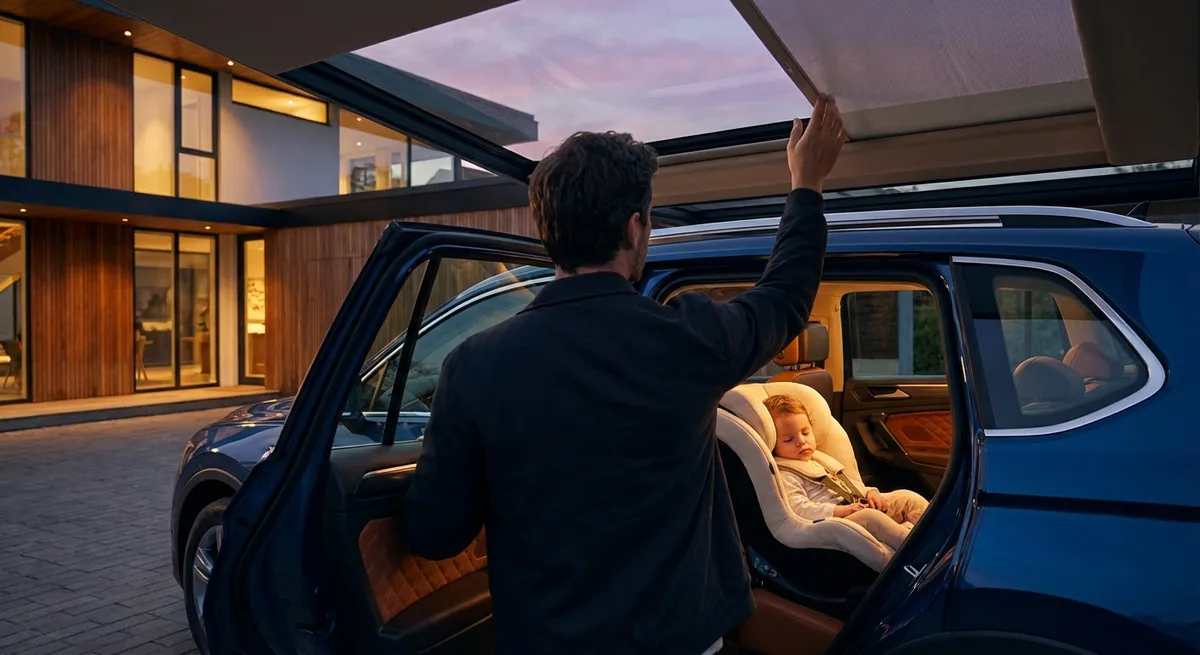
Keyless entry and push-button start are now expected, but the most family-friendly SUVs turn door access into an almost invisible choreography. Look for vehicles that separate proximity detection across all doors, not just the front, so a parent approaching with a stroller can open the rear door first without shifting positions. Small? Yes. Transformative in a crowded parking lot with a sleeping toddler? Absolutely.
Refined implementations also include delayed auto-lock that adapts to your routine, preventing the familiar “Did I lock the car?” anxiety loop after a chaotic unloading. Some systems allow you to set different behavior profiles, so your daily solo commute feels distinct from full-family weekends. Digital key functionality—using your smartphone as the key—adds another layer of elegance by allowing you to share access with caregivers or teenagers without handing over a physical fob, often with time- and feature-limited permissions.
The most thoughtful designs pair this with softly damped door checks that hold doors open on inclines, wide rear door apertures for easy child-seat loading, and handles shaped for secure grip even with gloved or wet hands. The result is not just convenience, but a subtle feeling of being anticipated rather than accommodated.
Cabin Architecture That Grows With Your Children
Many family SUVs advertise three rows; few think deeply about how a family actually evolves inside that space over a decade. The most sophisticated interiors treat the cabin as a configurable environment, rather than a fixed layout of seats.
Look for second rows with fore-aft sliding travel beyond the norm, enabling you to prioritize either third-row legroom for visiting grandparents or maximum cargo space during sports-season overload. Premium implementations allow the second-row seat to tilt and slide even with a child seat installed, making third-row access possible without redoing a carefully secured installation.
Pay attention to the beltline height and window shapes around the second and third row. A slightly lower beltline and larger glass area help younger children feel less confined and more engaged with the outside world, often resulting in calmer journeys. Adjustable head restraints that don’t obstruct rear visibility when lowered, yet offer full support as children grow, are another detail that elevates long-term usability.
Truly family-oriented designs build in concealed anchor points for accessories—tablet holders, hooks, organizers—so that personalization doesn’t require improvised solutions. Over years of school runs and road trips, this flexibility feels less like a feature and more like foresight.
Climate as a Comfort Strategy, Not a Mere Specification
Dual- or tri-zone climate control is commonplace; what distinguishes a genuinely family-first SUV is how intelligently that system manages temperature, airflow, and quietness in the cabin.
Rather than simply “rear vents,” look for SUVs that place outlets where they actually matter for children: at mid-height in the B- and C-pillars or integrated into the headliner, not just at floor level. This prevents the classic scenario where the driver is chilled while the third row still feels stuffy. Quiet, variable-speed fans that avoid sudden blasts of air help babies and younger children sleep more soundly.
Advanced models allow independent rear control with a lockout function—handy when older children want autonomy but you still need the final say. Air quality systems that incorporate particulate filters and, in some cases, cabin air purification, are no longer a luxury for urban families; they’re an investment in everyday wellbeing during commutes through traffic and construction zones.
The most refined executions integrate climate settings with remote pre-conditioning—allowing you to cool or warm the cabin before you even buckle in. In extremes of summer or winter, stepping into a pre-conditioned interior feels less like a feature and more like a serene reset before the next segment of your day.
Quiet Storage Genius: The Hidden Infrastructure of Calm
Cargo volume numbers tell only part of the story. What truly defines a sophisticated family SUV is how it manages the small, recurring clutter that otherwise accumulates into chaos: stray water bottles, half-read books, snacks, sports gear that never seems to find a home.
Seek out vehicles that offer a layered approach to storage: a deep center console for everyday essentials, shallow felt- or rubber-lined trays for small items that would otherwise rattle, and cleverly placed door pockets shaped to hold both bottles and slim items like notebooks or wipes. Underfloor storage in the cargo area that’s compartmentalized—rather than a single open well—lets you separate emergency equipment, bulky items, and rarely used accessories without sacrificing space for strollers or suitcases.
Premium touches include integrated hooks to secure grocery bags, low-profile rails or tie-down points for modular cargo systems, and recesses designed for specific family realities, like a designated umbrella slot or a lined, easily cleaned compartment for muddy shoes. The ability to fold seats from the cargo area with one hand, using levers or buttons, makes loading large items possible even when you’re holding a child’s hand in the other.
Over time, these elements don’t feel like “extras.” They become the infrastructure that keeps the vehicle—and by extension your days—visibly calmer and more composed.
Digital Peace of Mind Done with Restraint
The modern family SUV is as much a digital environment as a physical one. The challenge is balance: you want connectivity, navigation, and entertainment without overwhelming the driver or turning every journey into a screen-centered experience.
Look for infotainment systems that prioritize clarity and restraint. Larger screens are useful, but only when paired with intuitive layouts and responsive controls that minimize distraction. Physical knobs and buttons for critical functions—temperature, volume, defogging—remain a hallmark of considered design, allowing quick adjustments by feel alone.
For families, rear-seat connectivity can be transformative when implemented thoughtfully. Multiple USB-C ports with sufficient charging output, outlets positioned away from kicking feet, and neatly routed cable paths reduce the tangle of cords. Some of the most sophisticated solutions include built-in Wi-Fi hotspots with configurable profiles, enabling you to limit data use or streaming access according to who’s on board.
Advanced driver-assistance systems (ADAS)—adaptive cruise control, lane centering, blind-spot monitoring—should be evaluated not just for their presence but for how smoothly and predictably they behave. Systems that intervene abruptly can unsettle both the driver and younger passengers. Those calibrated with a more natural, human-like response reduce fatigue on long journeys and quietly protect against lapses in attention, giving families a more relaxed and secure driving experience.
When these digital features are tuned with restraint and precision, they disappear into the background, offering reassurance rather than distraction—a form of luxury that becomes most apparent when you move to a vehicle that lacks it.
Conclusion
A truly exceptional family SUV reveals its value not during a test-drive around the block, but across months and years of real life: early mornings, late returns, unexpected detours, and cherished getaways. The features that matter most are often the ones you don’t notice immediately—the ease of reaching a car seat, the calm of a well-ventilated cabin, the quiet absence of clutter and distraction.
By looking beyond headline specifications and tuning into these subtle, family-centric details, you curate more than a vehicle. You shape a moving space that supports your family’s rhythm with quiet competence and understated grace—an everyday companion that feels more considered, more composed, and, ultimately, more worthy of the journeys you take together.
Sources
- National Highway Traffic Safety Administration (NHTSA) – Driver Assistance Technologies - Overview of modern ADAS features and how they enhance safety and reduce driver workload
- U.S. Department of Energy – Vehicle Air Conditioning - Explains how climate control systems work and their impact on comfort and efficiency
- IIHS – Child Seat Safety and LATCH Evaluation - Independent assessments of child-seat anchor accessibility and usability in family vehicles
- Honda – CabinTalk and Rear-Seat Convenience Features - Example of how a mainstream brand implements thoughtful family-focused interior technology
- Volvo Cars – Air Quality and Advanced Climate Systems - Details on premium air-filtration and cabin air-quality solutions in modern vehicles
Key Takeaway
The most important thing to remember from this article is that this information can change how you think about Family Features.