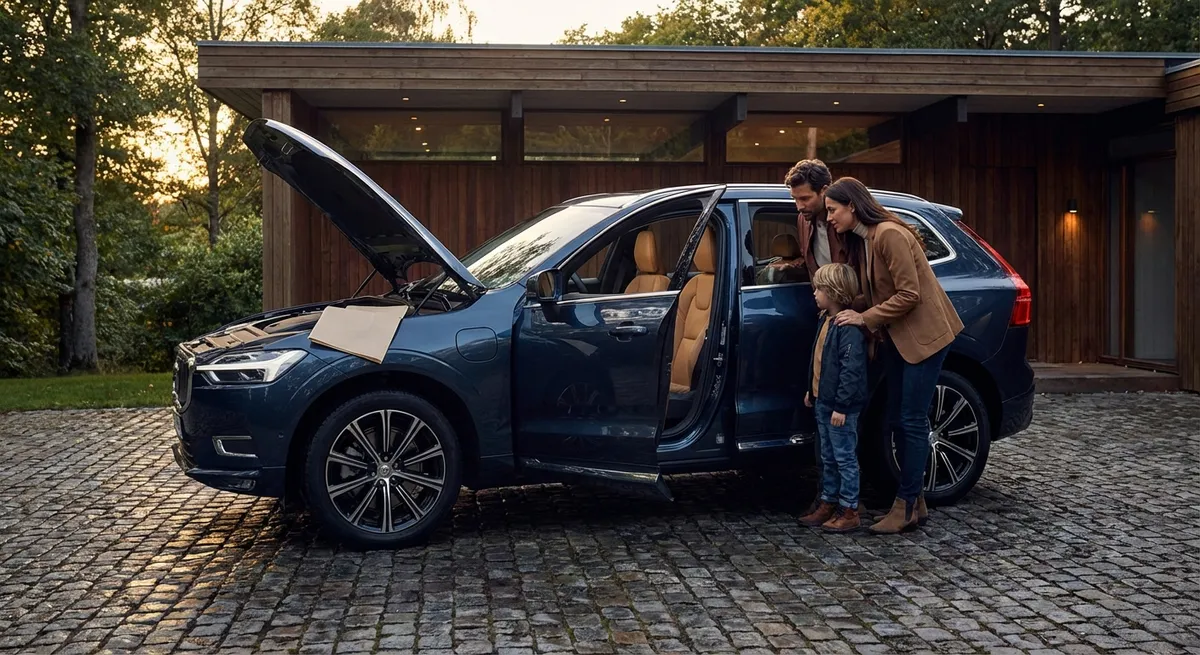
For families who value refinement as much as practicality, most SUV reviews feel strangely incomplete. They note horsepower but not how the engine’s character feels on a sleepy Monday school run. They list cargo capacity in cubic feet but say nothing about how gracefully a stroller, cello case, or week’s worth of groceries actually fit. At Family SUV Review, our lens is different: we focus on the quiet, often-overlooked qualities that make an SUV feel impeccably suited to family life.
What follows is a sophisticated framework for reading SUV reviews with discernment—anchored by five exclusive insights that matter deeply once the novelty of a new vehicle gives way to everyday routine.
Redefining “Family-Friendly”: Beyond Cupholders and Car Seat Count
In many mainstream reviews, “family-friendly” has been reduced to a checklist: rear-seat space, cupholders, and maybe a passing mention of ISOFIX/LATCH anchors. For discerning families, that is the bare minimum, not the benchmark. The true measure of a family SUV is how it anticipates the nuance of real life—muddy cleats, violin lessons, last-minute airport runs, and sleeping toddlers after late dinners.
When you read or watch reviews, look for commentary on how intuitive the cabin actually feels in motion. Are climate and audio controls reachable without taking eyes off the road? Does the rear-seat layout allow an adult to comfortably sit between two child seats when needed? Do reviewers describe the ease (or frustration) of installing and tightening car seats across different rows? Subtle cues—such as whether a reviewer mentions bending awkwardly into the third row, or needing two hands to move a seat—speak volumes. The most genuinely family-centric SUVs tend to disappear into the background: everything works, everything is where you expect it, and nothing about the cabin design calls attention to itself.
Five Exclusive Insights Discerning Families Should Look For
The majority of reviews will tell you if an SUV is “spacious” or “comfortable.” For families who care about longevity, serenity, and everyday grace, those words are not precise enough. These five nuanced insights rarely make the headline, yet they define how an SUV will feel in year four as much as in week one.
1. The Micro-Ride: Low-Speed Composure on Imperfect Streets
Many reviews focus on highway stability and cornering prowess, but a family SUV spends much of its life at 25–40 mph on imperfect urban and suburban roads. The more refined question is: how does the SUV behave at low speeds over patched asphalt, speed humps, or pockmarked neighborhood streets?
Sophisticated reviewers will describe how suspension and tire choice interact at these speeds: does the vehicle shudder over manhole covers, or does it round off imperfections with a muted, single thump? Do small cracks produce tremors through the steering wheel or remain distant and unobtrusive? Pay close attention to mentions of “secondary motions” or “body oscillations” after bumps—these are the subtle movements that can induce fatigue or motion sickness in susceptible family members. The most elegant family SUVs glide rather than jostle, preserving quiet conversations and sleeping children without the drama of sport-tuned stiffness.
2. Cabin Acoustics: The Signature Sound of a Calm Commute
Noise isolation is often reduced to a single line—“it’s quiet at highway speeds”—but the reality is far more intricate. True acoustic refinement is about the type and layering of noise, not merely the volume. Listen for reviewers who differentiate between wind rustle around the mirrors, tire roar on coarse pavement, and engine presence during acceleration.
A premium family SUV will prioritize a smooth, low-frequency soundscape rather than sharp, intrusive tones. Electric and hybrid SUVs introduce a different challenge: without an engine masking background noise, poorly insulated cabins can make every pebble and grain of asphalt sound amplified. Look for references to double-pane front glass, acoustic windshields, and specific comments about how the cabin sounds with the rear seats occupied and cargo loaded. An acoustically considered SUV allows you to speak quietly at 70 mph, take calls without raising your voice, and let children nap without being disturbed by every passing truck.
3. Ergonomic Honesty: The Reality of 90 Minutes in the Driver’s Seat
Early impressions of comfort can be misleading; many seats feel inviting for 10 minutes and quietly punishing after an hour. Discerning reviews will go beyond “the seats are comfortable” and discuss how support holds up during longer drives. Watch for mentions of adjustable thigh support, multi-way lumbar adjustments, and the relationship between seat height, pedal placement, and steering wheel reach.
For family life, the front seats are your command center, while the second row is your lounge. A refined review will comment on whether rear passengers sit low with knees elevated (fatiguing over time) or on a more natural bench height, and whether the headrests encourage an upright, relaxed posture or push the head forward. Premium family SUVs often offer subtly sculpted cushions that balance lateral support (to keep you from sliding during turns) with gentle padding that doesn’t collapse. Trust reviewers who mention emerging tension points—lower back, shoulders, or hips—after extended drives; that honesty will serve your family better than generic praise.
4. The Practical Ballet: Cargo Space That Actually Works
Cargo volume in liters or cubic feet is a useful metric, but it doesn’t tell you whether an SUV will gracefully accept your real-world items. Elegant family utility is less about an abstract number and more about geometry, access, and depth. When you read reviews, look for detailed descriptions of how strollers, sports gear, suitcases, or bulky grocery hauls fit—especially with some seats folded and others upright.
Sophisticated assessments will mention the loading height: can a grandparent comfortably lift a suitcase into the rear? Does the liftover angle force you to lean in awkwardly? Is the floor flat with the seats folded, or interrupted by steps and ridges that make sliding boxes or storage bins awkward? Subtle design decisions—a small storage well beneath the floor, sturdy hooks for shopping bags, a wide opening that doesn’t taper dramatically near the roofline—can transform everyday errands. The most thoughtfully designed SUVs perform a kind of “practical ballet,” allowing you to reconfigure the space fluidly without wrestling with heavy or unintuitive mechanisms.
5. Digital Manners: How the Tech Behaves When You’re Distracted
Family life is rarely linear; navigation prompts arrive while you’re answering a question from the second row, an important call comes in just as you’re merging, or a playlist needs adjusting mid-school-run. Most reviews will list screen sizes and feature sets, but few evaluate how the technology behaves when your attention is fragmented.
Seek reviewers who comment on menu depth and responsiveness: are climate controls buried in submenus, or always accessible with a single, physical control? Is there meaningful voice control that actually understands plain language, or a system that forces you to prod at tiny icons? Pay attention to whether wireless Apple CarPlay and Android Auto are stable or glitch-prone, and whether the interface remains fluent when a phone is connected and a navigation app is running. In a premium family SUV, good tech is not about spectacle; it is about grace under imperfect conditions, minimizing cognitive load so you can focus on the road—and on the people in your vehicle.
Reading Between the Lines: Interpreting Reviews with a Curated Lens
Once you know what to look for, the language of SUV reviews becomes much more revealing. Instead of skimming for power outputs and fuel economy alone, read descriptively and contextually. Phrases like “firm but controlled ride” can mean pleasing composure for one driver and unwelcome harshness for a young family on bumpy streets. Comments about “light steering” may signal easy maneuvering in tight parking lots—or a lack of precision at higher speeds. Your task is to translate these observations into the context of your own routines.
Look for reviews where the author imaginatively inhabits family scenarios: three kids after a long day, luggage for a week away, a late-night drive home from a recital. Are they noting how easy it is to buckle a child into the third row when another seat is installed in front? Do they mention how many hands were required to fold a row of seats while holding a bag or a toddler’s hand? Seek consistency across multiple reputable sources; when several reviewers independently highlight similar virtues or frustrations, you gain a reliable signal. Ultimately, the most valuable reviews help you sense not just how an SUV performs, but how it might quietly enrich, or subtly complicate, your daily life.
Conclusion
For families with a refined eye, choosing an SUV is less about chasing the latest trend and more about finding a vehicle that feels effortlessly aligned with their habits, priorities, and standards. The usual metrics—horsepower, screen size, cargo volume—still matter, but they are only the outer frame. Within it lies a more intricate portrait: low-speed ride quality, cabin acoustics, enduring seat comfort, believable practicality, and technology that behaves with grace under pressure.
By seeking out reviews that illuminate these subtler dimensions, you elevate the process from a mere purchase to a considered selection—one that respects not only your time and resources, but also the quiet, everyday moments that define family life. In that space between the spec sheet and the school run, the truly exceptional family SUVs reveal themselves.
Sources
- National Highway Traffic Safety Administration (NHTSA) - Authoritative information on vehicle safety standards, crash tests, and safety technologies relevant to family SUVs
- Insurance Institute for Highway Safety (IIHS) – Ratings - Independent crash-test results and evaluations of headlights, crash avoidance tech, and child seat anchor usability
- Consumer Reports – Guide to Car Seat Safety and Installation - Practical insights on car seat fitment and installation challenges in different vehicles
- Edmunds – Car Interior and Cargo Space Reviews - Detailed expert reviews often discussing seat comfort, cargo usability, and cabin ergonomics in real-world terms
- U.S. Department of Energy – Fueleconomy.gov - Official fuel economy data and operating cost estimates for SUVs, helpful for long-term family ownership planning
Key Takeaway
The most important thing to remember from this article is that this information can change how you think about SUV Reviews.