Family SUV shopping is no longer about simply “fitting everyone in.” For many modern households, it’s an exercise in aligning quiet comfort, safety nuance, technology restraint, and long-term value—without surrendering to trend-driven excess.
This guide explores five exclusive, often-overlooked insights that give families a meaningful edge in the showroom. Think of it as the difference between choosing an SUV that merely works, and one that quietly enhances your daily rhythm for years to come.
1. Cabin Architecture: How the Interior Shapes Family Harmony
Most brochures highlight seat count and cargo volume. Fewer talk about cabin architecture—the way space, sightlines, and access work together to reduce friction in real life.
Start by focusing on second-row usability. A bench seat may offer an extra seatbelt, but a well-executed pair of captain’s chairs can dramatically improve school-run logistics: easier access to the third row, less shoulder contact between siblings, and a natural “lane” for kids to move through without climbing over upholstery. The key is to evaluate not just layout, but how easily the seats tilt, slide, and recline with one hand while you balance backpacks or a toddler.
Third-row design also matters far more than the spec sheet suggests. Look for adult-tolerable legroom, seat cushions that are high enough to support thighs (so older kids don’t feel “folded”), and thoughtful footwell depth. Pay attention to how naturally the second row folds forward—if it’s awkward in the dealer’s well-lit showroom, it will be maddening in a rain-soaked school parking lot.
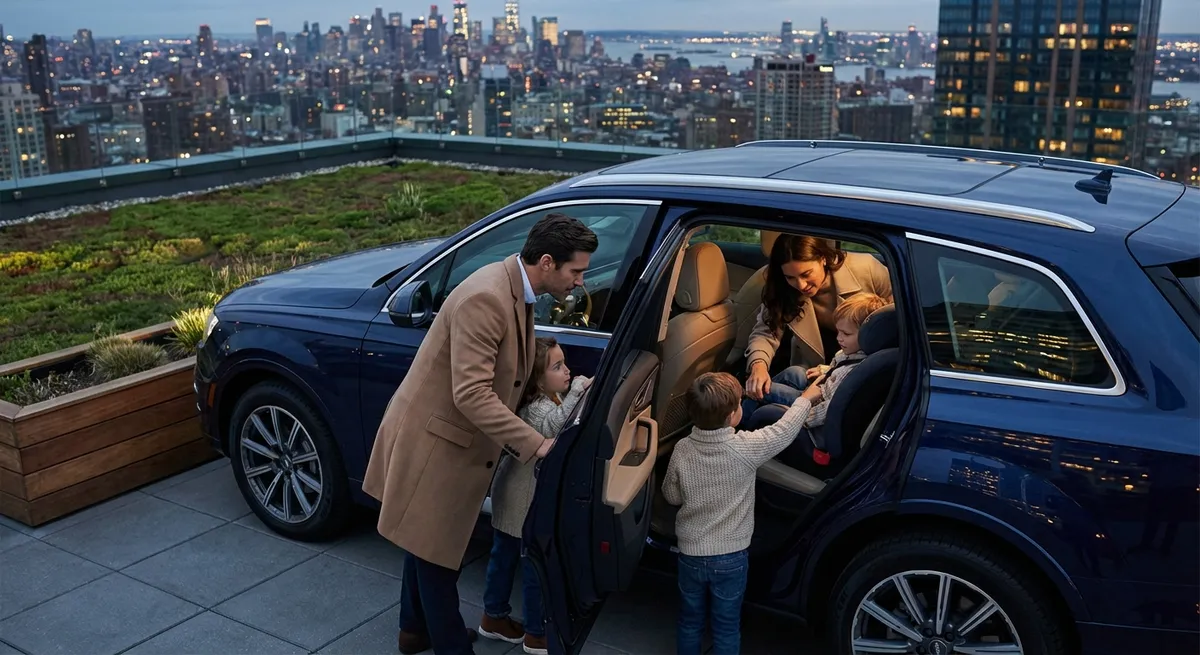
Finally, test the “family choreography”: one parent in the driver’s seat, kids accessing both rear rows, and someone loading the cargo area. You’re not just buying a vehicle; you’re buying the layout of your weekday routine.
2. Ride Quality as a Parenting Tool, Not a Performance Metric
Ride comfort is often described in vague terms—“plush,” “sporty,” “firm”—but for families, it can function as an unspoken parenting assistant. A well-tuned suspension, coupled with well-insulated cabin materials, calms the cabin in ways that go beyond simple comfort.
Begin with wheels and tires. The largest wheel option often looks glamorous, yet it can introduce sharper impacts over potholes and expansion joints. Opting for a slightly smaller wheel with a taller tire sidewall often yields a far more sophisticated ride—especially noticeable for rear passengers, where bounce and shudder can trigger motion sickness in children. It’s a detail commonly overlooked in favor of aesthetics.
Noise, vibration, and harshness (NVH) tuning is equally vital. Close the doors and listen: do you hear a muted “thunk” and a well-dampened quiet, or a hollow ring? On the test drive, pay attention at 30–45 mph on imperfect roads. Can you easily speak in a low voice to someone in the third row? Do you feel subtle vibrations through the steering wheel or the seat base? These micro-impressions accumulate over years of school runs and holiday drives.
The right SUV doesn’t simply “drive well.” It hushes the background chaos—allowing conversations, naps, and audio books to take center stage.
3. Technology That Serves, Not Shouts
Advanced technology can either elevate family life or constantly demand your attention. The difference lies in interface design and how thoughtfully features are integrated.
Look beyond headline features like “biggest screen” or “most speakers.” Instead, examine the interface under pressure: Can you adjust climate settings or seat heating with a physical button, or must you dive into a touch menu? Are the most-used controls—defrost, fan speed, audio volume—intuitive enough to operate without taking your eyes off the road? Families benefit most from tech that disappears into muscle memory.
For infotainment, test smartphone mirroring (Apple CarPlay, Android Auto) with your own device. Notice how quickly it connects on startup, whether the system lags when multiple functions run (navigation plus streaming plus calls), and how cleanly the audio transitions between navigation prompts, calls, and rear-seat entertainment. In a family SUV, audio chaos is real; good software prioritization prevents it.
Also examine how the vehicle handles multiple profiles. Can each driver have personalized seat positions, mirror angles, ambient lighting, and driver-assist preferences? This is especially useful if caregivers, grandparents, or a nanny frequently use the vehicle.
The most refined SUVs feel almost analog in their ease of use, despite the tech beneath; the sophistication is in the restraint, not the spectacle.
4. Safety Beyond the Spec Sheet: Usability of Protection
Most modern SUVs score well on crash tests and list similar active-safety features. The meaningful differentiation for families is not just what safety systems exist, but how gracefully they operate.
During the test drive, deliberately experience driver-assistance systems in realistic conditions. How gently does the lane-keeping assist nudge the wheel—does it feel like a subtle guide or a constant correction? Does adaptive cruise control behave calmly in stop-and-go traffic, or surge and brake in a way that might disturb sleeping children?
Pay close attention to blind-spot monitoring and rear cross-traffic alerts. Is the visual warning placed naturally in your sightline, and is the audio alert clear but not alarming? A thoughtfully tuned system quietly supports your awareness without startling young passengers.
For families with younger children, inspect the LATCH anchor accessibility and seatbelt geometry. Can you easily reach the anchors without digging into the upholstery? Do buckles stand upright enough that kids can eventually buckle themselves? Some SUVs also provide built-in rear seat reminders or occupant alerts, which—while simple in concept—reflect a deeper understanding of real-world family safety.
Ultimately, family safety is not a checklist—it’s the cumulative ease and reliability with which you can use those protections every single day.
5. Subtle Luxury: Materials and Details That Age Gracefully
True family-friendly luxury is not fragile; it’s the interplay of materials and details engineered to withstand real life with quiet dignity.
Start with seating surfaces. High-quality leather or well-chosen synthetic alternatives should feel supple yet robust, with stitching that appears even and tightly executed. Run your hand along the seams. Do they feel precise and consistent, or loose and uneven? Consider perforation patterns: finely detailed perforations often indicate greater attention to craftsmanship and can improve ventilation, but they should be easy to clean around.
Examine the touchpoints your family will interact with most: door pulls, window switches, steering wheel, armrests, and the center console lid. Are they padded and solid, or hollow and plasticky? Over time, these details influence how “new” the cabin still feels after countless commutes and road trips.
Storage sophistication is another quiet luxury. Look for a smart mix of covered and open compartments, a console deep enough for a small handbag or tablet, and door pockets that welcome water bottles without rattling. Hidden storage—under-floor cargo bins, discreet organizers, or modular cargo trays—can dramatically tidy the look of the vehicle, even on hectic days.
Finally, consider how the SUV looks and feels after five years. Darker, subtly textured materials hide scuffs and fingerprints elegantly. Metallic accents should feel cool and weighty to the touch, not like lightweight plastic painted to imitate metal. Families live in their vehicles; choose an interior that gains character, not clutter, with time.
Conclusion
For families seeking an SUV that truly elevates daily life, the real advantage lies in what doesn’t shout from the brochure: cabin architecture that simplifies movement, ride quality that soothes, technology that recedes into the background, safety that operates with quiet confidence, and materials that gracefully endure lived-in luxury.
Approach your next SUV not as a collection of features, but as an ecosystem for your family’s routines—drop-offs, road trips, late-night drives home from activities. When you prioritize the subtle, practical refinements described here, you’re not merely purchasing transportation. You’re curating a moving space that supports, calms, and quietly enriches the way your family moves through the world.
Sources
- [National Highway Traffic Safety Administration (NHTSA)](https://www.nhtsa.gov/ratings) - Official U.S. government crash test ratings and safety feature information
- [Insurance Institute for Highway Safety (IIHS)](https://www.iihs.org/ratings/by-class/suvs) - Independent crash test results and safety evaluations for SUVs by size class
- [Edmunds SUV Buying Guide](https://www.edmunds.com/suv/) - Expert overviews on SUV segments, features, and real-world shopping advice
- [Consumer Reports: Guide to Car Safety Features](https://www.consumerreports.org/cars/car-safety-features-guide-a2392304012/) - Detailed explanations of modern driver-assistance technologies and how they work
- [University of Michigan Transport Research Institute](https://www.umtri.umich.edu/) - Research and publications related to vehicle safety, driver behavior, and transportation trends
Key Takeaway
The most important thing to remember from this article is that this information can change how you think about Buying Guide.