Choosing a family SUV today is less about horsepower and headlines, and more about how gracefully a vehicle disappears into the rhythm of your life. The most rewarding choices feel almost premeditated—anticipating school runs, late-night airport pickups, and weekend escapes with an ease that never needs announcing. At Family SUV Review, we look beyond surface impressions and spec-sheet bravado to understand how an SUV behaves in the real world of refined, modern family life.
Below, we share five exclusive insights that guide how we review SUVs for families who value composure, intelligence, and understated luxury over flash. These are the quiet differentiators that rarely make brochures, but fundamentally reshape the ownership experience.
How We Look at Ride Comfort: Not Just “Soft” vs “Firm”
Many reviews casually describe ride quality as either “comfortable” or “sporty.” For families, that binary is almost meaningless. What truly matters is how the SUV manages motion—especially with kids, luggage, pets, and occasionally overtired adults on board.
We pay close attention to how the suspension handles low-speed imperfections like speed bumps, expansion joints, and broken urban pavement, because these are what your passengers actually feel day to day. The best family SUVs exhibit what we call “layered composure”: they isolate jolts without feeling floaty, and settle quickly after a bump instead of bobbing or pitching. We also evaluate vertical motion in the second and third rows, where children are seated; some SUVs feel composed up front but become surprisingly unsettled at the back. When adaptive dampers or air suspensions are available, we assess whether the comfort modes genuinely filter out fatigue on long drives, or simply soften the ride at the cost of control. It’s in these nuances that a school run either feels serene—or subtly tiring.
Cabin Layout as a Daily Ritual, Not a Seating Chart
Most spec sheets will tell you how many seats an SUV has and how they fold. That’s the baseline. What families actually need is an interior that understands choreography: how people and things move in and out of the vehicle, often hurriedly, often with hands full.
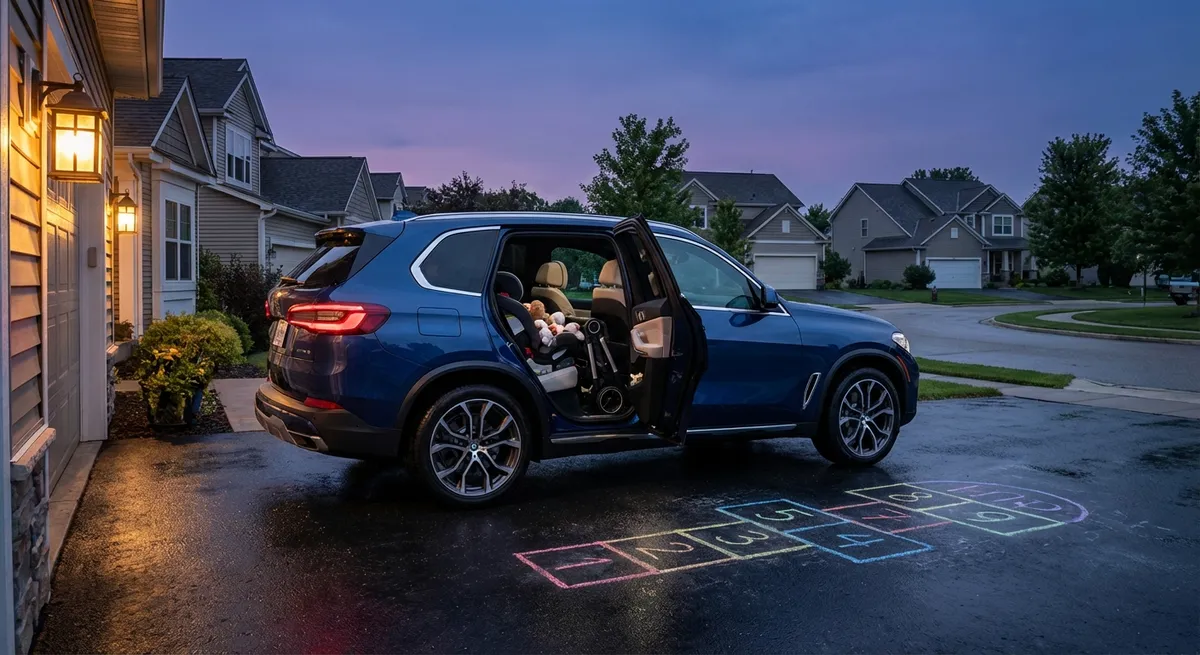
In our reviews, we focus on ingress and egress as much as the seating itself. We look at door opening angles, step-in height, and how easily a child can climb into the second or third row without a wrestling match. We pay attention to how far second-row seats slide, and whether they still permit access to the third row with a child seat installed—this single detail can make or break daily usability. Storage is evaluated as a system, not a collection of bins: is there a logical, elegant place for phones, snacks, water bottles, sunglasses, and small toys, or does clutter inevitably spread across every surface? We also examine how the cabin feels when partially loaded: two adults and one child, or four adults with luggage. The best family SUVs maintain a sense of order and calm, regardless of the combination of passengers and gear.
Tech That Serves Quietly, Instead of Competing for Attention
It’s tempting to judge an SUV by screen size alone. For families, the question is not how much tech you get, but how discreetly and intelligently it works in the background, especially when there are distractions in the cabin.
When we evaluate in-car technology, we prioritize responsiveness, clarity, and minimalism over sheer spectacle. We note whether essential functions—climate, seat heating, drive modes—are accessible via physical controls or buried in submenus, because fumbling through a screen at 70 mph with kids in the back is not luxury. Voice control is tested for its ability to handle natural phrasing (“I’m cold” vs. “Set temperature to 72 degrees”) and to recognize multiple voices, including a quieter one from the second row. We also examine the quality of smartphone integration: does Apple CarPlay or Android Auto connect reliably, and can they be used wirelessly without draining your phone battery excessively? The most sophisticated SUVs allow you to treat their tech as a calm, invisible assistant—not a fussy, attention-seeking centerpiece.
Real-World Refinement: Noise, Vibration, and Fatigue
Quite a few SUVs are impressive for an afternoon test drive; far fewer remain effortlessly soothing after three hours on the interstate with a full cabin. To assess this, we move beyond the usual “quiet cabin” descriptors and look at how an SUV manages sensory fatigue over time.
We listen for the quality—not just the volume—of road, wind, and engine noise. A faint but coarse tire hum can be more fatiguing than a slightly louder, smoother sound profile. We test how the cabin sounds at typical family speeds: 30–40 mph around town, 60–75 mph on the highway. We also pay attention to how the vehicle idles at a stoplight with the climate system on—especially in hybrids and plug-in hybrids where engine start-stop is frequent. Vibrations through the steering wheel, seat base, and floor can be subtle but telling; in premium family SUVs, these should be nearly imperceptible. Over time, these tiny refinements are what make late-night drives home feel cocooned rather than draining.
Safety as an Experience, Not Just a Rating
Star ratings and crash test scores are non-negotiable baselines, and we always consider independent safety data. But for a family, safety is also about how intuitively a vehicle helps you avoid mistakes in the first place—and how gracefully it intervenes when you’re distracted or tired.
Our reviews examine how driver-assistance systems behave in dense traffic, poorly marked roads, and at night, because these are the conditions where families often drive. Lane-keeping systems are evaluated for subtlety: constant ping-ponging between lane markers is more stressful than reassuring. Adaptive cruise control is assessed not only for maintaining distance, but for how smoothly it accelerates and brakes, particularly with fragile passengers asleep in the back. We also look closely at child-seat friendliness: the accessibility of ISOFIX/LATCH anchors, the ease of correctly routing top-tether straps, and whether the roofline makes it awkward to secure a child in a rear-facing seat. True safety is when the vehicle consistently supports good habits and forgives human imperfection—without scolding, beeping, or startling you into distraction.
Conclusion
For families seeking an SUV that feels genuinely considered rather than merely well-equipped, the real differentiators are often subtle: how calmly it rides with a full cabin, how naturally children move through the space, how discreetly the tech assists you, and how gently it cushions the unavoidable chaos of daily life. At Family SUV Review, these five insights shape the way we assess every model, from understated premium crossovers to three-row flagships.
The result is a perspective that goes beyond numbers without ignoring them, pairing objective data with the realities of refined family living. Because the right SUV should do more than transport your family—it should quietly elevate the way you move through the world together.
Sources
- [National Highway Traffic Safety Administration (NHTSA) – 5-Star Safety Ratings](https://www.nhtsa.gov/ratings) - Official U.S. government crash test ratings and safety information for SUVs and other vehicles
- [Insurance Institute for Highway Safety (IIHS) – Ratings & Research](https://www.iihs.org/ratings) - Independent crash tests, child seat evaluations, and safety technology assessments
- [Edmunds – Car Seat Compatibility & Family Car Reviews](https://www.edmunds.com/car-seat-compatibility/) - Practical guidance on installing child seats and evaluating family usability in modern vehicles
- [Consumer Reports – Guide to Car Safety Features](https://www.consumerreports.org/cars-guide-to-car-safety-features/) - Detailed explanations and evaluations of driver-assistance and active safety systems
- [EPA – Fuel Economy Guide](https://www.fueleconomy.gov/feg/findacar.shtml) - Official fuel economy data and efficiency comparisons for SUVs, including hybrid and plug-in models
Key Takeaway
The most important thing to remember from this article is that this information can change how you think about SUV Reviews.