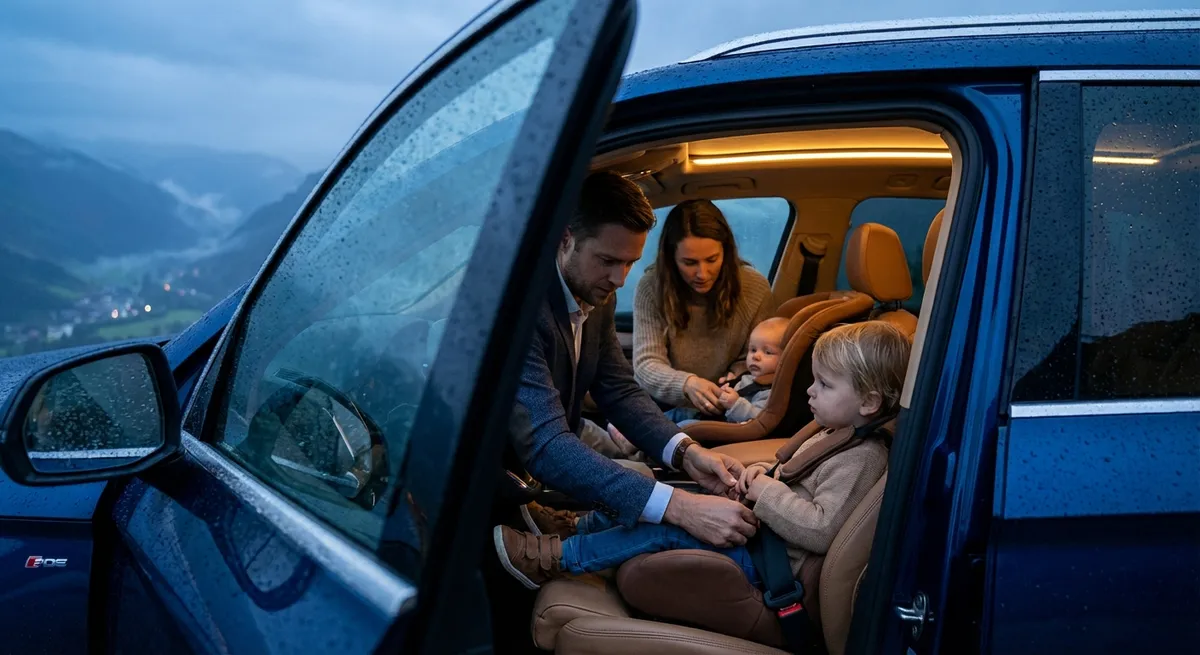
For families who see their vehicle as an extension of their home—and their standards—most SUV reviews feel oddly incomplete. Horsepower figures and cargo volumes tell part of the story, but not the part that determines whether a long day ends in calm or in friction. At Family SUV Review, we look for what makes a vehicle genuinely liveable for a family that values refinement: the way a cabin filters chaos, the poise of a chassis when fully loaded, and the small engineering decisions that turn everyday drives into something quietly elevated.
Below, we share five exclusive insights we use when reviewing family SUVs—factors that rarely make the headline specs, but often define whether a vehicle truly earns its place in a discerning driveway.
How an SUV Manages Real-World Noise, Not Just Decibels
Many reviews quote a single decibel number and move on. For a family SUV, how noise behaves is more important than how loud it is in a laboratory test. In our evaluations, we focus on the texture of cabin sound: the way wind noise concentrates around the mirrors, the subtle boom that can arise in the rear when the third row is up, and how road noise changes when you transition from coarse asphalt to smoother surfaces.
We pay close attention to how well the vehicle isolates conversation in all rows. In a refined family SUV, a third-row passenger should be able to speak at a normal volume and be heard in the driver’s seat without strain. We also look at how the vehicle manages noise with a mixed passenger load—children talking, a podcast playing, climate fans running at mid-speed. Premium family comfort means that everything still feels serene, not cacophonous.
Models that stand out often combine laminated front glass, strategic sound insulation in the floor and wheel wells, acoustic windshield technology, and well-tuned active noise cancellation (when equipped). In our reviews, we call out which SUVs preserve a sense of calm at 70 mph on imperfect highways and which simply feel “luxurious” in a showroom.
The Subtle Art of Seat Architecture for Growing Families
Seat comfort is usually described in vague terms, but for families, it’s one of the most technical aspects of an SUV. When we test seats, we’re looking well beyond surface softness. We assess thigh support that accommodates both shorter and taller occupants, upper back and shoulder support for long drives, and how well the head restraints support the neck—not just meet regulations.
For parents, the second-row architecture matters as much as the driver’s seat. We examine how the seat cushions interact with child seats, whether the seat contour can cause boosters to tilt, and how easy it is to properly route seatbelts across a variety of child restraint systems. The best family SUVs strike a difficult balance: firm enough to maintain posture and reduce fatigue, yet supple enough to absorb daily stop‑and‑go jolts.
We also look at micro-adjustability: four-way lumbar support instead of two-way, tilt-adjustable head restraints, and multi-way adjustable second-row seats that allow children to sit slightly reclined on long journeys. In our reviews, we flag SUVs whose seating remains supportive after a full day of driving with multiple occupants—because true comfort only reveals itself after hours, not minutes.
Climate Systems That Respect Every Passenger, Not Just the Driver
Dual-zone climate control has become commonplace, but a refined family SUV treats cabin climate as a multi-layered experience. When we review, we consider three critical questions: How evenly is air distributed throughout the cabin? How intuitive is it to adjust settings from every seating position? And how quietly does the system operate when doing serious work in extreme temperatures?
Well-designed models offer genuine tri- or quad-zone climate control where rear passengers can set and reach their preferred temperature, not just adjust fan speed. We look for rear vents positioned at both the center console and roof or B‑pillars to avoid hot or cold “dead zones” around the third row. The sophistication of the automatic climate logic matters too: an advanced system ramps fan speed initially, then settles into near-silent operation once temperature stabilizes.
We also examine subtle details such as the ease of syncing and unsyncing zones, the quality of seat heating and ventilation (including how quickly they respond and how evenly they distribute warmth or cooling), and whether rear-seat controls are simple enough for children to use without constant adult intervention. In our reviews, we highlight which SUVs maintain a composed climate from front to third row in both winter pre-dawn school runs and summer afternoon traffic.
Powertrains Tuned for Poise, Not Just Speed
Many SUVs boast impressive 0–60 times, but that’s not what defines a great family powertrain. We prioritize linear, predictable power delivery—the kind that allows the driver to merge confidently, overtake smoothly, and navigate inclines with a full cabin, all without sudden surges or harsh downshifts that unsettle passengers.
In our scoring, we pay particular attention to mid-range response, where most real-world driving occurs. A refined family SUV should respond promptly but gently when the throttle is pressed halfway—not leap forward aggressively nor hesitate before suddenly downshifting. Transmission tuning is central here; we look for automatic gearboxes that quietly find the right gear and stay there, avoiding constant hunting on gentle hills or at highway speeds.
Hybrid and plug-in hybrid SUVs receive special scrutiny. We evaluate how seamlessly they transition between electric and combustion power, whether the brake pedal feel remains consistent with regenerative braking active, and how the vehicle behaves in stop-start traffic with children on board. Models that stand out are those where the entire powertrain feels like a single, harmonious system—assisting the driver rather than demanding constant adaptation.
Everyday Usability That Stays Elegant Under Pressure
On paper, many SUVs offer similar cargo figures and seating capacities. The difference for a discerning family emerges in everyday choreography: school runs, sports practice, airport pickups, and weeklong getaways. In our reviews, we explore how gracefully an SUV manages these rituals when everyone is running slightly behind schedule.
We examine the step-in height for children and grandparents, how easy it is to open and close doors in tight parking spaces, and whether power tailgates can be adjusted for height to accommodate low garage ceilings. Third-row access is a major differentiator: we assess whether children can reach the third row independently without dislodging child seats, and how much effort is required to fold or slide second-row seats with one hand while holding a bag—or a toddler.
We also pay attention to the “small luxuries” that reveal considered design: a flat load floor that makes packing luggage straightforward; smart underfloor storage that keeps essential items tidy; hooks sturdy enough for heavy grocery bags; and thoughtfully placed USB-C ports that prevent cable clutter. In our write-ups, we don’t just mention these details—we describe how they work together when the vehicle is fully loaded, hurried, and expected to perform with grace.
Conclusion
For families with elevated expectations, the true measure of an SUV lies in how it supports the quiet rituals of daily life: the school run conversations, the weekend escapes, the late-night drives home when everyone else is asleep. Our reviews at Family SUV Review are shaped by the belief that refinement is not a veneer of luxury jargon, but a disciplined attention to details that genuinely reduce friction and elevate comfort.
By looking beyond standard specifications to cabin acoustics, seat architecture, climate logic, powertrain poise, and real-world usability under pressure, we aim to highlight the SUVs that don’t just move your family, but genuinely serve them. For those who expect more than a generic “family car,” these are the nuances that separate a merely capable SUV from one that feels quietly exceptional, every single day.
Sources
- [National Highway Traffic Safety Administration (NHTSA) – Vehicle Safety Information](https://www.nhtsa.gov/ratings) - Authoritative source for crash test ratings and safety performance data that underpin responsible SUV evaluations
- [Insurance Institute for Highway Safety (IIHS) – Ratings & Research](https://www.iihs.org/ratings) - Independent safety testing and research that inform our understanding of structural integrity and crash avoidance technologies
- [U.S. Department of Energy – Fuel Economy Guide](https://www.fueleconomy.gov/feg/findacar.shtml) - Official data on fuel economy and energy use for gasoline, hybrid, and plug-in hybrid SUVs
- [EPA – Green Vehicle Guide](https://www.epa.gov/greenvehicles) - Environmental impact information and emissions data for modern SUVs, including hybrid and electrified options
- [Consumer Reports – Car Buying & Ratings](https://www.consumerreports.org/cars/) - Long-term reliability findings and user-centered testing that complement our own qualitative assessments
Key Takeaway
The most important thing to remember from this article is that this information can change how you think about SUV Reviews.