Families rarely buy an SUV on impulse. It is a considered decision, one that quietly shapes school runs, weekend escapes, and the rhythm of daily life for years. Yet most buying advice stops at the obvious: price, size, fuel economy, and safety ratings. Necessary, yes—but not remotely sufficient for a family that values refinement, longevity, and a sense of calm amid the everyday rush.
This guide steps beyond the usual checklist and into the subtler dimensions that define a truly exceptional family SUV. The following five insights are not about features for their own sake, but about how a vehicle can support the way your family actually lives—gracefully, comfortably, and with a reassuring sense of order.
1. Cabin Architecture: How the Interior Directs Your Family’s Day
Beyond leather and touchscreens, what truly matters is how the cabin has been designed to be used. Families quickly discover that thoughtful interior architecture is worth more than an extra inch of screen or a gimmicky gadget.
Consider how you and your passengers move within the space. Is the second row designed so children can climb in and buckle themselves without acrobatics? Do the doors open wide enough for easy child seat installation yet close with a reassuring solidity? Flat floors and sliding second-row seats are not mere comforts; they’re daily time-savers and conflict reducers.
Attention to storage reveals how seriously a brand takes real life. A well-conceived family SUV will have deep, rubberized door bins that actually fit water bottles, a dedicated spot for handbags or laptop bags near the front passenger, and covered storage for valuables that doesn’t require a treasure map to locate. Watch for clever touches: dual gloveboxes, configurable center consoles, and rear-seat storage that does not vanish the moment you install car seats.
Even more subtle is sightline management. A refined family SUV allows the driver to make eye contact with every passenger via a convex conversation mirror or a simple, well-placed rear-view mirror angle. Thoughtful visibility to the edges of the vehicle, low dashboard cowl height, and generous glass area contribute not just to safety but to a feeling of ease—critical when managing both traffic and back-seat negotiations.
2. Ride, Noise, and Powertrain Harmony: Protecting the Calm
For a family, calm is a luxury. A premium-feeling SUV doesn’t just look upscale; it orchestrates the experience of motion so that even long days feel manageable.
Ride quality is more nuanced than “soft versus firm.” Look for a suspension that can absorb broken pavement and speed bumps without float or aftershocks. Multi-link rear suspension, adaptive dampers, or air suspension (where available) often deliver a more settled ride over a variety of surfaces, particularly when the vehicle is loaded with passengers and luggage. A composed chassis reassures the driver and reduces fatigue.
Noise management is equally transformative. Families quickly learn the difference between a technically quiet cabin and one that feels serene. Acoustic laminated glass, well-insulated wheel wells, and a refined engine note keep conversation at a low, natural volume. Pay attention on the test drive to wind noise at highway speeds, tire roar on coarse asphalt, and how often the engine needs to flare its revs for routine acceleration.
The character of the powertrain matters more than pure output. A strong low- to midrange torque band, whether from a turbocharged engine, hybrid system, or well-tuned naturally aspirated motor, allows the SUV to flow with traffic without constant downshifts or drama. A smooth, predictable transmission—be it traditional automatic, dual-clutch, or hybrid e-CVT—should prioritize seamlessness over theatrics. The goal is not excitement at full throttle, but an effortless, controlled response when merging, overtaking, or climbing with a full complement of passengers.
3. Technology That Enhances, Not Distracts, the Parenting Experience
Modern SUVs are packed with technology, but not all tech has been designed with families—or discernment—in mind. A refined family SUV uses its technology to simplify life, not to add another layer of complexity.
Start with the interface. A clean, responsive touchscreen with logical menus is now table stakes. What sets a premium family-focused system apart is redundancy and restraint: physical buttons or knobs for core climate and audio functions, clear fonts and icons, and minimal submenu diving for everyday tasks. Wireless Apple CarPlay and Android Auto should connect reliably without ritual, and multiple USB-C ports—ideally in all three rows—democratize charging and reduce device skirmishes.
Driver assistance systems deserve particular scrutiny. Adaptive cruise control that behaves predictably in stop-and-go traffic, lane-centering assistance that feels natural rather than insistent, and blind-spot monitoring with clear visual indicators are all more valuable to a busy parent than flashy, seldom-used features. Pay attention to how easily these systems can be configured to your preferences and whether alerts are refined (haptic or gentle visual cues) rather than jarringly vocal.
For rear passengers, consider how technology supports quieter journeys. Rear-seat entertainment systems are less crucial now that most children have personal devices, but integrated Wi-Fi, thoughtful device mounts, and discreet power outlets can make the difference between a fraught road trip and a tranquil one. Advanced voice recognition that understands natural speech—“I’m cold,” “Navigate to home,” “Call Dad”—can reduce the number of touches required and keep the driver’s attention where it belongs.
4. Family-Focused Ergonomics: The Science of Easy Days
Ergonomics is the discipline of how humans interact with objects. In a family SUV, it is also the art of designing out daily frustrations before they appear. This is where a vehicle reveals whether it has truly been engineered around family life rather than merely marketed to it.
Driver ergonomics go beyond seat comfort. An ideal family SUV offers an expansive range of seat and steering wheel adjustment, with memory settings for multiple drivers and supportive cushioning that resists fatigue on long journeys. The relationship between pedals, steering wheel, and infotainment screen should feel natural, with no awkward reach or twist required to access key controls. If available, multi-way lumbar support, extendable thigh cushions, and adjustable side bolsters add subtle but meaningful sophistication.
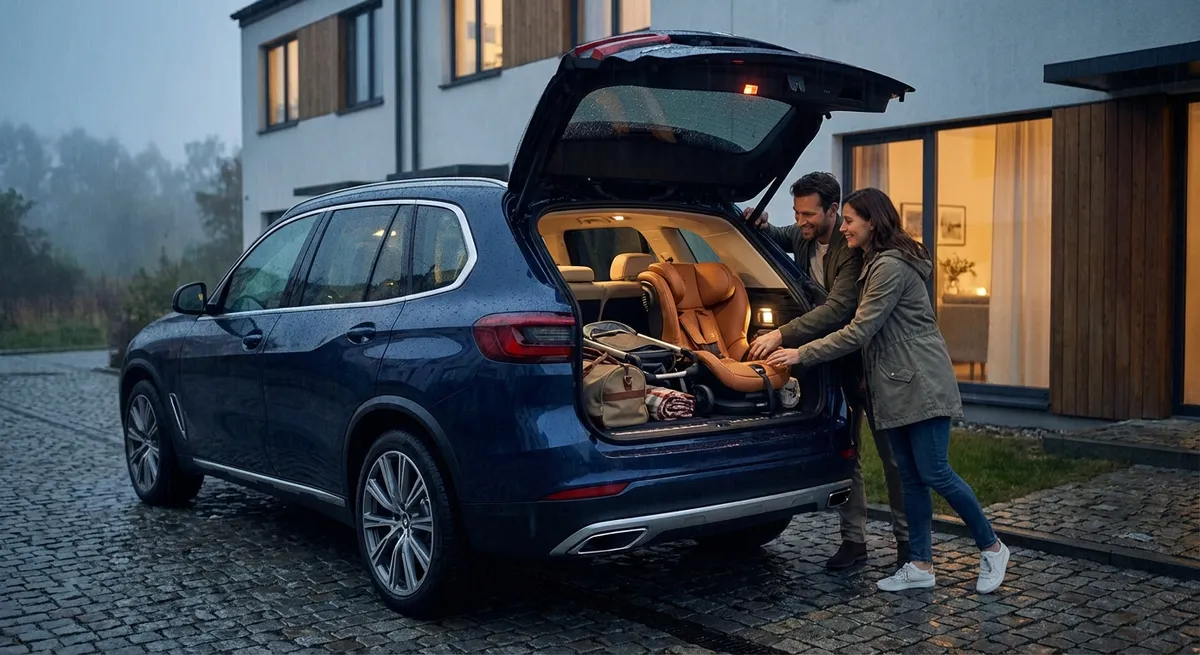
The rear rows tell the deeper story. ISOFIX/LATCH anchor accessibility can be a make-or-break detail. Anchors that are clearly marked, not buried behind stiff covers, and positioned to accommodate modern, bulkier child seats indicate an understanding of real parenting scenarios. In the third row, consider both adult viability and child independence: can an older child buckle themselves in without assistance? Is there enough foot room under the second row? Are there vents, cupholders, and small-item storage within reach?
Cargo area ergonomics often reveal the brand’s attention to the everyday. Power tailgates with adjustable opening height, low lift-over floors, and split-folding rear seats that operate with one-touch releases make strollers, sports equipment, and grocery runs feel less like logistical challenges. Look for features such as underfloor storage, bag hooks, side cubbies for fragile items, and a flat load floor when all seats are folded—still surprisingly rare, and invaluable for everything from flat-pack furniture to impromptu naps.
5. Long-Horizon Thinking: Ownership, Durability, and Discreet Value
The most elegant SUV purchase is one that remains satisfying years beyond the first showroom moment. This requires looking past initial impressions to the long arc of ownership—durability, cost of upkeep, and how gracefully the vehicle will age with your family.
Begin with the fundamentals: reliability record and maintenance profile. While no predictive tool is perfect, consulting long-term reliability data, recall histories, and brand-specific track records provides a more grounded view than marketing claims. Pay attention to warranty coverage—both duration and what is actually included. Complimentary scheduled maintenance for the first years of ownership, corrosion warranties, and hybrid or battery coverage (for electrified models) can significantly affect total cost of ownership.
Interior materials deserve particular scrutiny. Soft-touch dashboards and supple seat leather are appealing, but examine how surfaces will look after years of small shoes, snack spills, and frequent cleaning. High-gloss piano black trim, for instance, often collects scratches and fingerprints, whereas matte finishes, textured plastics, and subtly grained leathers wear more gracefully. Removable, washable floor mats and seat upholstery that resists staining are the quiet heroes of family luxury.
Consider the vehicle’s adaptability. Can the seating configuration evolve from rear-facing infant seats to booster seats to tall teenagers with ease? Does the powertrain feel future-conscious—through hybridization, plug-in capability, or at least strong efficiency—for potential changes in commuting habits or fuel prices? Subtle flexibility, such as roof rails rated for cargo boxes or bike racks and towing capacity sufficient for a modest trailer or camper, extends the SUV’s usefulness as your family’s lifestyle shifts.
Finally, think in terms of discreet value rather than headline pricing. A slightly higher upfront cost can be justified by better residual values, lower fuel or energy use, reduced maintenance, and greater daily satisfaction. A truly well-chosen family SUV should feel as composed and appropriate in year seven as it did on day one—an enduring, quietly capable partner rather than a fast-fading novelty.
Conclusion
A family SUV is more than a collection of specifications; it is a moving extension of your home, your routines, and your standards. When you move beyond the usual talking points and focus on cabin architecture, ride and powertrain harmony, technology that genuinely helps, family-centered ergonomics, and long-horizon ownership, the right choice becomes clearer—and considerably more satisfying.
In a market overflowing with options, refinement is found in the details: how effortlessly your children climb aboard, how calmly you arrive after a demanding day, how naturally the vehicle supports your evolving life. Choose the SUV that respects those nuances, and you will have secured more than transportation. You will have curated a space where your family can move through the world with quiet confidence and enduring comfort.
Sources
- [National Highway Traffic Safety Administration (NHTSA) – Buying a Safer Car](https://www.nhtsa.gov/buying-safe-car) - Official U.S. government guidance on evaluating vehicle safety and key features to consider
- [Insurance Institute for Highway Safety (IIHS) – Vehicle Ratings](https://www.iihs.org/ratings) - Independent crash test results and safety evaluations for SUVs and other vehicles
- [Consumer Reports – New & Used Car Reviews and Ratings](https://www.consumerreports.org/cars/) - Long-term reliability data, road tests, and ownership cost insights for family vehicles
- [Edmunds – Car Buying Tips and Advice](https://www.edmunds.com/car-buying/) - Practical guidance on test driving, evaluating features, and understanding total cost of ownership
- [U.S. Department of Energy – Fuel Economy Guide](https://www.fueleconomy.gov/feg/findacar.shtml) - Official fuel economy and efficiency information, including hybrid and plug-in SUV options
Key Takeaway
The most important thing to remember from this article is that this information can change how you think about Buying Guide.