Family SUVs are often marketed with bold claims and big numbers, yet the most transformative qualities are rarely the loudest. For discerning families, the difference between “good enough” and “quietly exceptional” lies in subtleties: how the cabin flows around daily routines, how effortlessly children can be secured, how calm the drive feels at the end of a long day.
This is an exploration of the nuanced family features that profoundly shape real life with an SUV—five exclusive insights that go beyond spec sheets and showroom tours.
Insight 1: Cabin Layout That Anticipates Movement, Not Just Seating
Most brochures talk about how many people an SUV can seat. Far more revealing is how gracefully those people can move through the cabin.
In a thoughtfully designed family SUV, the second and third rows function as a dynamic space rather than static benches. Look for second-row seats that slide and recline independently, allowing you to prioritize legroom where it’s actually needed on a given day. The most family-conscious layouts ensure the third row can be accessed without removing a child seat—via a tilt-and-slide mechanism that works even when a car seat is latched in place, or a wide side-step area that feels secure for small feet.
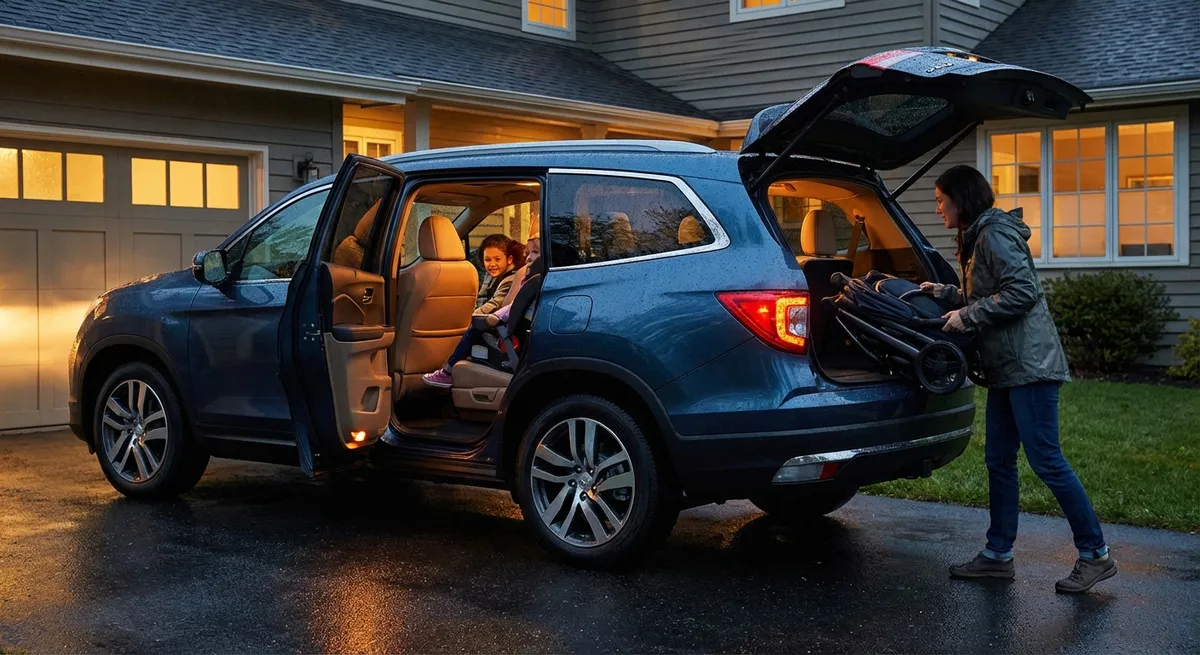
Pay attention, too, to how the cabin handles transitions: school drop-off, weekend sports, late-night airport pick-ups. Are door openings high and wide enough to allow easy entry without head bumps? Do the doors open to nearly 90 degrees, making it effortless to buckle in a child without contortions? A refined family SUV subtly choreographs every movement: in, out, buckled, unbuckled, folded, and stowed, all with a sense of calm rather than chaos.
Insight 2: Child Seat Integration That Treats Safety as a Design Language
While safety ratings are essential, they rarely show how an SUV behaves in the real-world ritual of installing and adjusting child seats. This is where premium family design reveals itself.
A sophisticated family SUV makes child seat installation intuitive, not adversarial. Isofix/LATCH anchors are clearly marked, easily reachable, and positioned so you don’t have to dig blindly between cushions. Some high‑end models pair these anchors with lower cushion angles that naturally position the seat correctly, reducing the need for rolled-up towels and aftermarket wedges. Generous rear door apertures and higher “H‑points” (hip points) mean parents can lift and lower children into their seats without strain.
Consider also how an SUV supports mixed-age families. Can you comfortably run two rear‑facing seats and still have a functional front passenger seat? Are there three proper child seat positions across the second row, or only two with a token middle perch? The true luxury here is not leather or trim; it is the quiet confidence that every buckle and anchor point has been intentionally placed for daily repetition, not occasional use.
Insight 3: Calm-First Acoustics and Climate for Shared Serenity
Families often underestimate how profoundly cabin acoustics and climate management affect every journey. On paper, dual-zone or tri-zone climate and sound insulation sound like standard fare. In practice, a well-resolved system can transform long drives into a surprisingly restorative experience.
The most family-focused SUVs treat noise as a comfort feature, not just a refinement stat. Laminated glass, well‑sealed door frames, and carefully tuned insulation create a soft acoustic backdrop where conversations can happen at normal volume—even at highway speeds. This isn’t about dead silence; it’s about a controlled interior soundscape where engine, wind, and tire noise recede into a gentle hum, making it easier for children to nap and adults to relax.
Climate systems tell a similar story. True tri‑zone control allows rear passengers to tailor their environment independently, with vents placed where small passengers actually feel the airflow—not just at head level for adults. Rear controls that are simple, backlit, and reachable by older children reduce constant “too hot, too cold” negotiations. Look for intelligent sensors that adjust fan speed and temperature gradually rather than in abrupt bursts, preserving a sense of composure even on the hottest days.
Insight 4: Storage That Mirrors Real Life, Not Brochure Life
Every SUV claims abundant storage, yet discerning families soon discover whether that storage genuinely aligns with daily life. The right configuration doesn’t merely swallow luggage—it accommodates the full spectrum of family objects, from school art projects to folding strollers and sports kits.
Thoughtfully designed family SUVs prioritize low, wide cargo openings with minimal load lips, making it easy to slide in heavy items rather than lift them over a ridge. Split-folding rear seats that create a flat load floor are essential, but pay attention to the details: can one child remain seated while you fold the adjacent section? Does the third row fold electrically with switches located both at the rear and inside the cabin, enabling quick configuration changes while holding a child’s hand or a bag of groceries?
Interior storage should feel almost tailored. Deep door bins that accept reusable water bottles upright, a discreet place for handbags that doesn’t invite visibility from outside, and a center console that can house tablets, charging cables, and small toys without becoming a tangled drawer all signal thoughtful intent. Underfloor compartments in the cargo area can serve as hidden storage for emergency gear, picnic essentials, or items you prefer to keep out of sight. When storage is properly curated, the vehicle feels composed even after a long, busy day.
Insight 5: Digital Ecosystems That Enhance, Not Dominate, Family Time
The modern family SUV can easily become a rolling cluster of screens and notifications. The best examples resist the temptation to overwhelm, instead crafting a digital environment that supports safety, connection, and calm.
Begin with the fundamentals: an infotainment system that is genuinely responsive, with a learning curve measured in minutes, not weeks. Physical knobs and switches for high‑frequency tasks—volume, temperature, defrost—are not old-fashioned; they are quietly luxurious in their immediacy. A clear, high‑resolution central display should be complimented by uncluttered menus and intuitive navigation, reducing the time your eyes leave the road.
For families, device integration matters deeply. Multiple USB‑C and USB‑A ports across all rows, ideally with fast‑charging capability, keep peace without requiring a complex rotation schedule. Wireless Apple CarPlay and Android Auto reduce cable clutter while allowing parents to control navigation and media effortlessly. Rear entertainment, if present, should integrate headphone support and independent content control, so front-row conversations aren’t competing with animated soundtracks. The most refined SUVs also allow parents to manage certain rear settings—locking content or muting rear audio—from the front, preserving both safety and harmony.
Advanced driver-assistance features can be a quiet guardian in this ecosystem. Adaptive cruise control with smooth acceleration and deceleration profiles, gentle lane-centering assistance, and intelligent blind-spot monitoring all reduce cognitive load on long trips. When these technologies are calibrated to intervene subtly rather than intrusively, they feel like a poised co‑driver, not a nervous passenger.
Conclusion
The mark of a truly premium family SUV is not how loudly it announces its capabilities, but how quietly it enhances everyday life. When cabin layout anticipates movement, child seat integration feels effortless, acoustics and climate sustain calm, storage aligns with reality, and digital systems recede into the background, the vehicle becomes more than transport—it becomes an extension of how your family lives.
As you evaluate your next SUV, look past the obvious metrics. Sit in every row, fold and unfold each seat, test the reach of every buckle and button. Listen to the cabin at idle and at speed. Ask how well this vehicle will handle not just the perfect weekend getaway, but the imperfect Tuesday morning. In those details lies the real luxury: an SUV that supports your family’s rhythm with quiet, considered precision.
Sources
- [National Highway Traffic Safety Administration (NHTSA) – Car Seats and Booster Seats](https://www.nhtsa.gov/equipment/car-seats-and-booster-seats) - Authoritative guidance on child seat installation, LATCH use, and best practices for families
- [Insurance Institute for Highway Safety (IIHS) – Ratings & Child Seat Anchors](https://www.iihs.org/ratings/child-seat-anchors) - Evaluations of child seat anchor accessibility and usability across different vehicles
- [U.S. Department of Energy – Fuel Economy: SUV and Minivan Considerations](https://www.fueleconomy.gov/feg/suvsminivans.jsp) - Context on efficiency, vehicle types, and usage patterns relevant to family SUVs
- [Edmunds – Car Interior Storage and Cargo Space Guide](https://www.edmunds.com/car-buying/cargo-and-storage-space.html) - Detailed overview of how to assess cargo and interior storage practicality
- [Consumer Reports – Guide to Advanced Driver Assistance Systems](https://www.consumerreports.org/cars/guide-to-advanced-driver-assistance-systems-a6354107463/) - Explanation of modern driver-assistance features and their implications for family driving
Key Takeaway
The most important thing to remember from this article is that this information can change how you think about Family Features.