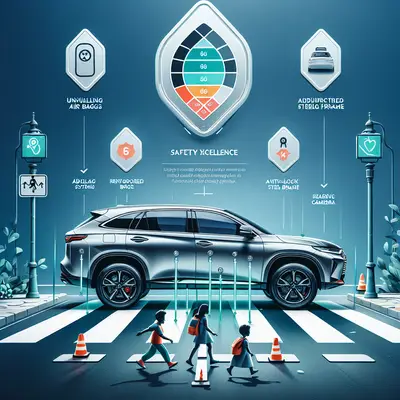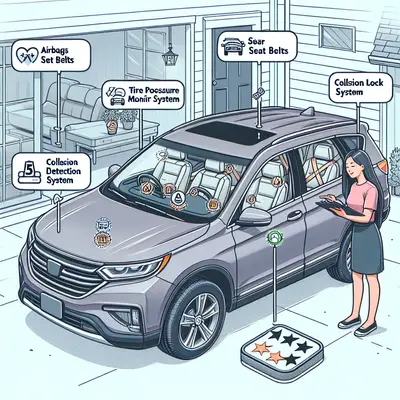
The most meaningful safety features in a family SUV are rarely the ones shouted about in advertisements. They are the quietly engineered details—the tuning behind the airbag deployment curve, the calibration of driver-assistance cameras at dusk, the way a chassis manages a sudden lane change with a full load of passengers. For families who value refinement as much as reassurance, understanding safety ratings becomes less about chasing a score and more about decoding the engineering story behind it. This guide looks beyond the surface of ratings to uncover five exclusive insights that discerning SUV buyers will appreciate.
Why Safety Ratings Are the Beginning, Not the Conclusion
Safety ratings from agencies such as the National Highway Traffic Safety Administration (NHTSA) and the Insurance Institute for Highway Safety (IIHS) offer an essential first filter. They distill complex crash testing into understandable scores and awards, making it simpler to eliminate clearly underperforming options. Yet the sophistication of modern SUVs means that similar scores can conceal very different safety philosophies.
Two vehicles may both earn top crash-test marks, but one might achieve them through sheer structural robustness, while another relies on advanced restraint tuning and active crash-avoidance technology that reduces the chance of impact in the first place. For a family that values long-distance comfort, urban maneuverability, and multi-driver households, it matters whether a vehicle’s safety strengths align with real-world usage. Treat ratings as a curated shortlist—then look more closely at how each SUV achieves its performance.
Insight 1: “Top Safety” Badges Can Mask Nuanced Trade-Offs
Prestigious safety awards—such as the IIHS “Top Safety Pick+”—have become shorthand for reassurance. Yet within that top tier, there are critical nuances. For example, many families now prioritize protection in small overlap front crashes (those that simulate hitting a pole or the edge of another vehicle), as well as performance in newer tests that evaluate rear occupant safety, not just the driver’s seat.
In practical terms, this means a family should examine the full testing matrix, not just the headline rating. Some SUVs may perform superbly for front-row occupants but offer more modest protection measures for the second row, where children often ride. Others may excel in newer side-impact protocols but lag slightly in pedestrian impact mitigation—important if your daily environment involves walking school zones and dense neighborhoods. The refined approach is to look at each sub-score and ask: does this reflect the way our family actually uses the vehicle?
Insight 2: Rear-Seat Safety Is Quietly Entering a New Era
For years, crash-test development focused heavily on driver protection. As that has matured, regulators and independent testers are now pushing into more sophisticated rear-seat evaluations. Updated IIHS moderate overlap tests, for example, scrutinize how well an SUV protects rear passengers in severe frontal impacts, including metrics such as chest loading, head excursion, and belt tensioner performance.
For families, this evolution is particularly significant. Children in boosters, teens sitting behind taller front passengers, and occasional adult guests all rely on rear-seat restraint systems that historically lagged in sophistication. When comparing SUVs, look for models whose latest ratings explicitly mention enhanced rear-seat protection, such as advanced seatbelt pretensioners, load limiters, and rear side-impact airbags. The most forward-thinking SUVs are now engineering second-row safety with the same precision once reserved for the driver’s seat—an important differentiator when safety ratings appear similar at a glance.
Insight 3: Driver Assistance Is Only as Good as Its Real-World Tuning
Advanced driver-assistance systems (ADAS)—automatic emergency braking, lane-keeping support, adaptive cruise control—are increasingly reflected in safety evaluations, especially in the domain of crash avoidance and mitigation. However, not all systems are calibrated equally, and their sophistication doesn’t always correlate neatly with a vehicle’s overall safety score.
Families should pay attention to three subtleties. First, look for independent test feedback on how consistently these systems detect pedestrians and cyclists in low light or poor weather—moments when families are often returning from evening activities. Second, evaluate whether the lane-keeping and steering assistance behave smoothly rather than abruptly; an elegantly tuned system reduces fatigue and builds driver trust rather than encouraging overreliance. Third, consider the user interface: a system that communicates clearly and unobtrusively is far more likely to be used properly by multiple drivers in the household. A refined family SUV doesn’t merely pack in technology; it integrates safety assistance in a way that feels natural and confidence-inspiring.
Insight 4: Weight, Size, and Physics Still Matter—But So Does Agility
Larger SUVs tend to offer an inherent advantage in multi-vehicle crashes because of simple physics—more mass generally translates to better energy management in a collision. Government and insurance data have consistently shown that larger, heavier vehicles tend to confer better occupant protection, all else being equal. Yet for a family, the equation is more nuanced than “bigger is safer.”
A very large SUV that is difficult to maneuver or park may increase exposure to low-speed incidents, curb impacts, or driver stress in tight urban environments. Meanwhile, a mid-size SUV with an exceptionally rigid structure, sophisticated crumple zones, and advanced crash avoidance systems can offer outstanding occupant protection while remaining more nimble and less fatiguing to drive. When interpreting safety ratings, consider the vehicle’s class and proportions alongside its scores. A thoughtful choice balances protective mass with predictable handling, visibility, and an overall sense of control—especially for drivers who may be transitioning from smaller vehicles.
Insight 5: Child Safety Depends on More Than the Ratings Sheet
Safety agencies primarily test with adult-sized dummies, which means parents must go a step further when evaluating child protection. Ratings won’t tell you how gracefully an SUV accommodates three child seats across the second row, whether the LATCH anchors are easily accessible without contortion, or if the third row provides sufficient belt geometry for a booster seat. Yet these are the details that shape day-to-day safety for young passengers.
Seek out models recognized for thoughtful child-seat integration: plentiful and clearly marked LATCH points, well-designed top tether anchors, and rear doors that open wide enough for comfortable seat installation. Pay attention to second-row seat adjustability—sliding and reclining seats can improve both comfort and correct belt fit as children grow. Some of the most family-centric SUVs also offer rear-seat reminders and occupant detection systems, quietly reducing the risk of a child being accidentally left behind. These elements may not dramatically alter an official safety rating, but they profoundly influence the practical safety of family life.
Conclusion
Safety ratings are a vital compass, but they are not the entire map. For the discerning family, the true measure of an SUV lies in how its safety engineering aligns with everyday reality: school runs in the rain, late-night drives home from activities, grandparents in the second row, teens learning to drive. By looking beyond a single score and examining rear-seat protection, driver-assistance tuning, vehicle dynamics, and child-seat practicality, families can uncover the quiet, sophisticated safety strategies that best match their lives. The most rewarding choice is not merely the SUV with an impressive badge, but the one whose safety story has been thoughtfully written for your particular family chapter.
Sources
- National Highway Traffic Safety Administration (NHTSA) 5-Star Safety Ratings - Official U.S. government crash-test ratings and explanations of test procedures
- Insurance Institute for Highway Safety (IIHS) Vehicle Ratings - Detailed crashworthiness, crash-avoidance, and updated rear-seat safety evaluations
- IIHS: Rear-seat occupant protection in frontal crashes - Research and test updates explaining the shift toward improved rear-passenger safety
- Centers for Disease Control and Prevention – Child Passenger Safety - Guidance and statistics on child restraints, booster use, and proper installation
- U.S. Department of Transportation – Advanced Driver Assistance Systems - Overview of ADAS technologies and their role in crash avoidance and road safety
Key Takeaway
The most important thing to remember from this article is that this information can change how you think about Safety Ratings.