Family SUVs no longer have to feel like a compromise between practicality and pleasure. Today’s best models manage school runs, road trips, and evening events with a level of polish that would have seemed excessive a decade ago—but now feels quietly essential. This review-driven guide doesn’t chase horsepower headlines or off-road bravado; instead, it explores how select SUVs genuinely elevate daily family life in ways that spec sheets and dealer brochures rarely capture.
Below, you’ll find five exclusive, detail-oriented insights drawn from real-world impressions of current family SUVs—from midsize stalwarts like the Hyundai Palisade and Honda Pilot to upscale choices such as the Volvo XC90 and Acura MDX. The focus is simple: how these vehicles actually feel to live with when your passengers matter more than your 0–60 time.
Insight 1: The Cabin’s “Evening Mode” Matters More Than You Think
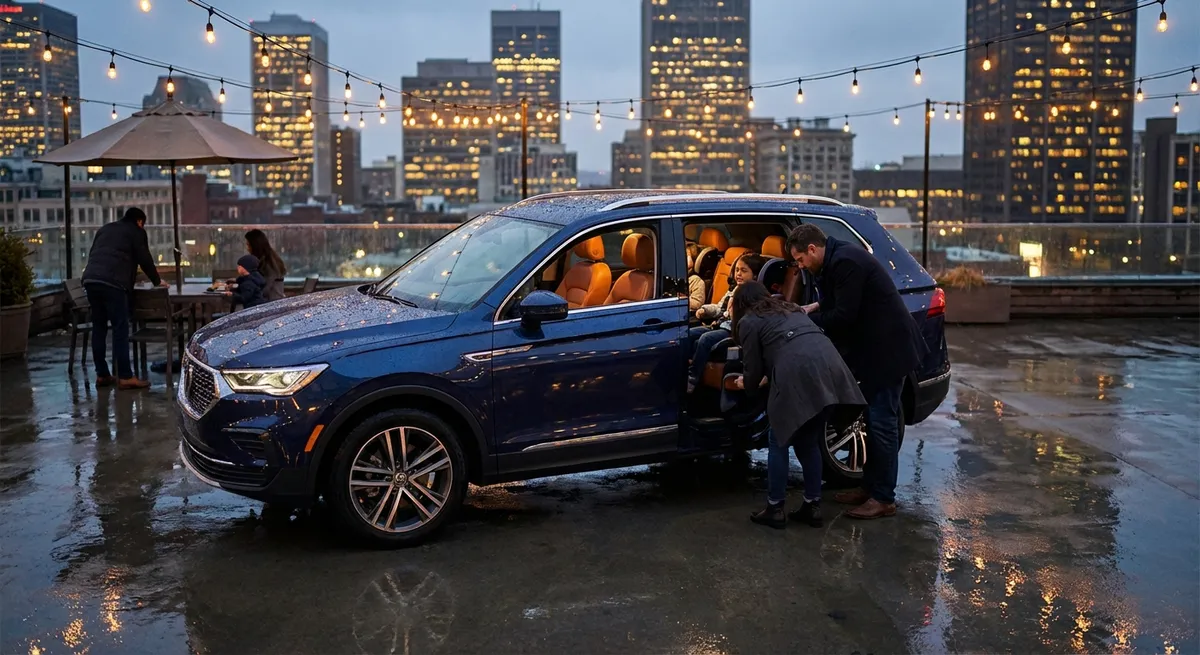
Most SUV reviews will mention interior materials and seat comfort, but they rarely ask how the cabin feels at 8:30 p.m. on a winter evening with tired children in the back and a long drive home ahead.
In models like the Volvo XC90 and Hyundai Palisade Calligraphy, subtle ambient lighting, muted color palettes, and well-damped touchpoints create what could be described as an “evening mode” for the cabin. Soft LED strips along the doors and footwells, non-reflective trim, and thoughtfully placed physical buttons (for climate, volume, and defrost) reduce cognitive load when you’re driving in the dark and don’t want to scroll through menus.
What distinguishes the more sophisticated SUVs is how quietly cohesive everything feels when the sun goes down. The steering wheel is warm but not hot, the cluster is legible without glare, the screens dim gracefully, and the cabin remains calm enough that a whispered conversation up front doesn’t disturb a napping child in row three. When test-driving, families should intentionally schedule at least one evening or dusk drive: dim the screens, set the ambient lighting, and notice whether the interior creates a sense of calm or visual chaos.
Insight 2: Second-Row Intelligence Is the Real Luxury
Modern family SUVs live or die in the second row. It’s where children grow, teenagers negotiate space, and adults occasionally endure long journeys. Yet many reviews still treat the second row as an afterthought, focusing more on horsepower than how effortlessly you can buckle a car seat.
Refined family SUVs like the Honda Pilot, Kia Telluride, and Acura MDX reveal their intelligence through the small details: seat recline angles that support genuine napping rather than awkward slouching; lower anchor points that are easy to access without bruised knuckles; and clearly labeled ISOFIX/LATCH markings that don’t require guesswork. Some models go further, offering one-touch tilt-and-slide mechanisms (even with a car seat installed in certain positions), making third-row access much less of an athletic event.
Ventilated second-row seats, retractable sunshades, and tri-zone climate control are more than indulgences—they help regulate comfort for children who may not be able to articulate why they’re irritable on long drives. If you frequently host grandparents or adult friends in the second row, evaluate the cushioning, thigh support, and headroom as critically as you would in a luxury sedan. A truly family-focused SUV should make everyone’s seat feel like the best one in the house, not simply the driver’s.
Insight 3: Technology That Disappears Is the Most Sophisticated Kind
It’s easy to be impressed by a dashboard filled with glass and graphics. But families quickly learn that the most refined technology is the kind that fades into the background, supporting you without constantly demanding attention.
In practical terms, this means prioritizing SUVs whose interfaces are clear and restrained. The best systems—like the latest from Hyundai/Kia, Toyota, and Volvo—offer wireless Apple CarPlay/Android Auto, yet also retain crucial physical controls for volume, temperature, and defrost. This allows parents to handle essential adjustments by feel rather than hunting through sub-menus while managing back-seat questions and navigation prompts.
Advanced driver-assistance systems (ADAS) also benefit from restraint. Adaptive cruise control, lane-keeping, and blind-spot monitoring are now common, but their tuning defines whether they feel reassuring or intrusive. Sophisticated SUVs tend to offer more organic steering assist, gentler braking, and alerts that are firm but not frantic. During a test drive, enable these features on a familiar stretch of road and ask yourself: Does the vehicle feel like a composed co-pilot, or a nervous passenger constantly reaching for the wheel?
Software longevity is another subtle, premium consideration. SUVs that support over-the-air updates, frequent map improvements, and ongoing safety refinements will age far more gracefully, protecting both your daily experience and eventual resale value. A quiet, well-designed interface that improves over time may not be glamorous, but for families, it is one of the clearest markers of long-term sophistication.
Insight 4: Road-Trip Serenity Is a More Honest Test Than a Short Spin
A quick dealership loop rarely reveals what matters most to families: how an SUV behaves after three hours on the highway with luggage, snacks, and subtle fatigue setting in. Road-trip serenity has become the new definition of premium for family vehicles, and the most impressive SUVs distinguish themselves not by raw speed, but by how consistently unflustered they feel over distance.
Sound insulation plays a central role. In vehicles like the Kia Telluride, Toyota Highlander, and higher trims of the Palisade and Pilot, laminated front glass, strategic insulation, and carefully engineered mirrors reduce wind and tire noise to a subdued murmur. This isn’t just about comfort; lower noise levels reduce fatigue, make podcasts and conversations easier to follow, and keep children calm when they’re trying to sleep.
Ride quality is equally decisive. Multi-link rear suspensions, thoughtfully tuned dampers, and sensible wheel choices (often 18–20 inches rather than the largest available) make a bigger difference than many families expect. A sophisticated SUV glides over expansion joints and patched asphalt without excessive float or harshness, even when fully loaded. When test-driving, try to find uneven pavement, take an on-ramp at a realistic speed, and note: does the SUV settle quickly and confidently, or does it bounce, pitch, or feel nervous?
Finally, consider the “living room factor.” Thoughtful storage for snacks and devices, accessible rear USB ports, cupholders that actually fit wide water bottles, and a quiet but effective climate system all contribute to an environment in which the miles melt away without drama. A well-reviewed SUV that excels here will quietly become your family’s preferred way to travel—even when flying is an option.
Insight 5: Everyday Elegance Hides in the “In-Between” Moments
The most revealing moments in a family SUV aren’t always the dramatic ones. They’re the in-between intervals that few reviews bother to describe: loading a stroller while holding a coffee, navigating a tight school pickup lane, or packing a week’s worth of groceries around a folded third row.
Premium-feeling SUVs understand this choreography. Power tailgates that can be opened hands-free with a foot gesture (and that don’t close aggressively on hesitant little hands) are more important than they sound. Low, wide cargo openings and flat-folding third rows make everyday life feel smoother—especially when the rear seats can be collapsed from the cargo area with simple pull handles or buttons, as found in many midsize three-row options.
Parking composure is another overlooked refinement. Surround-view camera systems with crisp resolution, intelligent parking sensors that distinguish between a passing pedestrian and a stationary hedge, and well-calibrated steering at low speeds turn crowded urban lots into manageable experiences rather than stressful puzzles. In many ways, this is the quietest form of luxury: the absence of friction in mundane tasks.
Finally, look for design continuity. An SUV that feels cohesive—from the weight of the door closing to the clarity of the backup camera, from the texture of the steering wheel to the responsiveness of the climate controls—reflects an overarching philosophy of care. This is what ultimately separates a merely “nice” SUV from one that feels like an elegant extension of your home: not one standout feature, but a thousand small decisions made thoughtfully on your behalf.
Conclusion
Family SUV reviews often emphasize the obvious—power, cargo volume, screen size—while the most meaningful qualities remain between the lines. For families seeking something more refined, the true differentiators lie in how an SUV supports your life during unremarkable Tuesdays as much as epic summer road trips.
When you evaluate your shortlist—whether it includes the polished familiarity of a Honda Pilot, the quiet assurance of a Volvo XC90, or the confident versatility of a Kia Telluride or Hyundai Palisade—look for these five understated markers: a calming evening cabin, intelligent second-row design, technology that disappears, long-distance serenity, and frictionless everyday moments. Together, they reveal whether an SUV is simply well-equipped on paper, or genuinely elevated in practice.
In a market crowded with options, that distinction is what makes a family SUV feel less like a tool and more like a considered, long-term upgrade to the way your family moves through the world.
Sources
- Volvo Cars – XC90 Overview - Official Volvo information on XC90 design, safety, and interior technology
- NHTSA – 5-Star Safety Ratings - U.S. government crash test ratings and safety evaluations for SUVs and other vehicles
- IIHS – Vehicle Ratings - Independent crashworthiness and crash-avoidance ratings for family SUVs
- Consumer Reports – Guide to Car Seat Safety and LATCH - Evaluation of LATCH usability and child-seat friendliness in modern vehicles
- Edmunds – 3-Row SUV Buying Guide - Comparative insights and testing notes on popular three-row family SUVs
Key Takeaway
The most important thing to remember from this article is that this information can change how you think about SUV Reviews.