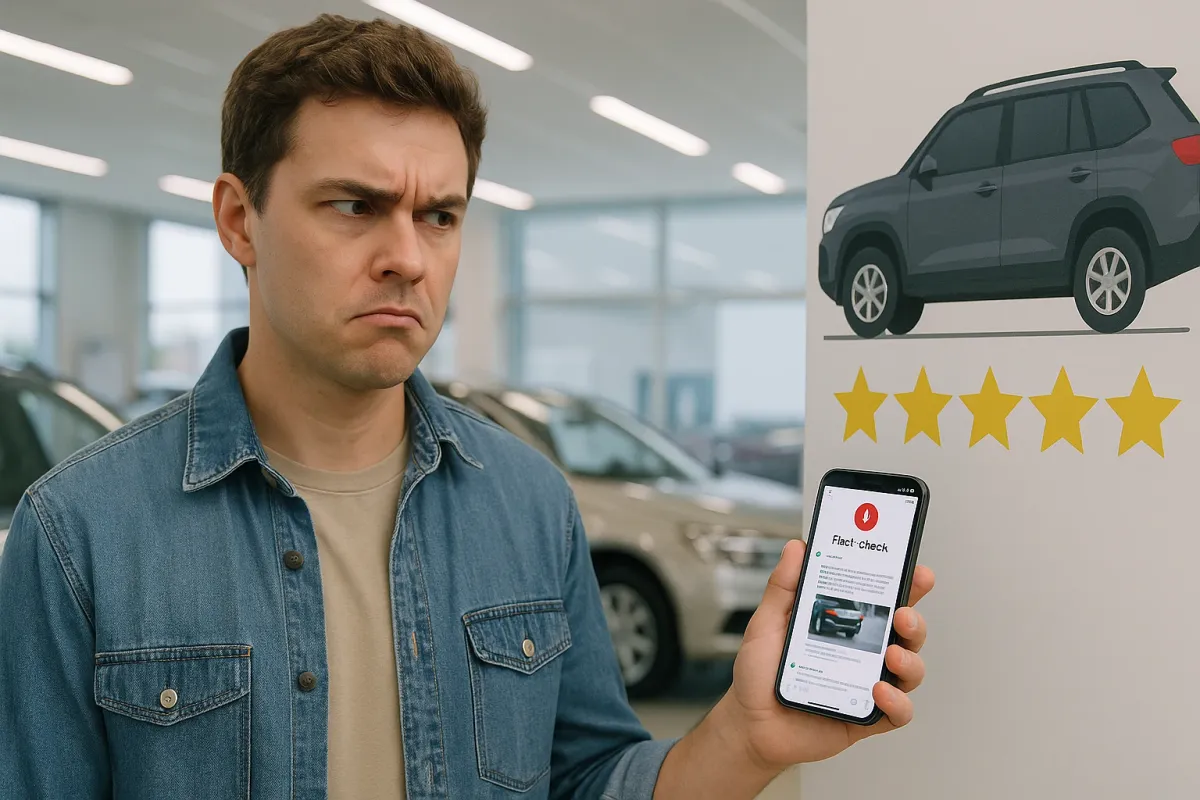
In an online world obsessed with calling out lies, one trending theme stands out: stories that seem fake at first glance, but are, in fact, completely true. A recent wave of posts—where people tried to “debunk” others only to discover the stories checked out—has captivated millions and underscores a deeper shift: we no longer take anything at face value. We verify, we cross‑check, we look for proof.
For families shopping for an SUV right now, that cultural reflex is not just entertaining—it’s essential. The same skepticism fueling “that can’t be real” viral threads is exactly what you should bring to crash‑test scores, automaker claims, and glossy safety commercials. Because behind every confident “Top Safety Pick” badge or five‑star graphic is data that deserves a second look.
Below, we translate today’s fact‑checking, myth‑busting internet mood into five refined, practical insights for evaluating SUV safety ratings with the same rigor the online world now applies to unbelievable stories.
1. Treat Every “5‑Star” Claim Like a Viral Story: Ask Who Verified It
One of the most shared online moments right now comes from threads where a seemingly “impossible” story gets challenged—only for someone to respond with receipts: documents, photos, timestamps. The lesson for SUV shoppers is simple: the source of the proof matters far more than how confident the storyteller sounds.
Automakers love to highlight safety in marketing copy, but the only ratings that truly count for families are those independently verified by trusted organizations. In North America, that means starting with:
- NHTSA (National Highway Traffic Safety Administration) and its 5‑star crash ratings
- IIHS (Insurance Institute for Highway Safety) and its Top Safety Pick / Top Safety Pick+ awards
Treat an in‑house “safety index” or vague phrase like “one of the safest in its class” the same way the internet treats a too‑perfect anecdote: interesting, but unproven until the independent data lines up. When you see a bold safety claim in an ad, pause and ask:
- Is there a specific rating attached to it?
- From which organization?
- For which model year and trim?
The premium way to shop is not to distrust everything—it’s to insist that every safety promise comes with verifiable, third‑party “receipts.”
2. Look Beyond the Headline Score: Read the “Comments Section” of the Crash Test
On social media, the headline often tells only half the story. It’s the comments—the nuance, the context, the corrections—that reveal what really happened. Safety ratings work the same way. A five‑star frontal rating or a Top Safety Pick title is essentially the “headline”; the true story is written in the test breakdown.
When you examine a vehicle’s results, spend time on the details:
- Individual crash categories: moderate overlap, small overlap (driver and passenger side), side impact, roof strength, and head restraint tests
- Pedestrian protection and headlight ratings (in IIHS scoring, both increasingly impact the top awards)
- Restraint and kinematics notes: did the dummy move excessively? Did the airbag or seatbelt performance earn comments?
In recent testing trends, for example, some midsize SUVs that perform admirably in traditional frontal collisions may post weaker results in small overlap crashes or updated pedestrian impact evaluations. For a family, those nuances matter more than a single composite score.
Think of the full test report as the “comment thread” under a viral post: that’s where the truth is sharpened. A sophisticated buyer doesn’t just ask, “Is it safe?” They ask, “Safe how, and for whom, and in which scenarios?”
3. Don’t Confuse Tech Demos with Proven Protection
Online, we’ve all seen dramatic clips—wild coincidences, unbelievable coincidences, near‑impossible escapes—that automatically trigger, “This has to be staged.” The same skepticism should apply to sleek videos of SUVs automatically braking inches from a mannequin or artfully avoiding a simulated obstacle.
Advanced driver‑assistance systems (ADAS) can be transformative for family safety, but only when they’re evaluated in the real world, not just in tightly produced brand content. When shopping, distinguish between:
- Marketing language: “next‑generation safety suite,” “intelligent guardian,” “360° safety cocoon”
- Verified performance: IIHS ratings for crash avoidance and mitigation, NHTSA evaluations of forward collision warning and automatic emergency braking
Pay attention to:
- Whether automatic emergency braking with pedestrian detection is standard, optional, or bundled only in higher trims
- Lane‑keeping assistance quality: gentle guidance versus intrusive, twitchy corrections
- The system’s behavior in low‑visibility or bad weather, as reported by owners and independent testers
The most refined safety experience feels calm, almost invisible—systems that quietly support your driving rather than constantly demanding attention. A premium family SUV doesn’t just offer every latest acronym; it offers driver‑assist features whose effectiveness has been independently validated, not just beautifully filmed.
4. Verify the “Too Good to Be True” MPG–Safety Balancing Act
Many of the viral “you won’t believe this happened” posts online revolve around surprising trade‑offs: someone achieved something extraordinary, but only after a hidden cost becomes clear. In SUV shopping, the hidden cost often appears where safety and efficiency intersect.
Modern families rightly want both safety and fuel economy (or range, in the case of EVs). Yet achieving top‑tier crash protection usually adds weight and structural reinforcement, while chasing efficiency pushes engineers to trim mass wherever possible. This tension is real and ongoing, especially in the crowded compact and midsize SUV segments.
When an SUV seems to promise everything—lightweight agility, stellar MPG, and “best‑in‑class” safety—approach it with a fact‑checker’s mindset:
- Compare its curb weight to direct competitors with similar dimensions.
- Check whether thinner glass, lighter seats, or less robust sound‑deadening have been used—and whether structural integrity has still tested well.
- Review both crash ratings and real‑world owner feedback on ride quality and solidity.
The sweetest spot for a family SUV often sits not at the extreme of lowest weight or highest efficiency, but in a carefully judged middle ground where robust structure, advanced materials, and thoughtful engineering harmonize. Elegant safety rarely shouts; it simply feels reassuringly substantial every time you shut the door and settle the children into their seats.
5. Make “Show Me the Evidence” a Family Habit, Not Just a Shopping Tactic
Today’s most compelling online trend isn’t just that unbelievable stories turn out to be true—it’s that entire communities now instinctively ask for proof. That mindset is powerful when choosing a family SUV, but it becomes transformative when you embed it into how your family actually uses the vehicle.
Once you’ve chosen a model with excellent safety credentials, continue the “verify, don’t assume” approach:
- Child seats: Don’t assume “LATCH‑equipped” means easy installation. Look for crash‑test programs (like those from safety organizations and consumer groups) that evaluate actual child‑seat performance in specific SUVs, as well as how accessible the anchors are.
- Teen drivers: If your SUV offers teen‑driver or valet modes, explore the data they provide—speed alerts, geographic boundaries, seatbelt reminders. Use them as teaching tools, not surveillance.
- Software updates: Increasingly, key safety features—from camera clarity to braking logic—can be improved via over‑the‑air updates. Keep your vehicle’s software current and read the change logs the way you’d study an update to a fact‑checking policy.
- Tire and brake care: The finest crash structure and electronics can only work with the grip they’re given. Make tread depth, tire pressure, and brake inspection part of your family’s normal rhythm, not an afterthought before a road trip.
In other words, don’t let safety remain a specification you admired at the dealership. Turn it into an ongoing, evidence‑based practice your whole family understands and participates in.
Conclusion
The internet’s fascination with “unbelievable but true” stories and public fact‑checking isn’t just a curiosity—it’s a mirror of how we’re learning to navigate a complex, noisy world. For families searching for a new SUV, that same instinct is your most powerful ally.
Insist on independent verification, read beyond the headline scores, distinguish cinematic tech demos from proven protection, and be wary of promises that seem to defy engineering trade‑offs. Then, carry that culture of “show me the evidence” into the everyday rituals of family driving—from child‑seat installation to software updates.
Because in the end, the most luxurious feature your next SUV can offer is not a panoramic roof or ambient lighting. It’s the quiet confidence that, when something unthinkable happens, you’ve chosen a vehicle whose safety claims stand up to the most demanding test of all: reality itself.
Key Takeaway
The most important thing to remember from this article is that this information can change how you think about Safety Ratings.